TAVI PCI: Fixing the Aortic Valve Before the Coronaries Can Be a Valid Option
Doing TAVI first was noninferior to a PCI-first strategy, with experts pointing out that each timing has its advantages.

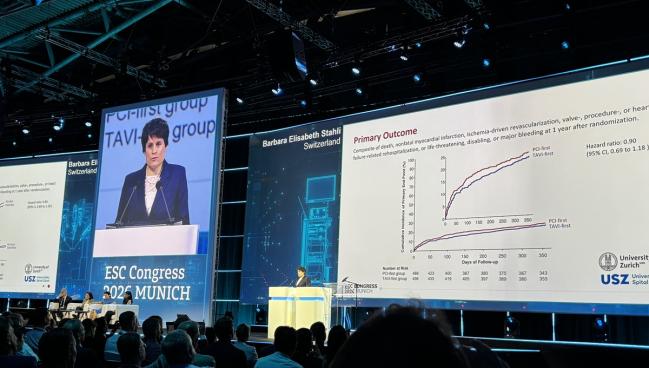
MUNICH, Germany—For patients who have both severe aortic stenosis (AS) and coronary artery disease, a TAVI-first strategy is noninferior to performing PCI first when it comes to clinical outcomes 1 year later, the TAVI PCI trial shows.
The findings were presented at the recent European Society of Cardiology Congress 2026 and simultaneously published in the New England Journal of Medicine.
Around half of patients with severe AS undergoing TAVI also have CAD, the researchers say, with 10-20% receiving not only the valve intervention but also PCI, a strategy that’s endorsed by guidelines.
“Performing PCI before TAVI represents the current standard approach, [but] the preferred treatment strategy has not previously been investigated. . . . The trial was designed to address this evidence gap,” lead investigator Barbara Elisabeth Stähli, MD (University Hospital Zurich, Switzerland), said in a Hot Line session.
Stähli stressed that the results support individualized decision-making, with potential advantages for each strategy.
With PCI first, “you have improved hemodynamic stability [and] may have less problems with coronary access,” Stähli told TCTMD. “But when you go for TAVI first, then you have the advantage that you do your TAVI procedure without having dual antiplatelet therapy” and subsequently start the medications ahead of PCI, something that could be beneficial for patients at high bleeding risk, she continued. For challenging cases, such as patients with lesions that are highly calcified, doing the TAVI first then enables the complex PCI that follows.
“What we also saw is that in the TAVI-first group, the number of PCIs performed was lower as compared to the PCI-first group,” Stähli said. “This was not due to impaired coronary access, but it seems that the view of the coronaries changed after the treatment of the aortic valve. Sometimes it was due to the decision of the operator, sometimes it was due to functional lesion assessment. So I think there are a lot of individual variables that now can be taken into account for each patient.”
What Comes First?
TAVI PCI enrolled 986 patients (median age 62 years; 66% men) with both severe aortic stenosis and coronary artery disease across 48 European centers. Patients were randomized to the order in which they were treated: either TAVI first or PCI first. Five patients crossed over from the TAVI to the PCI group and three from the PCI to the TAVI group over the course of the trial. Ultimately, 36 patients did not undergo TAVI and 71 did not undergo PCI. For TAVI, a variety of devices were used, most commonly the SAPIEN 3 Ultra/3 Ultra RESILIA (Edwards Lifesciences).
In the TAVI-first group, the median time from randomization to the procedure was 8 days and the median time between TAVI and the subsequent PCI was 27 days. In the PCI-first group, the median time from randomization to the procedure was 2 days, and the median time between PCI and the subsequent TAVI was 13 days. The two interventions were done during the same hospitalization for 38% of study participants.
It seems that the view of the coronaries changed after the treatment of the aortic valve. Barbara Elisabeth Stähli
By 1 year, the primary endpoint—a composite of death from any cause; nonfatal MI; ischemia-driven revascularization; rehospitalization related to the valve, procedure, or heart failure; and life-threatening, disabling, or major bleeding—had occurred in 22.2% of patients assigned to the TAVI-first group and 24.2% assigned to the PCI-first group. The risk difference of -2.0 percentage points (95% CI -7.4 to 3.4) fell within the prespecified noninferiority margin of 6.6 percentage points (P for noninferiority < 0.001). Results were consistent across subgroups.
In all, 264 patients from the TAVI-first group and 273 patients from the PCI-first group experienced serious adverse events, most of which were categorized as cardiac disorders.
Ajay Kirtane, MD (NewYork-Presbyterian/Columbia University Irving Medical Center, New York, NY), commenting on the TAVI PCI results for TCTMD, highlighted that the trial participants overall had noncomplex coronary artery disease and tended to be older.
In this scenario, “once you fix the aortic stenosis, you can debate whether or not the coronary disease actually needs to be treated because . . . patients might do okay with medical management of their coronary disease, especially at that age,” said Kirtane.
“To me, the bigger question is what the best strategy ought to be in more complex disease scenarios with younger patients,” he added. For them, “I think there is a tendency nowadays to just do the valve and deal with the coronary disease later.” One thing that made that sequence possible in TAVI PCI is that the trial for the most part used transcatheter heart valves that wouldn’t hamper future coronary access, Kirtane noted.
Following the trial, how best to manage concomitant CAD remains an open question, though the results do offer operators some freedom with regard to timing, he said. “To me, the standard of care at present is an individual patient-guided decision. And that’s probably the best way to treat patients.”
To me, the standard of care at present is an individual patient-guided decision. Ajay Kirtane
Julinda Mehilli, MD (Krankenhaus Landshut-Achdorf, Germany), the discussant following Stähli’s presentation, described the TAVI PCI trial as “well done” but questioned whether it was necessary.
PRO-TAVI, published earlier this year in the Lancet, for example, showed that undergoing PCI before TAVI was noninferior to deferring revascularization. As reported by TCTMD, a recent meta-analysis of four randomized trials—ACTIVATION, FAITAVI, NOTION-3, and the Transcatheter Valves and Vessels (TCW) study—showed a 30% lower relative risk of MACE when PCI, rather than optimal medical therapy, preceded TAVI.
TAVI PCI, of course, looked at the reverse by emphasizing the TAVI-first strategy.
Another question is whether the newer trial, where the median age was 82, is generalizable to the average patient who undergoes TAVI, she said. And finally, thanks to functional lesion assessment in a third of TAVI PCI participants, not every patient wound up needing PCI in the end, Mehilli pointed out. This aligns with results of the FAITAVI trial, which showed that patients with severe AS and significant CAD have a lower risk of MACE when their revascularization is guided by fractional flow reserve.
Overall, the message from TAVI PCI is that “for an elderly population with aortic stenosis and obstructive coronary artery disease presenting with chronic coronary syndrome, PCI after TAVI is safe, and safer maybe, than prior TAVI,” Mehilli concluded. Going forward, she added, the COMPLETE TAVR trial may settle the issue of whether routine PCI—regardless of timing—outperforms medical management in patients with both AS and CAD.

Caitlin E. Cox is Executive Editor of TCTMD and Associate Director, Editorial Content at the Cardiovascular Research Foundation. She produces the…
Read Full BioSources
Stähli BE, Ruschitzka F, Westermann D, et al. Timing of PCI in patients undergoing transcatheter aortic-valve implantation. N Engl J Med. 2026;Epub ahead of print.
Disclosures
- TAVI PCI was supported by institutional research support from the University Hospital Zurich and the University of Zurich, as well as by a grant from Edwards Lifesciences.
- Mehilli reports an institutional research grant from Boston Scientific as well as lecture fees from SMT, Novo Nordisk, Abbott Vascular, and Edwards Lifesciences.
Related News



Comments