TAVI Plus GDMT Suitable for Select Patients With Severe Aortic Regurgitation
Investigators warn, though, that TAVI also increases risks for bleeding and pacemaker implantation.

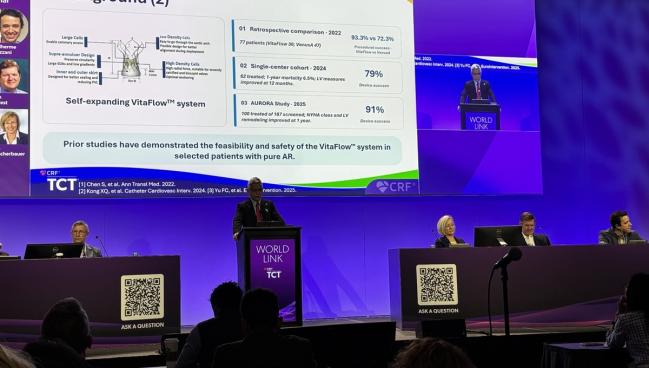
SAN DIEGO, CA—When surgery is not a good option, TAVI plus guideline-directed medical therapy (GDMT) improves clinical outcomes for patients with severe pure aortic regurgitation (AR), according to results from the SEASON-AR trial.
Compared with GDMT alone, the addition of TAVI lowered the rate of all-cause death, disabling stroke, or heart failure (HF) rehospitalization by a relative 69% at 1 year, mostly due to a reduction in HF rehospitalization, Jun-Jie Zhang, MD, PhD (Nanjing First Hospital, Nanjing Medical University, China), reported at TCT 2026 on Saturday.
However, patients who received TAVI plus GDMT had higher rates of major or life-threatening bleeding and new permanent pacemaker implantation compared with those who received GDMT alone.
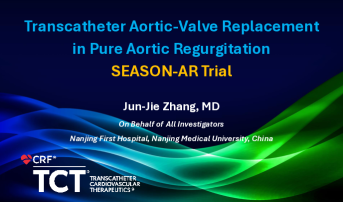
The results—simultaneously published online in Circulation, with Xiao-Fei Gao, MD (Nanjing First Hospital, Nanjing Medical University), as lead author—show support for TAVI where “current guideline recommendations remain cautious,” the investigators write. “The findings support transfemoral TAVR as a potential treatment option for selected patients with severe pure AR who are either at high surgical risk or had firmly declined SAVR.”
To TCTMD, Zhang noted that “for high-risk patients, or patients who are reluctant to receive open-heart surgery, the only way we can treat [them] is GDMT. So, this trial showed that even if a patient is high risk for surgery, if [they are] anatomically suitable, we can safely treat [them] with the TAVR procedure.”
Filling an Evidence Gap
Patients with symptomatic, severe AR are often recommended to undergo SAVR, but many have a high surgical risk due to significant comorbidities. In the United States, 26% of severe, symptomatic AR patients undergo surgery for the condition. In China, over 50% of patients with severe AR are treated surgically, and GDMT is the only guideline-recommended option for patients who are too high risk for surgery, the authors write.
“So far, there have been no relevant trials [comparing TAVI plus GDMT] versus GDMT,” Zhang said during his presentation at TCT, noting that prior studies have not provided a direct comparison of the two AR management strategies.
SEASON-AR, conducted at 18 medical centers in China, was designed to fill that gap, randomizing patients 1:1 to transfemoral TAVI plus GDMT (n = 109; median age 74 years; 63.3% male) or GDMT alone (n = 101; median age 73 years; 63.4% male).
The VitaFlow system (MicroPort; Shanghai, China), a new-generation recapturable valve, was used in 97.1% of TAVI cases.
More patients undergoing TAVI received oral anticoagulants with warfarin or non-vitamin K antagonists for GDMT compared with patients receiving medical therapy alone (55.0% vs 34.7%, P = 0.003). However, beta-blockers were less common in TAVI patients (43.1% vs 66.3%, P < 0.001). Other GDMT, for both groups, included aspirin or clopidogrel, SGLT2 inhibitors, ACE inhibitors/ARBs/angiotensin receptor-neprilysin inhibitors, and aldosterone receptor antagonists. Usage did not significantly differ between groups.
The primary endpoint was a composite of all-cause mortality, disabling stroke, or HF rehospitalization at 1-year follow-up. The rate was significantly lower in the TAVI group (8.3% vs 24.8%; HR 0.31; 95% CI 0.14-0.66). Reduced HF hospitalization was the main reason for the result (3.7% vs 21.3%; HR 0.16; 95% CI 0.06-0.47), with no differences in rates of all-cause death or stroke.
The investigators note that 10 patients in the GDMT group crossed over to receive rescue aortic valve replacement, with nine undergoing TAVI and one SAVR, before experiencing a component of the composite endpoint.
The overall benefit observed with TAVI in the trial “was mainly driven by fewer heart failure rehospitalizations and withstood a 9.9% crossover from medical therapy to valve replacement,” the authors write.
In terms of safety, rates of all-cause death and disabling stroke were similar in the two arms of the trial at 30 days. Major or life-threatening bleeding occurred more in the TAVI group 9.2% vs 0; P = 0.002), as did new permanent pacemaker implantation (20.2% vs 2.0%; P < 0.001).
Gao et al conclude that patients with severe pure AR may choose to undergo TAVI plus GDMT instead of GDMT alone and do so safely. Patient-clinician discussions should address the risks versus the benefits for TAVI compared with GDMT.
The authors acknowledge that the sample size was a limitation in the study and may have “limited the precision of subgroup and learning-curve analyses.”
The vast majority of patients screened for this study were excluded from enrollment: 724 of 936 patients did not qualify due to various comorbidities or conditions, such as LVEF < 30%, ascending aorta diameter > 45 mm, and annular perimeter > 85 mm.
Lead discussant Amr Abbas, MD (William Beaumont University Hospital, Royal Oak, MI), touched on the high number of patients who screened out in his comments. “This study had multiple patient exclusions, about 70%, of course, but certainly showed marked reduction in heart failure hospitalization,” he said.
Zhang said he sees the inclusion of TAVI with GDMT in the future of treatment for severe pure AR.

Bailey Salimes is a Medical Journalist at TCTMD. Prior to CRF, she was at MedStar Health Research Institute in Washington…
Read Full BioSources
Gao XF, Wang Y, Jiang H, et al. Transcatheter aortic-valve replacement in pure aortic regurgitation: the randomized SEASON-AR clinical trial. Circulation. 2026;Epub ahead of print.
Disclosures
- Gao and Zhang report no relevant conflicts of interest.
- Abbas reports grant support/research contracts from Edwards Lifesciences and consulting fees/honoraria/speaking fees from Anteris and Edwards Lifesciences.
Related News


Comments