‘Teleprehabilitation’ Likely Cost-effective Before Cardiac Surgery
The multimodal approach, administered digitally, saved more than €700 per patient compared with usual care.

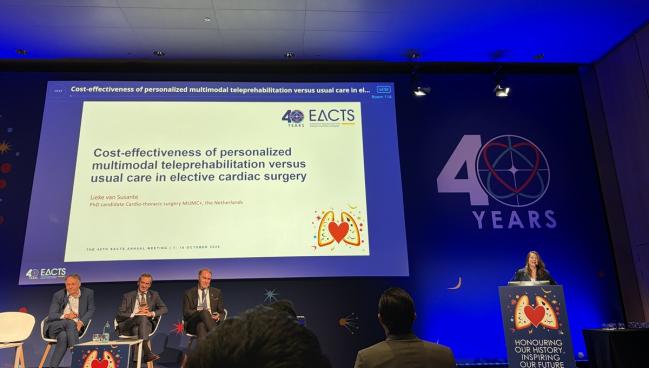
BARCELONA, Spain—Use of a multimodal teleprehabilitation program that encompasses physical training, psychological support, nutrition counseling, and smoking-cessation assistance before elective cardiac surgery is cost-effective compared with usual care, new data show.
Among a population of almost 400 adults in the Netherlands randomized to the program, teleprehabilitation saved €729 on average per patient. Moreover, the initiative resulted in 0.058 quality-adjusted life years (QALYs) added and 0.086 major adverse cardiac events prevented per patient.
The findings were calculated based on a population from the research group’s previous study, which showed both a reduction in MACE—especially repeat hospitalizations—and gains in quality of life with prehabilitation in the year following surgery. But adoption of these programs has been limited by lack of funding and other challenges.
Until now, “we weren’t really sure what it cost,” said Lieke van Susante, MD (Maastricht University Medical Center, the Netherlands), who presented the data during a late-breaking clinical science session at the 2026 European Association for Cardio-Thoracic Surgery meeting. “At least in the Netherlands, insurance decides what is covered and not, and when you cannot really prove that something is cost-effective, they are hesitant to insure you for that specific intervention.”
While the concept of prehabilitation isn’t brand new, randomized data in this space is limited, she told TCTMD. Moreover, the success of teleprehabilitation relies on a proactive case manager who will personally call all patients to make sure they are able to access the digital platforms and complete the modules.
Lower Costs, Better Outcomes
For the study, researchers looked at 394 patients who had been randomized to at least 6 weeks of teleprehabilitation or usual care at their center. Those in the study group were considered eligible for each of the five modules based on their needs:
- Inspiratory muscle training: pulmonary risk score ≥ 2
- Functional exercise training: visual analog scale (VAS) and/or 36-item short form health survey (SF-36)
- Psychological support: hospital anxiety and depression scale (HADS) ≥ 8
- Nutritional support: body mass index ≥ 30 kg/m2 and/or malnutrition universal screening tool (MUST) ≥ 2
- Smoking cessation: current smokers
Costs per patient differed between the study arms—the program decreased average costs related to postoperative complications (by €513), informal care (by €440), out-of-hospital care (by €130), and productivity losses (by €114). On the other hand, it increased costs related to MACE (by €213) and interventions (by €253).
Van Susante said the uptick in MACE- and intervention-related expenses were likely due to high-cost outliers, including one patient in the teleprehabilitation group whose total cost was over €100,000. When cost outliers were excluded, the savings with the intervention increased to €951 per patient on average.
“It was very interesting to find that specifically the informal care was a big part of why [teleprehabilitation] was less costly,” she said. “That’s something you can only state when you really do a cost-effectiveness analysis. . . . I was a little bit surprised by that, but it was a good surprise.”
One thing the researchers learned from their experience, said van Susante, was that while a completely digital platform works well for some patients, others prefer being physically supervised for the physical training components.
“It was not only the patients who were a little bit hesitant—also some of the cardiologists found it a little bit scary in the beginning,” van Susante said. While their previous research showed no difference in cardiac symptoms between those randomized to teleprehabilitation and usual care, and should allay any fears, she noted, that worry can persist.
“That’s the beautiful part of prehabilitation,” she continued. “I’m very glad that now it’s becoming a big part of cardiac surgery because now you can really motivate people. . . . The patients who get cardiac surgery, often they smoke, they have obesity, they’re not really motivated to work on their lifestyle. But cardiac surgery is a life event, and people really see that as a teachable moment to change their lifestyle.”
Even so, the researchers’ next randomized controlled trial will utilize a hybrid approach to offer in-person physical training for those who need it alongside digital modules for mental health, nutrition, and smoking cessation, van Susante said, adding that she’d also like to see more implementation studies to ease incorporation of these programs into care around the world.

Yael L. Maxwell is Senior Medical Journalist for TCTMD and Section Editor of TCTMD's Fellows Forum. She served as the inaugural…
Read Full BioSources
van Susante L. Cost-effectiveness of personalized multimodal teleprehabilitation versus usual care in elective cardiac surgery. Presented at: EACTS 2026. October 8, 2026. Barcelona, Spain.
Disclosures
- Van Susante reports no relevant conflicts of interest.
Related News


Comments