As TR Increases in Severity, It Also Becomes More Deadly
The study showed notable sex-based differences, as well as a trend toward better survival in those who got an intervention.

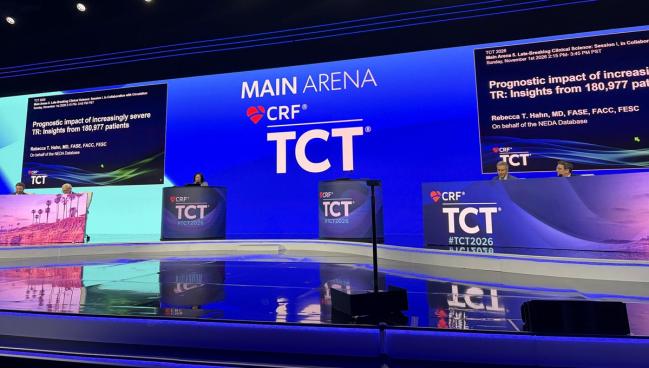
SAN DIEGO, CA—The risk of mortality increases alongside the severity of tricuspid regurgitation (TR), according to data from a large Australian database. Interventions, though uncommon, seem to be associated with better survival.
Moreover, the epidemiologic study of more than 180,000 characterizes the disease in a way that experts say will allow clinicians treating these patients to make more informed decisions.
“There’s a lot more that we need to learn to help inform the field about the timing of intervention, but I think it’s one of the first studies that has shown in a really large database that we have some mortality benefit from intervention,” Rebecca T. Hahn, MD (NewYork-Presbyterian/Columbia University Irving Medical Center, NY), who presented the findings today at TCT 2026, told TCTMD.
The PREVUE-VALVE study showed that TR was the most common type of valvular heart disease in the United States, and another electronic database study indicated that non-severe TR is not benign over the short-term, but longer-term outcomes of moderate TR remain unknown. The researchers sought to fill the knowledge gap by capturing the prevalence, characteristics, and prognostic impact in a real-world cohort.
The new data represent “the foundation of how we will triage our interventions,” said panelist Eric Secemsky, MD (Beth Israel Deaconess Medical Center, Boston, MA).
NEDA Numbers
For the study, Hahn and colleagues included more than 1.2 million adults evaluated with echocardiography at one of 45 centers in Australia between 2010 and 2022 as part of National Echo Database Australia (NEDA). Using natural language processing, the researchers identified 180,977 patients with TR: 73.7% of those cases were deemed mild, 20.7% moderate, and 5.6% severe (including 285 torrential cases). The prevalence of women, who tended to be slightly older than men (mean age 70.5 vs 69.9 years), increased with TR severity—they represented 51.8% of the population with mild TR and 56.1% of those with severe TR.
TR prevalence increased with age in both men and women, and all subtypes of TR—left heart disease (LHD), pulmonary hypertension (PH), cardiac implantable electronic device (CIED), right ventricular (RV), right atrial (RA), and primary—increased with greater TR severity. LHD-related TR was the most common subtype in both men and women, no matter whether TR was mild (60.3% and 53.3%), moderate (76.8% and 71.1%), or severe (81.1% and 78.4%).
Both LVEF and stroke volume index worsened with increasing TR severity in both sexes. Additionally, the likelihood of cardiac remodeling increased alongside TR severity as well as signs of increased LV filling pressure, prevalence of RV dysfunction, and atrial fibrillation (AF). Regardless of TR severity, women had higher levels of LVEF and less RV function impairment compared with men, as well as smaller ventricular and atrial dimensions.
The burden of comorbidity also increased with TR severity, in both sexes, for factors like chronic heart failure, AF, chronic kidney disease, and PH.
As TR severity increased, so did use of drugs like angiotensin receptor-neprilysin inhibitors, ACE inhibitors, beta-blockers, mineralocorticoid receptor antagonists, loop diuretics, and sodium-glucose cotransporter-2 inhibitors. In severe TR, almost 90% of men and women received diuretics over follow-up. Notably, use of medical therapy was consistently lower in women compared with men.
Only a small proportion of patients with TR underwent intervention—mostly surgical and primarily repair, according to Hahn—across the board. Even in men and women with severe TR, only 3.3% and 3.6%, respectively, had tricuspid valve repair, 42.3% of which were isolated tricuspid valve surgeries.
Over about 1.1 million person-years of follow-up, more than 3.4 million individual hospitalizations and 11.7 million days of hospital stay were recorded. Both of these metrics increased with TR severity, as did hospital-related costs. Women were less often admitted to the hospital compared with men, and when they were, they stayed in the hospital for less time.
The overall mortality rate was 47.8%, with lower rates seen in men and women with mild TR (45.3% and 39.0%, respectively) than in those with severe TR (76.3% and 71.9%, respectively). After adjustment, mortality risk was higher in patients with moderate TR (adjusted HR 1.26; 95% CI 1.24-1.28), severe TR (adjusted HR 1.60; 95% CI 1.56-1.64), and torrential TR (adjusted HR 2.13; 95% CI 1.85-2.45) compared with mild TR. Isolated TR intervention was associated with a 74% drop in the risk of mortality (adjusted HR 0.26; 95% CI 0.19-0.35).
The following TR subtypes were independent predictors of all-cause mortality: PH (adjusted HR 1.61), LHD (adjusted HR 1.21), RV (adjusted HR 1.16), and CIED (adjusted HR 1.05).
Across the spectrum of TR severity, women had less all-cause mortality compared with men, as well as higher age at death, but also more premature mortality. This resulted in an equivalent measure of median life-years lost for men and women with both mild TR (7.1 years for both) and moderate TR (8.1 years for both), but not severe TR (8.1 years for men and 6.1 years for women).
A ‘Treatment Gap’
Study discussant Yan Topilsky, MD (Tel Aviv Sourasky Medical Center, Israel), said this is the “largest database that I’ve ever seen, and of course, it allows us to assess many things that are important to assess.” Even so, the findings didn’t surprise him, as prior studies have hinted at worse mortality outcomes with increasing TR severity.
“Nevertheless, there are several limitations that should be acknowledged,” he said. “There was no core lab or quantification, so traditional TR and primary TR are probably underrepresented. It’s not a population-based registry because not all the echo is done in Australia, so there’s some limitation in external validity. The adjustment was for post-index drugs and procedures, but not for LVEF and kidney dysfunction.”
The findings represent a continued “treatment gap” in TR, Topilsky said. A question moving forward is, he said, “Is moderate TR a target or a marker? Can we use the almost 200,000 follow-up echoes we need . . . to assess for TR progression and identify unique patients with moderate TR that will further improve with early intervention?”
This was the first step, Hahn responded. “The analysis of regression and progression is obviously coming up.”
Panelist Neil Fam, MD (University of Toronto/St. Michael’s Hospital, Canada), said he was struck by the lower-than-expected prevalence of atrial functional TR compared with what he sees in clinic. “We see tons of females with this disease coming to us, and perhaps their prognosis is better than the men who probably have more ventricular functional TR that are much sicker,” he said. “When the ventricular functionals come in, this data really supports the fact that we probably need to be more aggressive in treating them.”
Additionally, panelist Paul Sorajja, MD (Banner Health, Phoenix, AZ), said while the survival rates for severe and moderate TR were striking, “mild TR wasn’t that much better. It was like most of our patients that normally survive. And so some of the challenges with these large databases is the associative nature of the TR. And the question is, is TR simply a marker of heart failure or is it as an isolated lesion really leading to this horrendous prognosis?”
It will be difficult to tease that out, according to Hahn. “When you look at the . . . bar graphs that I showed you, it’s very, very clear that severe TR has greater numbers of comorbidities,” she said. “It’s just that there’s phenotypes in patients with TR that will probably drive their adverse outcomes.
“We need to be able to tease apart those patients that will progress and those that can regress,” Hahn continued. “A lot of other epidemiologic studies are suggesting that regression rates may be as high as 30-40%, and we’ll be able to tease that apart because of these sequential echoes that we have.”
It may well be that moderate TR becomes a potential target for therapy, she said. “There are studies that are already suggesting that the mortality [benefit] . . . starts at moderate. And I think that we know that there is phenotyping that we will need to do in those moderate patients to identify the ones that are at the highest risk, similar to how we might do it for moderate aortic stenosis.”
With this kind of phenotyping, clinicians may be better able to identify which patients should be approached for potential interventional treatment “because we also know that we can get better results when we’re dealing with less TR at the start.”

Yael L. Maxwell is Senior Medical Journalist for TCTMD and Section Editor of TCTMD's Fellows Forum. She served as the inaugural…
Read Full BioSources
Hahn RT. Prognostic impact of increasingly severe TR: Insights from 180,977 patients. Presented at: TCT 2026. November 1, 2026. San Diego, CA.
Disclosures
- Hahn reports receiving speaker/consultant fees from Edwards Lifesciences and Philips Healthcare and holding equity in Trajectory Medical.
- Topilsky reports receiving speaker/consultant fees from Edwards Lifesciences and Venus Medtech.
- Fam reports receiving speaker/consultant fees from Edwards Lifesciences, Abbott, Venus Medtech, and Medtronic.
- Sorajja reports receiving speaker/consultant fees from Boston Scientific, Medtronic, Abbott, 4C Medical, Laza, Philips, GE Healthcare, and Adona.
Related News



Comments