TRANQUILITY: Pacibekitug Safely Lowers hs-CRP Through 6 Months in CKD Patients
The phase II trial didn’t look at MACE, but excitement over inflammation’s role in CVD—and how to tame it—isn’t done yet.

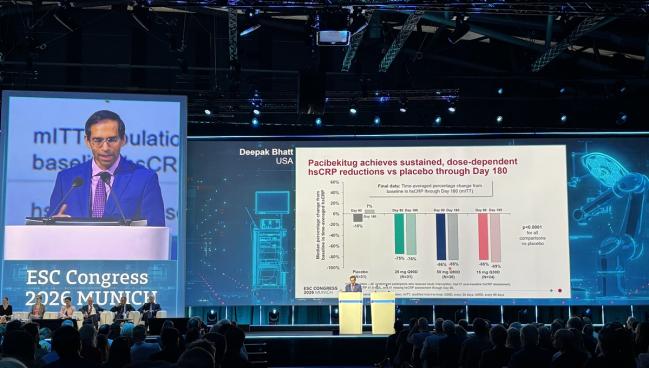
MUNICH, Germany—Pacibekitug, an interleukin-6 (IL-6) antibody, successfully reduces high-sensitivity C-reactive protein (hs-CRP) and other signs of inflammation among patients with chronic kidney disease (CKD) at high inflammatory risk, according to final 180-day data from the phase II TRANQUILITY trial.
Yet exactly how those biomarker changes might translate into clinical benefit remains to be seen, researchers acknowledged at the European Society of Cardiology (ESC) Congress 2026. Just last month, top-line findings from the phase III ZEUS trial showed that ziltivekimab (Novo Nordisk), which also targets IL-6, failed to decrease the risk of MACE in patients with atherosclerotic cardiovascular disease (ASCVD), CKD, and inflammation.
To ESC attendees, TRANQUILITY senior investigator Deepak Bhatt, MD (Icahn School of Medicine at Mount Sinai, New York, NY), explained the rationale behind their trial of pacibekitug.
“Persistent inflammation drives atherosclerotic plaque progression, increasing risk of adverse cardiovascular events. This is well known,” Bhatt noted. “IL-6 is hypothesized to drive inflammatory risk in cardiovascular disease. Elevated hs-CRP reflects IL-6 pathway activation [and] systemic inflammation and identifies patients at increased risk of cardiovascular events.”
Speaking at a press conference, Bhatt said the main goal of TRANQUILITY, as a phase II trial, was to assess the safety and efficacy of targeting inflammation with various doses of pacibekitug.
“This is currently an investigational medicine,” he said, adding that “a difference between this IL-6 inhibitor versus other IL-6 inhibitors out there in clinical use for noncardiovascular conditions, or being studied in phase III trials for cardiovascular conditions, is it has this option of quarterly dosing.”
Whether the reductions in inflammatory biomarkers they found here translate to a MACE reduction, Bhatt acknowledged, “is really the million-dollar question.”
Tourmaline Bio, the company that had been developing pacibekitug, was acquired by Novartis in September 2025. Notably, years ago, Novartis sponsored the CANTOS trial of canakinumab and had pursued a cardiovascular indication for that drug, a monoclonal antibody. But hopes faded after the US Food and Drug Administration balked and the manufacturer dropped its plans. Bhatt said it’s not yet known how Novartis plans to continue research on pacibekitug.
Manesh Patel, MD (Duke University, Durham, NC), the current president of the American Heart Association, elaborated on how the inflammatory hypothesis for CVD manifests in daily practice for cardiologists. “We know [inflammation] plays a biologic process. I think most people feel quite comfortable with that based on years of data,” he told TCTMD.
Moreover, there’s the accepted concept of residual risk, Patel added. “We have lots of patients in whom we have what feels to be near-optimal care—cholesterol’s managed, blood pressure’s managed, they’re not diabetic, they’re trying to stay active and do the [lifestyle] things we know about—and they still would have a clinical event.”
Specific to IL-6 reduction, though, thus far there has only been canakinumab, which is no longer under study for cardiovascular disease. “We’ve yet to find another therapeutic that’s met the mark [enough] to say, ‘That’s a clinical thing I can do for someone who has residual inflammatory risk,’” he said.
Biomarkers Move in the Right Direction
The double-blind TRANQUILITY enrolled 141 patients with CKD (stage 3-4) and elevated hs-CRP (2 to < 15 mg), randomizing them 1:1:1:1 to receive placebo or subcutaneous pacibekitug (either 25 mg every 90 days, 50 mg every 90 days, or 15 mg every 30 days) for a total of 6 months. Participants had a mean age of 69 years, 64% were women, 72% were on statins, and 59% had diabetes.
Treatment with pacibekitug led to dose-dependent decreases in the primary endpoint of hs-CRP at 90 days—median time-averaged changes from baseline were -15% with placebo, -75% with pacibekitug 25 mg, -86% with pacibekitug 50 mg, and -85% with pacibekitug 15 mg (all P < 0.0001 vs placebo).
These reductions were sustained to 180 days—median time-averaged changes from baseline were +7% with placebo, -76% with pacibekitug 25 mg, -85% with pacibekitug 50 mg, and -89% with pacibekitug 15 mg (all P < 0.0001 vs placebo).
By 180 days, hs-CRP levels had fallen below 2 mg/L for 84% of patients receiving pacibekitug 25 mg, 77% of those receiving the 50-mg dose, and 88% of those receiving the 15-mg dose, as compared with 6.5% of the placebo group. More than half of patients in each of the pacibekitug groups, but none in the placebo group, saw their hs-CRP decrease to < 1 mg/L at 180 days (all P < 0.0001 vs placebo).
Serum amyloid A and fibrinogen dropped by 57% and 38%, respectively, with pacibekitug. Levels of lipoprotein(a) decreased by 20-30%.
Treatment-emergent adverse events (TEAEs) occurred in 56.2% of the pacibekitug group and 63.9% of the placebo group. Among the pacibekitug patients, 1.9% discontinued the study drug due to TEAEs. There was one death in the pacibekitug group (1.0%), a fatal case of COVID-19.
No clear dose-related safety signals emerged, Bhatt reported. He concluded: “These findings support further clinical evaluation in high-cardiovascular-risk populations.”
Filippo Crea, MD (Gemelli Hospital, Rome, Italy), the discussant for TRANQUILITY, praised what he described as its “strong methodology and clear results.”
Yet he also pointed out that CRP is “not on the causal pathway leading to atherosclerotic plaque formation and complications,” but rather is a marker of inflammation. Across the trials that have been done thus far, hs-CRP levels have inconsistently been associated with MACE risk, Crea noted. This is perhaps because acute coronary syndromes can develop by several mechanisms, including both plaque erosion and plaque fissure.
“My suggestion is that new anti-inflammatory treatments for the prevention of acute coronary syndromes, rather than CRP, should perhaps address all interleukins activated by the inflammasome—1, 6, and 18—and, to prevent erosion, neutrophil activation mainly mediated by TLR4,” Crea concluded.
That ‘Million-Dollar Question’
Bhatt pointed out that while TRANQUILITY investigators focused on CKD patients, this may not be where the clinical benefit lies. Patients with ACS, where inflammation is thought to be more causally related to events, are probably the ones for whom “an anti-inflammatory, if it is going to shine [and] be effective, is most likely to do so.”
ZEUS similarly was done in CKD patients, who are a “challenging population,” Bhatt commented. “Many things that work in the cardiovascular space don’t work in chronic kidney disease patients. . . . I think there’s a future for this approach of targeting inflammation, but it has to be the right patients.”
Bhatt, speaking with TCTMD, observed that data have been mixed even for colchicine, which is now approved in the United States for CV event reduction in patients with established ASCVD. COLCOT and LoDoCo2 came out positive, only to be followed by the negative CLEAR SYNERGY. “I think, again, it’s a matter of matching the right drug to the right population,” he emphasized.
“My hope is there’s still enough excitement in the field of anti-inflammatory drugs that the negative ZEUS press release doesn’t take away that momentum,” said Bhatt. “My suspicion is that inquiry will go on, not only with IL-6 inhibition but with other targeted anti-inflammatories.”
Conversations over the best mechanism to target in inflammation are indeed exciting, Patel agreed. “But for the average general cardiologist in practice right now, I think most of what we would say is what the guidelines say, and what the recommendations are, which is to get your patients to goal with a lot of the known proven therapies, which include blood pressure, cholesterol, and glucose control.”

Caitlin E. Cox is Executive Editor of TCTMD and Associate Director, Editorial Content at the Cardiovascular Research Foundation. She produces the…
Read Full BioSources
Bhatt D. Efficacy of monthly and quarterly dosing of pacibekitug targeting inflammation in chronic kidney disease with high cardiovascular risk: final results from the phase 2 TRANQUILITY trial. Presented at: ESC 2026. August 29, 2026. Munich, Germany.
Disclosures
- Bhatt reports receiving research contracts with Novartis and Novo Nordisk as well as consulting for Tourmaline Bio.
- Patel reports research grants to his institution from the National Heart, Lung, and Blood Institute and from Regeneron.
Related News


Comments