Transseptal TMVR in MAC Shows Promise in Registry
Event rates, though relatively high, were lower than predicted, offering hope for patients with few options.

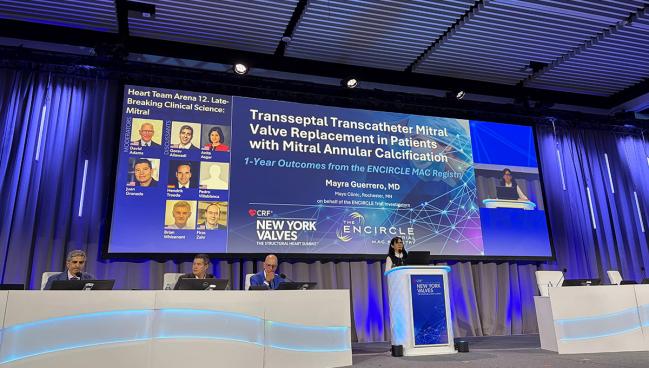
NEW YORK, NY—In patients with mitral annular calcification (MAC) and symptomatic mitral regurgitation (MR) deemed unsuitable for surgery or transcatheter edge-to-edge repair (TEER), transseptal transcatheter mitral valve replacement (TMVR) was associated with a lower-than-predicted mortality rate as well as reductions in MR and improvements in functional status and quality of life, according to new data from the ENCIRCLE MAC registry.
Among 100 patients with grade 3+ MR treated with the Sapien M3 system (Edwards Lifesciences) at 36 centers in five countries, the primary composite endpoint of all-cause mortality or heart failure hospitalization was reported in 33.6% at 1 year, which is less than the performance goal of 45%. Additionally, 98.5% of the population had MR no higher than 1+ at 1 year.
Primary results of the ENCIRCLE trial led to approval of the M3 device by the US Food and Drug Administration as the first fully percutaneous TMVR system in 2025. The population included in the MAC registry represents a very sick cohort without many treatment options, and the results, though sobering, indicate progress, according to Mayra Guerrero, MD (Mayo Clinic, Rochester, MN), who presented the data here today at New York Valves 2026.
“These results support consideration for transseptal TMVR with the Sapien 3 system as a treatment option for selected patients with MAC-related mitral valve dysfunction,” she said.
Gorav Ailawadi, MD (University of Michigan, Ann Arbor), who served as the discussant for the study, agreed that this cohort of patients is “very challenging,” as evidenced by the high rate of events. But it’s clear that this device reduces MR, he added.
“While I welcome technologies like this as a physician who treats more than my fair share of MAC [and] I’m really excited for this as well as new technologies, I do think we have to be a bit honest about what the outcomes were,” Ailawadi added.
“We need to be very careful moving forward now that there’s commercial approval,” Guerrero agreed. “We should be very careful not to treat patients who are at high risk of procedural complications.”
Notably, “we can’t expect the results in MAC like in native mitral,” said panelist Pedro Villablanca, MD (Henry Ford Hospital, Detroit, MI). “MAC is like a stage 3/4 cancer. Native valve is like stage 1/2 where you have chances of going back to normal. When we see all the MAC results, in general, are not as good as a valve-in-valve, valve-in-ring, or M3 native, I’m not surprised. It’s the disease itself which is making this seem more morbid. If there’s technical success, I think I would take it as a win.”
MAC Results
Of the 100 patients (mean age 76.1 years; 51% male) enrolled in the registry, 93 had successful implantation of the Sapien M3 devices. Baseline mean STS PROM was 8.4% and 73% had NYHA class III/IV symptoms. Two-thirds of patients had atrial fibrillation, 14% had prior stroke, and almost half had prior transcatheter or surgical aortic valve replacement.
On echocardiography at baseline, most patients (77%) had primary MR and had an MR grade of at least 3+ (71%); another 19% had an MR grade of 2+ accompanied by at least moderate mitral stenosis and 10% had severe stenosis with an MR grade < 2+. Mean LVEF was 54.6% and mean mitral valve gradient was 6.1 mm Hg. Almost all patients (95.9%) had at least moderate MAC with a mean total MAC score of 5.9.
Mean procedural time was 119.5 minutes, including a mean device time of 97 minutes. One patient died during the procedure, one patient was converted to surgery, and one had valve embolization. Six patients had pericardial effusion leading to cardiac tamponade and 12 required percutaneous paravalvular leak closure. One in four had their atrial septal defect closed, including 13% with clinically significant cases.
By 1 month, the mortality rate was 6.0%, rising to 21.1% at 1 year. The rate of heart failure hospitalization rose from 5.2% at 1 month to 19.4% at 1 year.
We should be very careful not to treat patients who are at high risk of procedural complications. Mayra Guerrero
Among the secondary endpoints, more than 95% of patients had improvements in mitral regurgitation grade and 66.2% had improvement in NYHA class. Kansas City Cardiomyopathy Questionnaire overall summary score improved by a mean of 18.5 points (P < 0.001 for all).
Notably, stroke was reported in 1.0% at 30 days and 7.4% at 1 year, including a 5.1% rate of disabling stroke. The rate of mitral valve reintervention was 3.1% at 30 days and 11.4% at 1 year, and the rate of hemolysis requiring intervention was 9.2% at both time points.
One lesson learned from the study, according to Guerrero, is that “we need to be more careful during deployment of the dock. There’s no tactile feel, and therefore you’re not going to feel resistance, so we should not push too hard. Moving forward, . . . if you see on fluoroscopy that there is loading of the system or signs of resistance, don’t push. Then just retract and take your time.”
Ultimately, she continued, “there were procedural complications, but still the outcomes are favorable.”
These data are important because they not only help drive the field of TMVR forward, but also help clarify issues related to patient characteristics and those potentially technology-driven, argued co-moderator Juan Granada, MD (Cardiovascular Research Foundation, New York, NY).
“There are certain aspects that are not necessarily related to MAC, even though they could be improved with technology [and] future iterations, just like PVL, LVOT obstruction, hemolysis, and thrombosis,” he said. “This is what is going to push the field forward with all these new iterations of devices and technologies.”

Yael L. Maxwell is Senior Medical Journalist for TCTMD and Section Editor of TCTMD's Fellows Forum. She served as the inaugural…
Read Full BioSources
Guerrero M. Transseptal transcatheter mitral valve replacement in patients with mitral annular calcification: 1-year outcomes from the ENCIRCLE MAC registry. Presented at: New York Valves 2026. June 25, 2026. New York, NY.
Disclosures
- Guerrero reports receiving institutional research support from Edwards Lifesciences.
- Ailawadi reports receiving consulting/speaking fees or honoraria from Abbott, Medtronic, Edwards Lifesciences, W. L. Gore and Associates, Arthrex, Philips, Anteris, JenaValve, Johnson & Johnson, Capstan, and Enable CV.
- Villablanca reports no relevant conflicts of interest.
Related News



Comments