TRIC-I-HF Scores Big Clinical Wins for Transcatheter Tricuspid Repair in High-risk Patients
As the first trial of these valve interventions to impact HF hospitalization and mortality, it “feels like a COAPT-like moment,” says Mohamad Alkhouli.

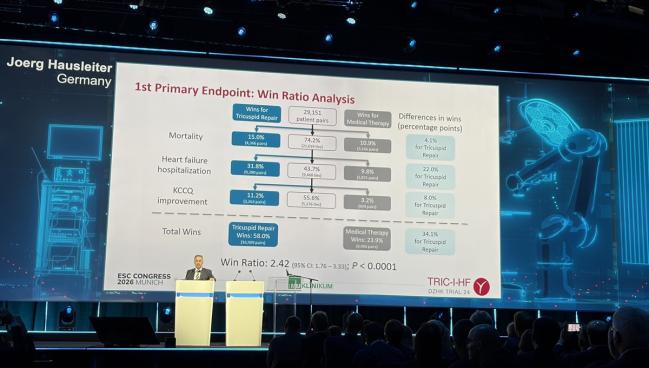
MUNICH, Germany—Transcatheter tricuspid valve repair added to medical therapy decreases the likelihood of death and hospitalization for heart failure (HF) compared with medical therapy alone, while also improving quality of life (QoL) in patients with severe tricuspid regurgitation, according to results of the TRIC-I-HF trial.
Presenting TRIC-I-HF in a Hot Line session here at the European Society of Cardiology Congress 2026, Jörg Hausleiter, MD (Ludwig-Maximilians-Universität München, Germany), said the win ratio for the first primary endpoint (a hierarchical composite of death from any cause, hospitalization for HF, and QoL improvement at 1 year) was 2.42 (95% CI 1.76-3.33) in favor of tricuspid repair. In Kaplan-Meier analysis, the estimate of freedom from death or HF hospitalization at 3 years (co-primary endpoint) was 52.4% versus 21.0%.
“This resulted in a relative reduction of 60% of the combined primary endpoint of mortality and heart failure hospitalization, with a highly statistically significant P value of 0.0001,” Hausleiter noted. “When we calculated the number needed to treat to prevent one mortality or heart failure hospitalization at 1 year, the number was four.”
For Rebecca Hahn, MD (NewYork-Presbyterian/Columbia University Irving Medical Center, New York, NY), the discussant for the trial, the findings are “just an incredible result.”
She noted that the TRIC-I-HF investigators enriched the population with patients at high risk for HF hospitalization and death, required participating sites to be experienced, and allowed operators to decide for themselves which commercially available device to use.
Together, Hahn said, this “points to the fact that the heart team discussion was integral to this trial result.”
Two prior RCTs—Tri.Fr and TRILUMINATE Pivotal—have shown significant improvements in quality of life when comparing transcatheter tricuspid repair plus medical therapy to medical therapy alone, but both failed to show hard clinical benefits in the form of hospitalization for HF or mortality.
Mohamad Alkhouli, MD (Mayo Clinic, Rochester, MN), who was not involved in TRIC-I-HF, told TCTMD that this is the trial many interventionalists have been waiting for. “It’s the first one that shows hard clinical outcome change with tricuspid valve interventions. It feels like a COAPT-like moment for the field,” he said.
When it was presented in 2018, the COAPT trial moved the needle for transcatheter mitral valve repair by demonstrating reductions in the primary endpoint of HF rehospitalizations and mortality at 2 years.
Alkhouli said TRIC-I-HF also appears to be a big “win” when it comes to the win-ratio analysis.
“I think this is another example of being innovative in using novel statistical methodologies to do these trials. The typical first event counts approach is not suitable for this kind of disease where the hard clinical endpoints are less and where patients are older and sicker,” he added. “It showed elegantly how [win-ratio analysis] was helpful in answering the question. Even when they did the secondary analysis, which was the traditional statistical Kaplan-Meier approach, we saw a similar direction. So, that was reassuring and I’m glad they reported both.”
The study was simultaneously published in the New England Journal of Medicine.
Wins Across All Endpoint Components
TRIC-I-HF was conducted between March 2022 and June 2025 at 29 high-volume heart valve centers (mean 176 total procedures) in Germany and included 360 patients (mean age 80 years; 56% women). In this high-risk population, 75.0% had NYHA class III or IV heart failure, 55% had been hospitalized for HF in the previous year, 81.7% had cardiorenal syndrome, and 46.2% had cardiohepatic syndrome. The degree of tricuspid regurgitation was severe in 50.8%, massive in 34.2%, and torrential in 10.3%.
In those assigned to the tricuspid intervention, 98.3% received transcatheter edge-to-edge repair (T-TEER),1.3% underwent transcatheter annuloplasty, and 0.4% underwent transcatheter tricuspid-valve replacement. The devices used were the Pascal (Edwards Lifesciences) in 65.6% and TriClip (Abbott Cardiovascular) in 33%. The number of devices per patient was one in 28.6% of patients, two in 62%, and three or more in 9.4%.
Compared with medical therapy alone, the intervention plus medical-therapy group had more wins across all components of the primary endpoint. Among the individual components of the primary endpoint, Kaplan-Meier estimates showed survival rates of 86.5% with transcatheter tricuspid repair and 82.5% with medical therapy at 1 year. By 3 years, the rates were 72.3% and 53.9%, respectively, indicating a 38% lower relative risk of all-cause death in the trispid-repair arm (HR 0.62; 95% CI 0.40-0.96).
Approximately 80% of patients in the transcather repair group were alive and free from hospitalization for HF at 1 year compared with 51.3% in the medical-therapy group (HR 0.35; 95% CI 0.25 to 0.50). At 3 years, those rates were 62.4% and 31.0%, respectively (HR 0.35; 95% CI 0.25 to 0.51). Furthermore, analyses accounting for competing risks of death also showed an advantage for the tricuspid interventions group in terms of lower cumulative incidence of hospitalization for HF.
[It’s] just an incredible result. Rebecca Hahn
The investigators permitted crossover to transcatheter tricuspid repair in patients who had a primary endpoint event for which they were hospitalized for severe HF resulting in IV diuretic therapy. Of the 48 patients in the medical-therapy arm who crossed over, 58% of the repairs were performed during the hospitalization for the primary endpoint event.
At 1 year, 56.3% in the transcatheter-repair group had mild tricuspid regurgitation compared with 19.2% in the medical-therapy group. For NYHA functional class, 73.8% of those in the intervention group had class I or II HF at 1 year compared with 57% in the medical-therapy group. QoL was measured with the Kansas City Cardiomyopathy Questionnaire (KCCQ), with mean improvements of 11.2 points from baseline in the intervention group and 4.3 points in the medical-therapy group.
More to Come
Hahn noted that the HF hospitalization benefit emerged early and the curves continued to diverge as the trial wore on, driving much of the advantage for transcatheter tricuspid intervention over medical therapy alone.
She theorized that if crossovers enriched the HF hospitalization benefit, it raises questions about who the noncrossover patients are and if there is a way to filter them out so they can safely be treated on medical therapy alone as first-line therapy.
Yet another possibility, Hahn said, is whether some patients in the trial had tricuspid regurgitation that was too advanced for them to see a benefit.
”This is a landmark study that will inform patients and clinicians about the benefit of transcatheter repair therapy,” Hahn said. “We eagerly look forward to subsequent analyses that may further inform clinicians about who, when, and how to treat.”
Alkhouli agreed that further information about the crossover population in particular will be an important component in understanding the value and generalizability of TRIC-I-HF.
“Substudies that will come from this trial will be very helpful to understanding how we apply it to the individual patients,” he noted, adding that he was struck by the high rates of cardiorenal syndrome and cardiohepatic syndrome in the trial participants and what it may mean.
“Those were really congested patients, and we know that medical therapy is less efficient when you have cardiorenal and cardiohepatic syndrome. So it seems like by just taking the edge off that congestion, reducing the backflow, [transcatheter tricuspid repair] helps potentially the medical therapy be more efficient in improving symptoms,” Alkhouli said.
Session chairperson Nicolas Van Mieghem, MD, PhD (Hospital Oost-Limburg, Genk, Belgium), congratulated the investigators on the trial results.
“I hope this trial can stimulate future guideline committees in formulating updated recommendations for the treatment of tricuspid regurgitation with transcatheter interventions,” he added.

L.A. McKeown is a Senior Medical Journalist for TCTMD, the Section Editor of CV Team Forum, and Senior Medical…
Read Full BioSources
Hausleiter J, Stocker TJ, Geisler T, et al. [Tricuspid-valve intervention in heart failure]( https://www.nejm.org/doi/full/10.1056/NEJMoa2606934. N Engl J Med. 2026;Epub ahead of print.
Disclosures
- The study was supported by the German Center for Cardiovascular Research, the university hospital of Ludwig Maximilian University Munich, and an unrestricted research grant from Edwards Lifesciences.
- Hausleiter reports consulting for and receiving travel support from Edwards Lifesciences.
Related News



Comments