Tricuspid Repair Benefits Consistent Across TRIC-I-HF Subgroups
The population was enriched with a sicker phenotype than prior trials, which may have enhanced the impact on hard outcomes.

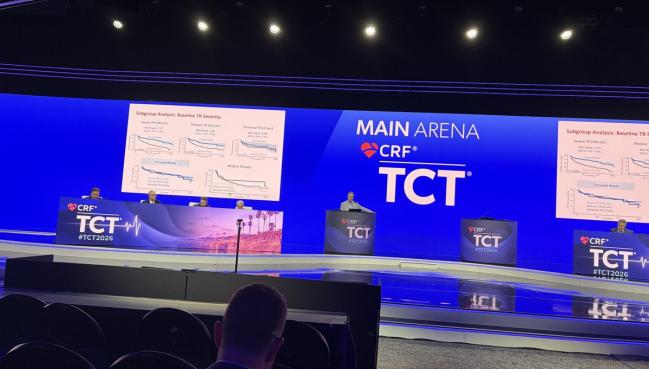
SAN DIEGO, CA—Transcatheter tricuspid valve repair plus medical therapy results in better clinical outcomes and quality of life (QoL) compared with medical therapy alone across diverse presentations in patients with severe tricuspid regurgitation (TR), according to subgroup analyses of the investigator-initiated TRIC-I-HF trial.
Regardless of prior HF hospitalization or the presence of secondary organ dysfunction, and among all but a small group of patients with torrential tricuspid regurgitation, the win ratios mirrored the results of the main trial, with lower rates of mortality and hospitalization for HF.
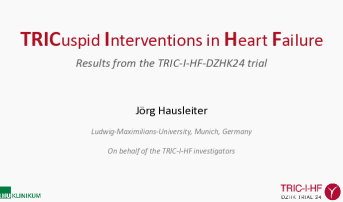
Jörg Hausleiter, MD (Ludwig-Maximilians-Universität München, Germany), presented the findings in a late-breaking trial session here at TCT 2026.
Two prior RCTs—Tri.Fr and TRILUMINATE Pivotal—have shown significant improvements in quality of life when comparing transcatheter tricuspid repair plus medical therapy to medical therapy alone. Unlike TRIC-I-HF, however, neither demonstrated an impact on hard clinical endpoints such as HF hospitalization and mortality.
To TCTMD, Hausleiter stressed that patient selection may have made the difference in TRIC-I-HF. The high-risk clinical profiles of the patients, he added, ensured that “we had enough events during the follow-up so that we can also show a benefit of the therapy.”
Also speaking with TCTMD during a media briefing, Rebecca Hahn, MD (NewYork-Presbyterian/Columbia University Irving Medical Center, New York, NY), agreed that “enriching the population with prespecified enrollment criteria [so] that then you had a sicker phenotype, I think, was key.”
Hausleiter said another important factor was experience with the procedure. Centers were required to have performed a high volume of transcatheter tricuspid valve repairs, with the mean number being 176 procedures before trial-site initiation.
Another factor specific to the trial was that crossovers were only allowed if there was a HF hospitalization. “So all patients who crossed over had a severe heart failure hospitalization with the need for an IV diuretic and all those heart failure hospitalizations were also adjudicated by an independent committee,” he explained.
Hahn expanded on this, noting that the prior trials that failed to show an impact on hard endpoints showed a HF hospitalization benefit.
“We probably did choose in those prior trials a less sick population, and we didn’t realize that . . . we needed a longer follow-up time,” she said. “But the 2-year results of TRILUMINATE clearly show heart failure hospitalization [benefit], and the 18-month follow-up of TRISCEND II, particularly in those patients who have torrential and massive disease, showed heart failure hospitalization benefit.”
Also in the media briefing, Suzanne Baron, MD, (Massachusetts General Hospital, Boston), acknowledged criticism that some of the pivotal tricuspid repair trials showed impacts on QoL only.
“I don’t really think that’s the case. I think that really what it represents is more of a canary in the coal mine in that we were seeing this biologically plausible improvement in quality of life brought on by the reduction in TR,” she observed. “I think what you did here is that you enriched the population so that we didn’t have to wait 2 to 3 or 4 years to see it. We saw it right away.
“So I think there absolutely are patients who may not be as sick as the folks that you enrolled who will still see benefit from these therapies,” Baron continued. “I still think that we need more work to better define who those patients are, because it’s such a heterogeneous population.”
Similarities and Differences
TRIC-I-HF was conducted between March 2022 and June 2025 at 29 high-volume heart valve centers in Germany. The investigators enrolled 360 patients (mean age 80 years; 56% women). Of these, 75.0% had NYHA class III or IV heart failure, 55% had been hospitalized for HF in the previous year, 81.7% had cardiorenal syndrome, and 46.2% had cardiohepatic syndrome. Tricuspid regurgitation was severe in 50.8%, massive in 34.2%, and torrential in 10.3%.
Tricuspid interventions were transcatheter edge-to-edge repair (T-TEER) in 98.3%, transcatheter annuloplasty in 1.3%, and transcatheter tricuspid valve replacement in 0.4%. The devices used were the Pascal (Edwards Lifesciences) in 65.6% and TriClip (Abbott) in 33%. A single device was used in 28.6% of patients, two in 62%, and three or more in 9.4%.
In the primary analysis, the win ratio for the first primary endpoint (a hierarchical composite of death from any cause, hospitalization for HF, and QoL improvement at 1 year) was 2.42 (95% CI 1.76-3.33) in favor of tricuspid repair. In a Kaplan-Meier estimate, freedom from death or HF hospitalization at 3 years (second primary endpoint) was 52.4% versus 21.0%, with a number needed to treat to prevent one death or HF hospitalization at 1 year of 4.
For the subgroup with prior HF hospitalization, the win ratio for the first primary endpoint was 2.84 (95% CI 1.83.4.41), for those with cardiorenal syndrome it was 2.37 (95% CI 1.67-3.36), and for those with cardiohepatic syndrome it was 2.36 (95% CI 1.41-3.95). In comparison, the subgroups without those conditions had win ratios of 2.20 (95% CI 1.38-3.51), 2.79 (95% CI 1.31-5.95), and 2.43 (95% CI 1.63-3.63).
By baseline tricuspid regurgitation severity, the win ratios for the first primary endpoint were 3.27 (95% CI 2.04-5.26) and 2.16 (95% CI 1.32-3.93) for the severe and massive subgroups, respectively. In contrast, the torrential subgroup, which had just 37 patients, had a win ratio of 1.08 (95% CI 0.45-2.55). The Kaplan-Meier analyses of these groups for survival free of HF hospitalization also show a difference in the curves, with the torrential group well below the other two. However, compared with the medical therapy groups, the torrential subgroup had better survival free of HF hospitalization over the follow-up period, with Hausleiter saying that overall, they had “a better outcome than expected.”
Food for Thought in the Tricuspid Space
For discussant Paul Sorajja, MD (Banner Health, Phoenix, AZ), it’s important to keep in mind that the relation of the risk marker to tricuspid regurgitation is simply an association.
“And so one could actually speculate what the effects might have been, and I may speculate that they might have been even greater if TR were actually tied directly to the risk marker, such as heart failure hospitalization or end-organ damage,” he said. He added that the risk markers are “relatively single, they’re binary, and they only had to be abnormal.”
Estimated glomerular filtration rate only needed to be less than 60 mL/min/1.73 m2 for patients to qualify as having cardiorenal syndrome in the trial. The mean measures were 46 mL/min/1.73 m2 in the tricuspid repair group and 44 mL/min/1.73 m2 in the medical therapy group.
That “suggests that the presence of even mild end-organ damage puts a patient at risk and puts a patient at greater consideration for tricuspid TEER,” Sorajja said. Indeed, he said the subgroup analysis suggests that even asymptomatic patients with evidence of end-organ damage should be looked at closer in this regard.
“We need that insight because [it] would help us align our tricuspid TEER indications with other indications for asymptomatic patients with valvular heart disease who have evidence of end-organ damage,” he added.
Hausleiter agreed that there is food for thought there in some patient subgroups.
For those with cardiorenal or cardiohepatic syndromes, he said, “we’re probably treating those patients rather usually too late [so] treating those patients earlier—preventing secondary end-organ damage—I think would be the goal for the future.”
But he stopped short of agreeing that the TRIC-I-HF trial holds implications for asymptomatic patients, adding that more data could add confidence that isn’t quite there yet.

L.A. McKeown is a Senior Medical Journalist for TCTMD, the Section Editor of CV Team Forum, and Senior Medical…
Read Full BioSources
Hausleiter J. TRICuspid Interventions in Heart Failure: results from the TRIC-I-HF-DZHK24 trial. Presented at: TCT 2026. November 1, 2026. San Diego, CA.
Disclosures
- The TRIC-I-HF study was supported by the German Center for Cardiovascular Research, the university hospital of Ludwig Maximilian University Munich, and an unrestricted research grant from Edwards Lifesciences.
- Hausleiter reports speaker honoraria and consulting fees from Edwards Lifesciences and TriCares.
- Sorajja reports consulting fees/honoraria from 4C Medical, Abbott Structural, Adona, AMX Technologies, Boston Scientific, ConKay, Coramaze, Cultiv8, Edwards Lifesciences, GE Medical, Haemonetics, Medtronic, Philips, Polares, TriCares, VDyne, Unorthodox Ventures, Valcare, and xDot.
Related News

Comments