What’s Going to Be Hot at New York Valves 2026
Attendees will find 30 late-breaking clinical science and innovation presentations, the LAAC Summit, puppies, and more.

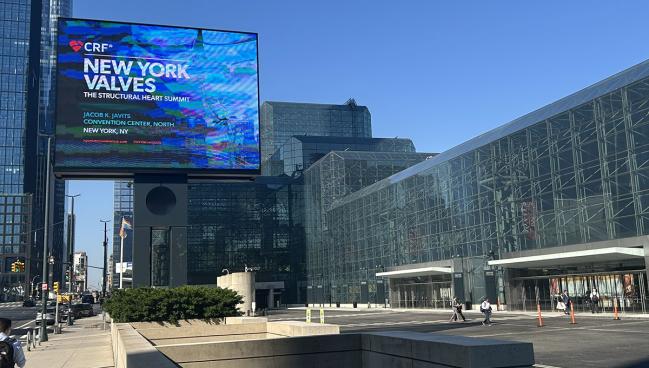
New York Valves takes place this week once again at the Javits Center in New York City, covering all aspects of structural heart care in a meeting running from June 24-26.
There will be four late-breaking clinical science sessions and two late-breaking innovation sessions covering new research on aortic, mitral, and tricuspid interventions, as well as left atrial appendage closure (LAAC); a day-and-a-half LAAC Summit for electrophysiologists, structural operators, and imagers performing the procedure; live cases from centers around the world; and much more spread across the 3 days of the conference. More than 3,000 people are expected to attend.
I’ll be on-site with Yael L. Maxwell to cover the big news. You can reach me via email with comments or story suggestions—or just to say hello—before, during, or after the meeting. I’m looking forward to connecting with many of you.
Main Arena and Late-Breaking Sessions
On the first day, Wednesday, the main Heart Team Arena opens with a session tackling when to intervene in patients with asymptomatic moderate and severe aortic stenosis (AS), which includes a flash debate on the role of preemptive aortic valve replacement versus clinical surveillance. Later in the day, that room will host sessions on long-term TAVI durability, atrial secondary mitral regurgitation (MR), and reintervention after mitral valve repair failure, as well as an opening session that will include presentation of a career achievement award to Igor Palacios, MD.
The first of the late-breaking clinical science sessions of the meeting, which covers TAVI and is being held in partnership with EuroPCR, takes place that morning. Attendees will see presentations on 7-year valve durability in the PARTNER 3 trial, 7-year outcomes in low-risk patients treated with balloon-expandable valves in the United States, multiple experiences with the Evolut platform (Medtronic), and updated results from EARLY TAVR.
In the afternoon, a second late-breaking clinical science session will tackle tricuspid interventions, with presentations on transcatheter tricuspid valve replacement (TTVR) after failed transcatheter edge-to-edge repair (T-TEER), treatment of patients who would have been ineligible for TTVR in the TRISCEND II trial, early outcomes after T-TEER with the TriClip system (Abbott), and valve thrombosis after TTVR.
On the second day, the Heart Team Arena will have sessions on the treatment of patients with tricuspid regurgitation (TR), tricuspid interventions in the presence of cardiac implantable electronic device (CIED) leads, the postapproval transcatheter mitral valve replacement (TMVR) landscape, management of aortic regurgitation (AR), and treatment of concomitant CAD and severe AS.
The single late-breaking clinical science session Thursday addresses mitral disease. Attendees will hear about 1-year outcomes of TMVR with the Sapien M3 system (Edwards Lifesciences) in patients with mitral annular calcification in the ENCIRCLE-MAC registry, LAMPOON trends and outcomes, real-world outcomes of M-TEER with the Pascal system (Edwards Lifesciences) or MitraClip (Abbott), repeat M-TEER, and M-TEER in patients with a small mitral valve orifice area.
That afternoon, there will be a late-breaking innovation session held in partnership with Structural Heart that will cover artificial intelligence (AI)-enabled ECG analysis for the detection and prediction of structural heart disease and several TAVI-related topics.
On Friday, the third and final day, sessions in the Heart Team Arena will address acute valve syndromes, the 2025 aortic valve guidelines from the European Society of Cardiology, and lifetime management of AS, including a flash debate on whether SAVR or TAVI should be the first choice in low-risk and young patients.
There will be a second late-breaking clinical science session dedicated to TAVI that morning, with talks on the characteristics of patients with moderate AS enrolled in the PROGRESS trial, the American Heart Association’s Target: Aortic Stenosis initiative, the DETECT AS II study, real-world outcomes of TAVI with the Navitor valve (Abbott) in patients with small aortic annuli, a randomized trial of femoral or radial secondary access, and an analysis of ALIGN-AR evaluating new permanent pacemaker implantation after TAVI for pure AR.
A second late-breaking innovation session contains four presentations touching on LAAC and treatment of mitral and aortic valve disease.
Other Offerings
Meeting attendees will find plenty more outside of the Heart Team Arena.
The LAAC Summit kicks off with a full day on Wednesday, featuring live pre-recorded cases and sessions discussing algorithms for device selection, imaging requirements, best clinical practices, clinical indications, how to build and manage an LAAC program, challenging cases and clinical conundrums, and imaging challenges after the procedure. The summit concludes on Thursday with a half day that includes sessions on performing LAAC along with other procedures, intracardiac echocardiography guidance, complex cases, and evidence generation.
There will be a total of 20 sessions dedicated to live cases and 20 Spotlight sessions delving into a wide range of structural topics.
Six US Food and Drug Administration Town Hall sessions will include discussions of bringing more transcatheter tricuspid devices on the market; long-term follow-up to establish treatment durability; navigating the US structural innovation ecosystem; the role of echo core labs in valve device trials; closing the gap between engineers and clinicians in medical device innovations; and general questions related to the FDA or the Centers for Medicare and Medicaid Services (CMS).
There will also be 36 scientific abstract sessions and a number of iCOACH sessions and discussions of innovation, challenging cases, and complications throughout the meeting. The Imaging Learning Center will host echo and CT training sessions across areas of structural heart disease, and hands-on stations will be available each day.
For attendees looking for a break from the science, the meeting will include a Fan Zone where they can watch World Cup soccer matches and visit the Puppy Zone, among other opportunities. And don’t forget to wear your favorite team jersey on Wednesday and white sneakers on Thursday!

Todd Neale is the Associate News Editor for TCTMD and a Senior Medical Journalist. He got his start in journalism at …
Read Full BioRelated News


Comments