As Years Pass, Mortality Seems to Grow Higher With TAVI vs SAVR in Low-risk Patients: Meta-analysis
Half of deaths in TAVI patients occurred between 5 and 7 years—researchers say this should spur more heart team discussion.

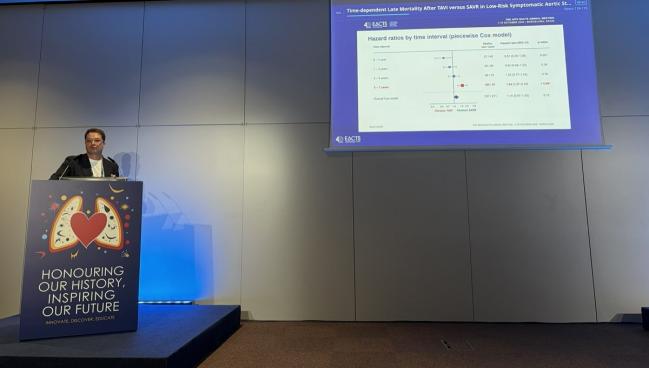
BARCELONA, Spain—When comparing mortality rates following TAVI or SAVR in patients at low surgical risk, the timing of deaths may matter more than what the trial evidence has shown so far, according to new data.
In a time-dependent analysis of three major trials comparing TAVI and SAVR in low-risk patients, presented at the 2026 European Association for Cardio-Thoracic Surgery meeting, the transcatheter option had higher mortality than did surgery after 5 to 7 years of follow-up (HR 1.64; 95% CI 1.27-2.12) despite hints of an early benefit with TAVI.
“The question is really still unresolved,” lead investigator Samuel Heuts, MD (Maastricht University Medical Center, the Netherlands), told TCTMD. “We really need longer-term follow-up data for these low-risk and often young patients. If this trend continues, and it’s now statistically significant, we’ll have quite a major difference probably at 10 years. . . . We may have to reconsider our current guideline recommendations, which will of course be complicated and complex, but it’s never too late, I think.”
The study included data on 2,644 patients at low surgical risk who were randomized to either TAVI or SAVR in the PARTNER 3, Evolut Low Risk, and NOTION trials, which each reported data out to at least 7 years.
“What we see is quite similar in all these trials,” Heuts explained. “Numerically, there’s an increased mortality rate at 7 years [with TAVI], and we also see that these survival or mortality curves cross at a certain point.” In a Bayesian analysis his team published in Heart this year, Heuts said they “observed a signal” of increased all-cause mortality in low- and intermediate-risk patients undergoing TAVI at the 5-year mark. This led them to also publish a “call for caution” in the Annals of Thoracic Surgery last month.
“We also have some methodological concerns because almost all of these trials use the hazard ratio as the effect to measure the mortality differences,” he said. “The hazard ratio is derived from a Cox model, and a Cox model has one really important assumption: that is the proportionality of hazards assumption. And that means that the risk or the hazard over time has to be constant between two groups, so you cannot have two curves that cross.”
When comparing a surgery like CABG or SAVR with a less-invasive intervention or even a conservative therapy, Heuts continued, “you will have an up-front risk in the surgical group, which may attenuate over time. So intuitively, the proportionality of hazards assumption is actually not met.”
Commenting for TCTMD, John K. Forrest, MD (Yale University School of Medicine, New Haven, CT), the primary investigator of the Evolut Low Risk trial, said the additional follow-up data in the low-risk TAVI trials has been informative.
“As these longer-term data become available, it is critical for us to work to understand where are the opportunities that will allow for improved patient care and outcomes,” he said in an email.
“The ultimate goal should be for patients who undergo TAVR not only to have improved outcomes in the short term, but also in the long term,” Forrest added. “The recent data shows there is room to improve and the next steps will be to understand what role does valve technology play, what role does more complete revascularization play, and how can we continue to improve patient quality of life and long-term outcomes.”
Similarly, Sreekanth Vemulapalli, MD (Duke University Medical Center, Durham, NC), said the primary question behind the study–understanding valve durability–is important.
“Patients want to know and providers want to know, if I put this valve in you, roughly how long do we think it’s going to last before it runs into some sort of trouble?” he told TCTMD, adding that several studies now indicate that 5 to 7 years might be the time point when some valves start to degenerate. “So that is a key point to figure out.”
Robert Bonow, MD (Northwestern University Feinberg School of Medicine, Chicago, IL), who also was not involved in the meta-analysis, called the data “preliminary” but indicated that the signal they pick up on may be important.
“What’s unclear is how close the follow-up was at that point in time, what the dropout rate may have been, and even the cause of death,” he told TCTMD. “Death is obviously a hard endpoint, but [how much is] valve-related mortality?”
He urged cardiologists to pay attention to this trend, “especially if we’re talking about intervening in younger people—at least be aware of this and continue to follow where this trail leads. But for an older individual, it’s probably, going to be less important.”
Outcomes Shift With Time
In their analysis, the total all-cause mortality rate over 7 years was higher in those undergoing TAVI compared with SAVR (26.9% vs 23.7%), leading to an absolute risk difference of 3.2% and a number needed to treat of “between 30 and 35, which, in my opinion, seems clinically relevant,” Heuts reported. However, the hazard ratio of 1.14 was not statistically significant (95% CI 0.99-1.29) and the curves cross, “so the proportionality of hazards assumption is not met.”
But when the researchers plotted the hazard ratio as a function of time, they did see an unsurprising protective effect with TAVI in the first 2 years, during which the hazard ratio crossed 1 after the second year. This benefit was nonsignificant up until 1 year, disappeared between 1 and 5 years, and flipped thereafter.
Mortality Risk by Time Interval: TAVI vs SAVR
| HR | 95% CI |
0-1 Year | 0.61 | 0.38-1.00 |
1-3 Years | 0.84 | 0.59-1.22 |
3-5 Years | 1.05 | 0.77-1.43 |
5-7 Years | 1.64 | 1.27-2.12 |
Overall | 1.14 | 0.97-1.33 |
“This is a really important pivotal finding, and it has not yet been established before in any of the TAVI versus AVR trials. This is a statistically significant mortality difference in favor of surgical AVR,” Heuts said. “So there are many more patients dying in this [5-7 year] time interval in the TAVI group.”
The findings held up in multiple sensitivity analyses and comparisons in which different trials were excluded—with the exception that there was no longer a significant difference observed when the Evolut Low Risk trial was excluded (HR 1.39; 95% CI 0.96-2.01)—and there was no statistical heterogeneity. Additionally, 49% of all TAVI deaths over the entire 7-year period occurred between 5 and 7 years.
“We cannot just assume that early procedural benefit and intermediate sort of noninferiority also leads to long-term equivalence,” Heuts concluded. “And based on that, I think we need to consider in the heart team the indication for TAVI, specifically when we extend it to younger patients as is in guidelines now.”
Practice Changing?
Panelist Peyman Sardari Nia, MD, PhD (Maastricht University Medical Center), said the study is “absolutely brilliant,” and asked, “Do you really think that cardiologists care and do you think that it’s going to change practice?” Rather, he suggested, research efforts might be more impactful if they focus on “granular allocation of treatments” by anatomy.
“I think a 3% mortality difference is huge, it’s gigantic,” Heuts countered. “But of course, that’s also a matter of belief. If we [look at] PCI versus CABG for left main stenosis, the difference in 5-year mortality is about 1-1.5%, and we perform CABG in all these patients. So as a community, I think we do think that’s clinically relevant. And I think 3% is very large.”
Vemulapalli cautioned, however, that the loss to follow-up in the trials might cancel out the effects of the randomization. “It’s usually selected patients, and it’s not the same between the two arms,” he said. “When you start comparing what’s left, it’s no longer a random comparison, and that’s an issue because now you don’t know [if we’re] comparing patients who are otherwise exactly equal or not or are they different in some fundamental ways?”
This leaves open the question of whether the differences observed are due to the SAVR or TAVI or to underlying differences in the patients, according to Vemulapalli. “That’s my main concern,” he said. “This differential follow-up makes it very difficult to answer the question like this.”
Secondly, he indicated, the fact that the analysis was no longer significant when the Evolut Low Risk data were removed shows that mortality might be affected by the choice of TAVI device—balloon expandable or self-expanding. “It looks like it might be different across different valve types,” Vemulapalli said.
To TCTMD, Heuts said his goal is to present objective data that might guide recommendations. “It’s not that I’m on a ‘surgical side’ against cardiology, but I think we have focused too much on the short-term outcomes and we have let the short-term reports, even 1-year follow-up reports, determine our guideline recommendations,” he said. “I think that may have been a bit premature, especially for patients with such a life expectancy who are young and low risk. You have to have long-term follow-up.”

Yael L. Maxwell is Senior Medical Journalist for TCTMD and Section Editor of TCTMD's Fellows Forum. She served as the inaugural…
Read Full BioSources
Heuts S. Time-dependent late mortality after TAVI versus SAVR in low-risk symptomatic aortic stenosis. Presented at: EACTS 2026. October 9, 2026. Barcelona, Spain.
Disclosures
- Heuts and Bonow report no relevant conflicts of interest.
- Forrest reports receiving grant support/research contracts and fees from Edwards Lifesciences and Medtronic.
- Vemulapalli reports receiving research grants from Edwards Lifesciences, Cytokinetics, Kardigan Bio, Idorsia, National Institutes of Health, Food and Drug Administration, ARPA-H, American Heart Association, and American College of Cardiology and serving as a consultant to Edwards Lifesciences, Medtronic, Abbott, Medscape, and Eli Lilly.
Related News



Comments