Zalunfiban Advantage in Suspected STEMI Lasts Up to 1 Year: CELEBRATE
The decrease in death/HF with a single subcutaneous injection of the novel GP IIb/IIIa inhibitor seen at 30 days persisted.

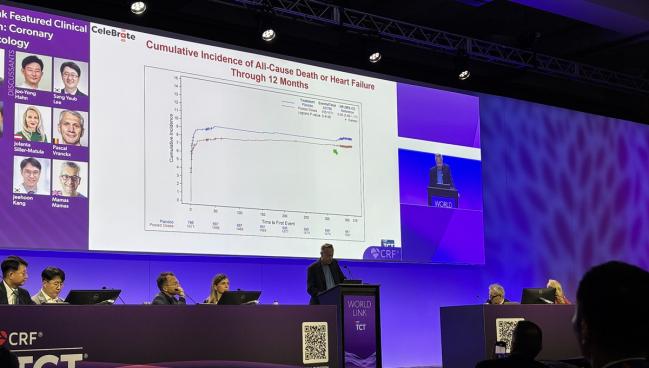
SAN DIEGO, CA—Patients with suspected STEMI who are given the novel glycoprotein IIb/IIIa inhibitor (GPI) zalunfiban (CeleCor Therapeutics) at first medical contact continue to derive benefits 1 year later, follow-up from the CELEBRATE trial suggests.
The data, presented today at TCT 2026, expand upon the trial’s main results showing improved patency of infarct-related arteries at cath lab arrival and fewer adverse events at 30 days.
“Time is muscle: early restoration of blood flow in STEMI reduces death and loss of myocardium, reducing the risk of developing heart failure and improving immediate and long-term mortality,” senior investigator C. Michael Gibson (Beth Israel Deaconess Medical Center, Boston, MA), noted in the Featured Clinical Research session.
There is urgent need for a therapy that can address ischemia and easily be given to STEMI patients before they present to the cath lab, Gibson added. But oral P2Y12 inhibitors have a delayed onset of 2 to 4 hours and haven’t been found to improve patency, while intravenous GPIs, for their part, are difficult to administer.
Zalunfiban is delivered as a single subcutaneous injection by emergency medical services in an effort to reduce the prolonged ischemic time as patients are taken to a PCI-capable hospital. It inhibits around 90% of platelet function within 15 minutes, Gibson said, but thanks to the drug’s hour-long half-life, platelet function returns at around 2 hours.
Lasting Benefits
CELEBRATE included 2,467 patients (mean age 63 years; 79% male) who presented within 4 hours of the onset of persistent ischemic chest pain and had presumed STEMI on ECG. Patients were randomized 2:1 to zalunfiban or placebo, with 853 patients receiving a 0.11-mg/kg dose of zalunfiban and 818 receiving a 0.13-mg/kg dose.
The median time from symptom onset to receipt of the study drug was 90 minutes, and the time from symptom onset to PCI was 140 minutes. Nearly all patients (95%) were treated with aspirin, heparin, and a P2Y12 inhibitor prior to PCI, the vast majority of which was performed via radial access.
At 12 months, rates of all-cause death were nearly the same between the pooled zalunfiban groups and placebo, at 3.7% vs 3.3%. Heart failure (HF) occurred at rates of 6.8% vs 8.2%, respectively. Combining those two endpoints, rates were 9.3% with zalunfiban and 10.3% with placebo.
Viewed as Kaplan-Meier curves, there was an early divergence between the two groups, but neither “further divergence [nor] late benefit” by 12 years, Gibson said.
Gibson and colleagues also analyzed the data by the interval between drug administration and PCI. For patients treated within 60 minutes, the combined rate of death/HF was 8.5% with zalunfiban and 9.3% with placebo. For patients who underwent PCI beyond that time point, there was a larger difference between the two groups, with death/HF rates of 9.4% and 11.7%, respectively. Neither difference was statistically significant.
The initial CELEBRATE results showed that patients who received zalunfiban had significantly better ST resolution before angiography than did those who received placebo. In the 12-month follow-up, the individuals who’d had better ST resolution were less likely to die or develop HF. Rates of death/HF were 11.1% when ST resolution was 30% or less, 8.5% when it was 30-70%, and 5.9% when ST resolution exceeded 70%.
Similarly, zalunfiban had previously been shown to improve TIMI flow before PCI. Twelve months after treatment, the patients with pre-PCI TIMI flow 0-1 had an all-cause mortality rate of 4.5%. The death rate was significantly lower—2.4%—among those with TIMI flow 2-3 (HR 0.51; 95% CI 0.32-0.82; log-rank P = 0.004).
Now that death rates have become so low, it can be hard to show a significant difference in that endpoint alone, said Gibson. Instead, he continued, outcomes like HF, stent thrombosis, and infarct size are where further strides can be made.
Jolanta M. Siller-Matula, MD, PhD (Medical University of Vienna, Austria), discussant for the 12-month data, described CELEBRATE as a “very much needed trial” that addresses a clinical need.
She drew attention to an earlier endpoint: acute stent thrombosis within 24 hours post-PCI, which was reduced by a relative 82% with zalunfiban compared with placebo (0.2% vs 1.0%; OR 0.18; 95% CI 0.03-0.74). Stent thrombosis was associated with higher mortality and smaller infarct size in CELEBRATE.
Panelist Mamas Mamas, BMBCh, DPhil (Keele University/Royal Stoke University Hospital, Stoke-on-Trent, England), for his part, pointed out “the absence of significant major bleeding [with zalunfiban] was quite a surprise for many of us. How do you interpret that?”
In fact, said Gibson, several measures of bleeding were numerically lower with the drug. “That’s different than the old days,” when bleeding was more an issue, he added. Not only is the drug new, but radial access has grown more common.
Pascal Vranckx, MD, PhD (Hartcentrum Hasselt, Belgium), also a panelist, asked if there was a role for zalunfiban not just at first medical contact but perhaps after hospital arrival.
“My hope and aspiration, frankly, would be prehospital, because we still have people waiting 2-and-a-quarter hours to get to the hospital. We’re losing [that window] for treatment. So ultimately if I had my dream come true: if you had an MI, you’d go home with a vial and if you had symptoms you’d inject yourself,” said Gibson, adding that a trial would be necessary to show that approach is feasible. Transfer between a receiving hospital and STEMI hub might present another opportunity.
The SOS-AMI trial is currently exploring self-administration of selatogrel (Viatris Innovation), an investigational, subcutaneous P2Y12 receptor antagonist, by patients with suspected acute MI.

Caitlin E. Cox is Executive Editor of TCTMD and Associate Director, Editorial Content at the Cardiovascular Research Foundation. She produces the…
Read Full BioSources
Gibson CM. Zalunfiban at first medical contact in patients with ST elevation myocardial infarction: 12-month clinical outcomes. Presented at: TCT 2026. October 31, 2026. San Diego, CA.
Disclosures
- Gibson reports research grant and consulting support from CeleCor Therapeutics; after the primary results were presented, he was granted modest equity in the company.
- Siller-Matula reports receiving consulting fees/honoraria/speaking fees from Cordis, Daiichi-Sankyo/Eli Lilly and Company, and Chiesi, as well as grant/research support from Chiesi.
Related News



Comments