AGENT IDE Midterm Results Still Give DCB an Edge for In-Stent Restenosis
At 3 years, Agent still outshined uncoated balloons. Registry data show rapid uptake of the DCB in the year after its FDA approval.


WASHINGTON, DC—For high-risk patients with in-stent restenosis (ISR), the Agent drug-coated balloon (DCB) maintains an advantage over uncoated balloon angioplasty alone, according to new 3-year follow-up data from AGENT IDE presented this week at CRT 2026.
A second presentation, meanwhile, showed how rapidly the DCB has gained adoption in the United States since its approval last year.
In AGENT IDE, 3-year rates of TLF—ischemia-driven target lesion revascularization, target vessel-related MI, or cardiac death—were 32.7% in the group that received the Agent DCB (Boston Scientific) versus 40.9% in the uncoated balloon group (HR 0.72; 95% CI 0.55-0.96). The difference was driven mainly by reductions in TLR and MI related to the target vessel.
In the main AGENT IDE results, TLF rates had been 17.9% in the DCB group and 28.6% in the uncoated balloon group at 1 year, meeting the criteria for superiority (HR 0.59; 95% CI 0.42-0.84).
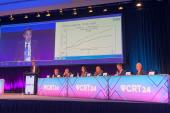
“When we do a landmark analysis, we see that most of the benefit, in fact all of the benefit, was achieved in the first year, with comparable growth of the curves after that 1-year mark, perhaps as might be expected for a treatment that is not durable per se,” Robert Yeh, MD (Beth Israel Deaconess Medical Center, Boston, MA), said in his presentation here at CRT 2026.
Session co-moderator Ron Waksman, MD (MedStar Washington Hospital Center, Washington, DC), said the comparison with uncoated balloon, which was mandated by the US Food and Drug Administration for the AGENT IDE trial, may not give the full picture of the therapeutic potential of the DCB or any downsides. For example, it’s worth asking if the TLF rate at 1 year was as good as seen with DES, said Waksman.
In response, Yeh noted that 40% of patients already had received multiple DES.
“All of these patients had not only failed a DES one time, but more than once,” he said. “The expected event rates for yet another third layer of a stent would certainly be expected to be high. But more importantly, they were not the [patients] that I think any of us who do interventional cardiology would want to do another stent layer in.”
He added that many of these patients likely could not be randomized to a DES in a head-to-head trial, “so for this particular population, I think it answers the question of interest.” A subanalysis, Yeh said, has suggested that there is a consistent benefit in favor of the DCB in patients with more versus fewer layers of stents.
Fewer Repeat Events
AGENT IDE randomized 600 patients (mean age 68 years; 26% female; 7% Black) to the low-dose paclitaxel DCB or balloon angioplasty. There were high rates of diabetes (51%), multivessel CAD (79%), and prior CABG (30%). In 43% of patients, multiple prior stents were present at the site of the target lesion. Intravascular imaging, while not mandated in the trial, was used in 72% of the DCB group and 77% of the uncoated balloon group. The trial required that patients remain on dual antiplatelet therapy (DAPT) for at least 1 month. At 3 years, more than half of patients in both groups were still on DAPT.
At 3 years, TLR rates were 25.3% in the DCB group versus 34.7% in the uncoated balloon group (HR 0.65; 95% CI 0.47-0.89), again maintaining the separation of the curves seen at 1 year.
To account for multiple recurrent revascularization events over the follow-up, a repeated events analysis was conducted that showed the DCB group retained a significant advantage over the uncoated balloon group with respect to TLR.
Among patients who had one or more repeat TLR procedures out to 3 years, fewer occurred in the DCB group (HR 0.66; 95% CI 0.48-0.91). The DCB group also had lower rates of target-vessel MI (HR 0.58; 95% CI 0.35-0.96).
Definite stent thrombosis rates also were lower with the DCB at 0.3% vs 3.8% in the uncoated balloon group (P = 0.001). One definite stent thrombosis event occurred in the DCB arm between years 2 to 3.
Among the unpowered secondary endpoints, non-Q-wave MI, TVR, and target vessel failure all were lower at 3 years with DCB than with uncoated balloon.
Following the presentation, C. Michael Gibson, MD (Beth Israel Deaconess Medical Center), noted that the 13% rate of patients missing at follow-up exceeded the event rate.
Yeh admitted that there were more missing patients than they would have liked, although the missing rate was higher in the conventional therapy arm, at about twice the rate as the DCB arm.
Panelist David Cohen, MD (Cardiovascular Research Foundation, New York, and St. Francis Hospital, Roslyn, NY), highlighted the fact that TLF rates exceeded 30% at 3 years even with this new technology. “My take-home here,” he said, “is we need better stents to avoid the problem in the first place because it looks like something which is best avoided rather than treated.”
Usage Patterns in the US
In a separate presentation at CRT, data from the National Cardiovascular Data Registry CathPCI Registry looking at real-world utilization and outcomes after Agent’s approval showed there were 12,729 procedures that involved the use of the DECB at 704 hospitals between April 2024 and June 2025.
In the year prior to approval, about 75% of treatment for ISR was done with DES and most of the remainder with POBA, with very little use of brachytherapy or alternative therapies. After the approval, there was rapid growth such that by June 2025, 18% of all ISR treatment was being done with the Agent DCB.
“Notably, there is significant hospital variation in DCB use for ISR,” said Christina Lalani, MD (Beth Israel Deaconess Medical Center), in her presentation. “About 41% of hospitals [in the CathPCI registry] had Agent DCB available by June 2025, she added.
A comparison of patients treated with the DCB, DES, or uncoated balloon angioplasty showed similar demographics in terms of age, sex, body mass index, race, and comorbidities. However, patients treated with DCB had a higher rate of prior CABG and chronic coronary syndrome compared with DES-treated patients.
“ We were surprised and intrigued to find that about 27% of Agent use through June of last year was for an off-label indication,” Lalani noted. While the numbers were small, the off-label use accounted for about 0.4% of all non-ISR cases. There was no difference in the rate of in-hospital adverse outcomes between use of the DCB and alternative therapies for non-ISR lesions.
To TCTMD, Yeh said off-label use is surprising because not only is there not strong randomized evidence supporting de novo use of DCBs, but also reimbursement for the device was not yet in place at the time.
“What it suggests is that clinicians are perceiving an unmet need that DCBs may fill for de novo disease, in addition to the clear indication we have for in-stent restenosis,” he said. “We need more data for this off-label cohort, and we plan to evaluate more recent data to help us understand which patients are being treated and how their outcomes [differ] in both the short and long term.”

L.A. McKeown is a Senior Medical Journalist for TCTMD, the Section Editor of CV Team Forum, and Senior Medical…
Read Full BioSources
Yeh R. Paclitaxel-coated versus uncoated balloon for coronary in-stent restenosis: three-year outcomes of the AGENT IDE trial. Presented at: CRT 2026. March 7, 2026. Washington, DC.
Lalani C. Use of the AGENT DCB in the United States in the first year after approval. CRT 2026. March 9, 2026. Washington, DC.
Disclosures
- Yeh reports receiving grants/research support from Abbott Vascular, Boston Scientific, Edwards, JenaValve, Medtronic, and Siemens; and consulting for Abbott Vascular, Boston Scientific, CathWorks, Edwards, Elixir Medical, Medtronic, Shockwave Medical, and Supira.
- Lalani reports no relevant conflicts of interest.
Related News


Comments