ALONE-AF: Less Bleeding When OAC Stopped After Successful Ablation
Questions remain about discontinuation in patients with higher AF burdens and/or stroke risks.

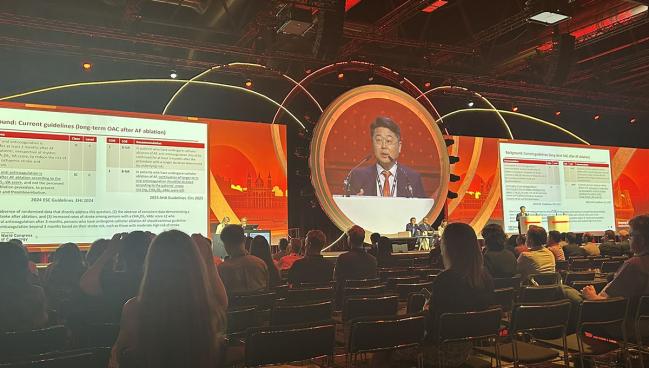
MADRID, Spain—Stopping oral anticoagulation (OAC) improves outcomes among patients who remain free from atrial arrhythmia recurrences for at least a year after catheter ablation for atrial fibrillation (AF), the ALONE-AF trial shows.
Event rates were low overall, but patients who discontinued versus remained on anticoagulation were less likely to have a stroke, systemic embolism, or major bleed through 2 years of follow-up (0.3% vs 2.2%; P = 0.02), Boyoung Joung, MD, PhD (Yonsei University College of Medicine, Seoul, South Korea), reported recently at the European Society of Cardiology Congress 2025.
The difference was driven mostly by fewer major bleeds in the discontinuation group, according to the results, which were simultaneously published in JAMA.
Both US and European guidelines recommend continuing long-term OAC after catheter ablation for AF on the basis of a patient’s calculated stroke risk, which means patients are typically on the medications for life. The question of whether it might be possible to stop OAC in the absence of arrhythmia recurrences after the procedure remains controversial, and—until now—there have been no randomized data to inform the issue.
Patients should ask their doctors about whether they can discontinue their OAC, Joung said at a press conference. “But I think this study can be one of the reasons we can stop.”
The ALONE-AF Trial
ALONE-AF, conducted at 18 sites in South Korea, enrolled 840 patients (mean age 64 years; 25% women) who had no atrial arrhythmia recurrences for at least 1 year after a first-time catheter ablation for AF. Freedom from recurrence was based on at least two 24- to 72-hour Holter monitoring sessions, including one in the 2 months prior to randomization. Patients were randomized to stop OAC or continue with a standard-dose direct oral anticoagulant.
At baseline, the median CHA2DS2-VASc score was 2, as was the median HAS-BLED score. Two-thirds of patients had paroxysmal AF. The mean time interval between AF ablation and randomization was 3.6 years. Ablation involved radiofrequency energy in about 85% of cases, with cryoballoon ablation making up the rest.
The primary outcome was a composite of stroke, systemic embolism, and major bleeding, assessed 2 years after randomization. This favored discontinuation of OAC due to a lower risk of major bleeding (0 vs 1.4%; P = 0.03). There was no difference in the rate of ischemic stroke or systemic embolism (0.3% vs 0.8%; P = 0.34).
Findings were consistent in a per-protocol analysis and across various subgroups.
Other outcomes, including TIA, all-cause hospitalization, and clinically relevant nonmajor bleeding, occurred at similar rates in the two trial arms. There were no MIs or deaths.
The rate of atrial arrhythmia recurrence during the 2-year follow-up was 9.6% among patients not taking OAC and 8.7% in those who remained on treatment, with median times to recurrence of 10.7 and 12.4 months, respectively.
Questions Remain
Carina Blomström Lundqvist, MD, PhD (Örebro University and Uppsala University, Sweden), the discussant for the study, noted that observational studies have shown a reduction in the risk of ischemic stroke after AF ablation. Patients not taking OAC after ablation see lower rates of total thromboembolic events and major bleeding overall, but among those with a CHA2DS2-VASc score of 2 or higher, thromboembolic events tend to be more frequent in patients who are not anticoagulated.
ALONE-AF provides some insights into whether OAC can be stopped after AF ablation, but there are limitations, Blomström Lundqvist pointed out. The combination of ischemic and bleeding outcomes as the primary endpoint muddies interpretation, she indicated. Regarding patient selection, there was no assessment of AF burden prior to ablation and participants included a mix of those with paroxysmal and persistent AF, leading her to question whether the results can be applied “to persistent AF patients with a higher risk for AF recurrence, AF burden, and stroke.”
Moreover, the frequency of monitoring for atrial arrhythmia recurrences was low, with use of just two 24- to- 72-hour Holter monitoring sessions associated with a sensitivity for AF detection of less than 25%, she said.
An unexpected finding was the slightly higher frequency of strokes in the patients who continued taking OAC, Blomström Lundqvist added, questioning whether it could be related to a difference in comorbidity or AF burden.
And finally, she said, there remains the controversial question of what to do in response to arrhythmia recurrences after AF ablation in a patient who is no longer taking OAC. “Which AF recurrences and which AF burden would lead to increased risk of stroke and lead to reinitiation of oral anticoagulation?” she asked.
More information on how best to manage patients after AF ablation—whether to skip OAC to lessen bleeding or maintain treatment to reduce stroke risk—will come from ongoing studies, she pointed out. The OCEAN trial, for example, is comparing long-term OAC with aspirin monotherapy, and both DESTINATION and POCKET-OAC are evaluating the utility of on-demand OAC based on monitoring for AF.
In the meantime, say Edward Gerstenfeld, MD, and Xiang Wen Lee, MBBS (both from University of California, San Francisco), in an accompanying editorial in JAMA, “the current study provides some support that cessation of oral anticoagulant therapy, if desired, is reasonable and may even offer benefit, particularly in patients at higher bleeding risk.”
They add, however, that “for patients at high stroke risk (CHA2DS2-VASc score > 3 or prior stroke), we recommend continued anticoagulation until more data becomes available.”

Todd Neale is the Associate News Editor for TCTMD and a Senior Medical Journalist. He got his start in journalism at …
Read Full BioSources
Kim D, Shim J, Choi E-K, et al. Long-term anticoagulation discontinuation after catheter ablation for atrial fibrillation: the ALONE-AF randomized clinical trial. JAMA. 2025;Epub ahead of print.
Gerstenfeld EP, Lee XW. Lifelong anticoagulation after AF ablation – time to reconsider? JAMA. 2025;Epub ahead of print.
Disclosures
- The trial was supported by grants from the Korean Health Technology Research and Development Project through the Korean Health Industry Development Institute, funded by the South Korean Ministry of Health and Welfare, and with funding from Samjin Pharmaceutical Co Ltd.
- Joung reports speaking fees from Bayer, BMS/Pfizer, Medtronic, and Daiichi-Sankyo; and research funding from Samjin, Yuhan, Medtronic, Boston Scientific, and Abbott Korea.
- Blomström Lundqvist reports honoraria from Boston Scientific, Johnson & Johnson, Medtronic, Organon, Philips, and Sanofi Aventis.
- Gerstenfeld reports serving on advisory boards for Abbott, Boston Scientific, and Biosense Webster; receiving lecture honoraria from Abbott, Biosense Webster, Boston Scientific, and Medtronic; and receiving research funding from Abbott and Adagio Medical.
- Lee reports no relevant conflicts of interest.
Related News


Comments