Cardiologists Lack Resources to Help Hospitalized Patients Quit Smoking
Only 12% report having access to a dedicated tobacco treatment team, counselor, or program to counsel patients on quitting.


Hospitalization for a cardiovascular event is a prime opportunity to counsel smokers about quitting and to start smoking-cessation treatment, but barriers such as lack of infrastructure and limited time for patient encounters often get in the way, according to a survey of cardiologists.
“Tobacco cessation counseling is one of the more important things that we do from a prevention and treating cardiovascular risk factors standpoint,” said Priyanka Satish, MD (The University of Texas at Austin), who led the survey. “There was not a lot of data on how cardiologists actually counsel their patients, and moreover, we didn't have a lot of data on inpatient tobacco cessation counseling at all.”
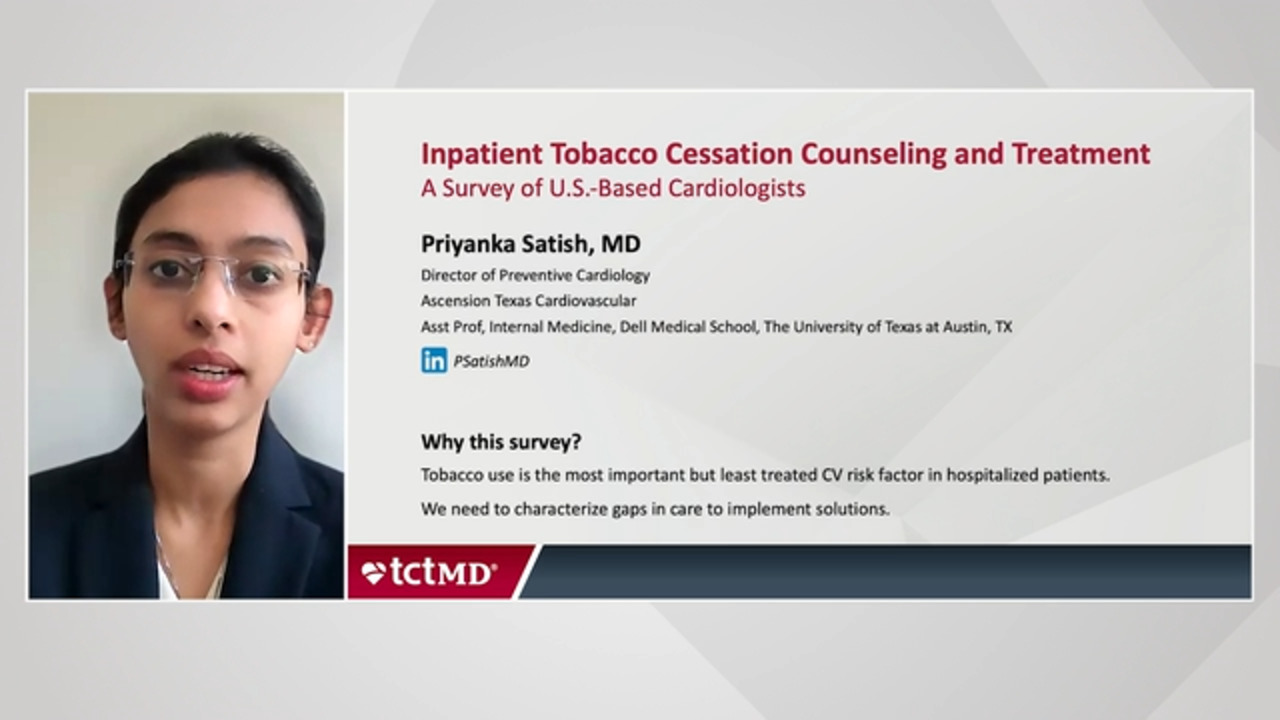
At total of 498 cardiologists (83% men) who take care of hospitalized patients and are part of the American College of Cardiology’s CardioSurve panel took the online survey in October and November 2023. It included multiple choice, Likert scale, and open-ended questions.
Only about 12% of the cardiologists reported that their hospital had a dedicated tobacco treatment team, counselor, or program to screen and counsel patients on cessation. Such resources were more likely to be found at larger centers.
“I think this study confirms what anecdotally we have known, which is that we don't have a lot of infrastructure around tobacco treatment and tobacco cessation counseling,” Satish noted.
Asked about barriers to offering in-hospital tobacco cessation assistance, 66% reported not having the support staff, 63% said they don’t have the necessary budget or finances, 42% didn’t have enough administrative staff, and 31% said they lacked the time or bandwidth for training and management.
That doesn’t mean cardiologists don’t want to be involved in these activities, with 41% saying they would spearhead an inpatient tobacco treatment team if given the opportunity. Additionally, 42% of general cardiologists and 24% of interventionalists said they would be “very” or “extremely interested” in specific training on tobacco use treatment. Continuing Medical Education (CME) sessions were the most popular choice for this activity, followed by webinars and grand rounds.
When asked how the ACC could facilitate tobacco cessation education programs for providers, survey respondents suggested such things as online case series for maintenance of certification (MOC) points, educational articles in JACC, presentations at scientific meetings, premade handouts that can be downloaded for free, and online webinars.
Medications and Advocacy
To TCTMD, Satish said another major theme that came from this survey is that medications proven to help patients quit smoking are underprescribed. Nearly 20% of those surveyed said they never prescribe varenicline or bupropion. Although most felt the agents are effective, nearly 60% indicated they have concerns about side effects, safety, or inadequate time to monitor patients on those therapies.
The most common nicotine replacement therapies recommended to patients were over-the-counter products like patches (74%), gum (47%), and lozenges (22%). The majority of cardiologists (66%) said they have no safety concerns about those products, and 97% said they believe they are efficacious in helping smokers quit.
These responses are valuable in understanding how to improve smoking cessation education for physicians, said Satish.
Tobacco cessation counseling is one of the more important things that we do from a prevention and treating cardiovascular risk factors standpoint. Priyanka Satish
“We know that pharmacotherapy, especially combined nicotine replacement and varenicline, really help improve quit rates,” she said. “Cardiologists are used to prescribing all kinds of drugs new and old, but somehow this doesn't seem to be a medication that they are very comfortable with prescribing.”
There also were indications that some cardiologists may not be comfortable with the subject of smoking cessation in general and may not think it’s their job to address it. Approximately 60% said a tobacco treatment specialist is the best person to counsel a patient about tobacco-related CV disease, compared with 29% saying the cardiology attending is best suited and 26% feeling it should be the responsibility of the primary-care practitioner.
According to Satish, an important takeaway for cardiologists is that data support the idea that patients hospitalized with a cardiac event are accepting of help for tobacco cessation, so capitalizing on that time period is important and puts the cardiologist in the driver’s seat to help.
An additional important message, added Satish, is that counseling patients about their tobacco use and helping them find effective ways to quit is not something that any one provider can do alone. But taking steps to start the conversation in the hospital may help more patients see it as a health priority that they can work on together and with their primary-care practitioner.
“What we would like to see is increased education and comfort around the topic, especially among practicing providers, but also among trainees,” Satish added.
Beyond that, there is the bigger issue of changing the infrastructure to accommodate this type of counseling, which many who took the survey said is necessary given that it adds time and additional responsibilities during busy clinical encounters in the hospital.
Satish and colleagues say some things that may help are innovations using electronic health record support, interactive voice response-based outpatient follow-up and quit-line support, incorporation of tobacco treatment metrics into mandatory outcomes reporting at the hospital level, nurse-led initiatives, and better reimbursement for tobacco cessation services.

L.A. McKeown is a Senior Medical Journalist for TCTMD, the Section Editor of CV Team Forum, and Senior Medical…
Read Full BioSources
Satish P, Abozenah M, Nazir N, et al. Inpatient tobacco cessation counseling and treatment: a survey of US-based cardiologists. JACC Adv. 2026;5:102291.
Disclosures
- Satish reports no relevant conflicts of interest.
Related News



Comments