CARPOOL Radial Access as Good as Femoral in PAD Procedures
Data are early, retrospective, and unlikely to influence guidelines, but interest among operators is growing, says Sameh Sayfo.

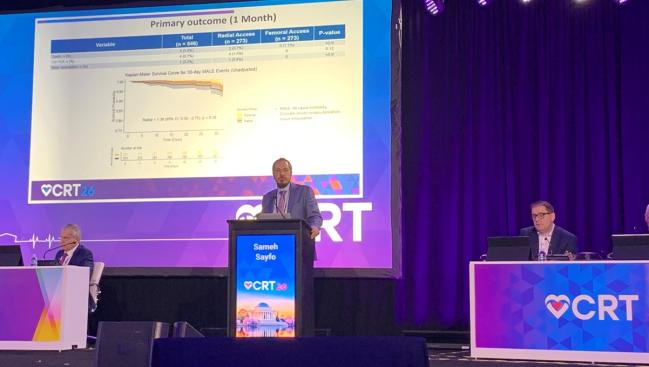
WASHINGTON, DC—Vascular interventions in patients with PAD are associated with comparable short-term outcomes no matter whether they’re performed via radial or femoral access, according to early results from the observational CARPOOL study.
At 30 days, there was little difference between the radial and femoral access groups for the primary endpoint of major adverse limb events (MALE), a composite of all-cause death, clinically driven repeat revascularization, and major amputation.
“I think the data [are] still retrospective,” said Sameh Sayfo, MD (Baylor Scott & White The Heart Hospital Plano, TX), in his presentation last week at CRT 2026. “I don’t think it’s going to move the needle in terms of a guidelines perspective, but I think the next step is to have a randomized, multicenter study that hopefully can change how people can approach radial and maybe creating an algorithm [as well].”
As with radial access for coronary interventions, some advantages of the approach in PAD include a lower risk of vascular complications, early mobilization/ambulation, shorter hospital stays, and better patient satisfaction, among others. Femoral access, though, may often be the better route due to being able to accommodate a wider range of sheath sizes and large-diameter equipment, no limitations on the patient’s height, avoidance of radial artery occlusion, and having more flexibility in emergency situations.
Little is known about why or when operators choose to go with radial-to-peripheral (R2P) access, say researchers. There have been no randomized trials and only limited prospective data to date, with procedures largely following hospital consensus. In a recent scientific statement, it was noted that radial considerations for peripheral vascular intervention (PVI) are at a stage of evolution comparable to where they were for coronary interventions between roughly 2005 and 2010, with more long-shaft equipment suitable for radial procedures being slowly tested and accepted by operators for femoral, popliteal, and tibial artery access.
“If you look from an industry perspective, there are seven different companies with some kind of a radial-to-peripheral product in the market,” said Sayfo. “So, slowly we’re adopting it.”
His institution began a R2P practice in 2019 and Sayfo described what he sees as “three buckets” of operators who use it: radial first; radial selective for simple cases; and radial opportunistic when it’s the only reasonable option.
Real-World Look at Radial Practices
To get a real-world look at how operators are doing with radial versus femoral procedures in peripheral procedures, Sayfo and colleagues analyzed consecutive cases from the multicenter, core laboratory-adjudicated XLPAD registry. They included two propensity-matched cohorts of 273 patients each (mean age 71 years; 32% women; 78% claudicants) who underwent either radial or femoral peripheral revascularization.
Both groups were well matched for baseline characteristics, with the exception of a greater incidence of MI and prior stroke in the radial group. Radial was more frequently the choice in lesions located in the external and common iliac artery and the common femoral artery, while femoral access was used more often in the superficial femoral artery.
Operators using femoral access had directional atherectomy and Jetstream (Boston Scientific) atherectomy choices that were unavailable for radial procedures.
For the procedures, the technical success rate with radial was 87.2%, as compared with 94.9% with femoral access (P = 0.002). The radial group had a higher rate of access-site switching compared with the femoral group (P = 0.01), but shorter hospital stays (5 hours vs 24 hours; P < 0.001).
The individual outcomes of the primary endpoint were not different between the radial and femoral groups. There were no strokes in the radial arm and two in the femoral arm (P = 0.5) at 30 days. Rates of repeat revascularization at the same time point were 5.9% in the radial arm and 4% in the femoral arm (P = 0.3).
Noninferiority was established with a technical success difference of -7.69 (P for noninferiority = 0.001), falling within the set margin for noninferiority.
RCTs Are Needed
Sayfo stressed that the observational registry is subject to confounding despite propensity matching, noting that operators may have selected access based on their expertise, device availability, and cost. Further follow-up at 6 months and 1 year is planned.
Session co-moderator Horst Sievert, MD (Cardiovascular Center Frankfurt CVC, Germany), wondered how these results might influence operators, particularly if the lower technical success rate might sway some to stay with femoral access.
Sayfo said the use of R2P is expanding rapidly, noting that since the 253 radial patients were enrolled in the registry another 250 patients have been added.
Additionally, Sayfo said while radial artery occlusion data in this area are needed, he has used the same radial artery multiple times in the same patient for R2P procedures and then in a coronary procedure as needed. Moreover, the radial can be an important option for operators to have in peripheral cases where the femoral artery is less desirable.
“Our patients are getting bigger, more complex,” he said, “so it’s been very exciting to see the evolution of workflow with industry” to accommodate radial procedures with the necessary equipment.

L.A. McKeown is a Senior Medical Journalist for TCTMD, the Section Editor of CV Team Forum, and Senior Medical…
Read Full BioSources
Sayfo S. Early outcomes of the CARPOOL study: comparison of radial to peripheral and femoral artery approaches for revascularization of lower limb arteries. Presented at: CRT 2026. March 10, 2026. Washington, DC.
Disclosures
- The study was conducted with an unrestricted grant from Terumo.
- Sayfo reports consulting for Medtronic, Boston Scientific, Shockwave, Inari, Penumbra, Cagent, Angiodynamic, Terumo, Surmodic, and Imperative Care; and serving on advisory boards for Cagent, Medtronic, and Boston Scientific.
Related News


Comments