Clinician EHR Alerts Lead to Speedier Evaluation, Treatment of Valve Disease
The notifications show promise for getting more patients at least evaluated by a multidisciplinary heart team within 90 days.

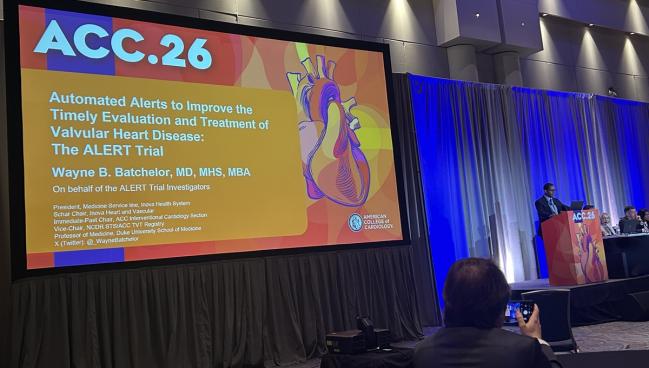
NEW ORLEANS, LA—Automated notifications sent through the electronic health record (EHR) to clinicians increase timely management of patients with significant aortic stenosis (AS) or mitral regurgitation (MR), according to results of the cluster-randomized ALERT trial.
Hospitals that implemented the system had greater proportions of patients who were evaluated by a multidisciplinary heart team and/or underwent a valve intervention within 90 days compared with centers that didn’t issue automated alerts (24.3% vs 19.9%; P = 0.01).
As ALERT investigator Wayne Batchelor, MD (Inova Health System, Fairfax, VA), reported here at the American College of Cardiology (ACC) 2026 Scientific Session, the impact appeared similar for patients with either type of valve disease, as well as across subgroups.
“Automated electronic clinician notification alerts improve referral rate to cardiac specialty care and valve intervention. This leads to shorter wait times and referral times and an increase in valve interventions,” Batchelor said.
He noted that fewer than half of patients with valvular heart disease receive treatment within 90 days, despite the fact that the ACC and the American Heart Association have established treatment within that time frame as a key quality metric for patients with symptomatic severe AS and chronic severe MR.
“We think that automated alerts might represent a scalable digital health strategy that could be applied to the real world to reduce the pervasive undertreatment of valvular heart disease,” Batchelor said.
The findings of the ALERT trial were published simultaneously in JACC.
The ALERT Trial
Previously, the DETECT AS trial showed that electronic clinician notifications increased the rate of aortic valve replacement in patients with AS and mitigated sex disparities in management of the disease. It was limited, however, in that it was conducted in a single integrated healthcare system with a homogeneous patient population (96% white) and included only patients with AS.
The ALERT trial evaluated notifications implemented across five health systems with 35 hospitals, with a more diverse cohort and patients with either AS or MR. Significant AS was defined by the presence of any of the following characteristics: aortic valve (AV) area ≤ 1.0 cm2, dimensionless index ≤ 0.25, mean AV gradient ≥ 40 mm Hg, peak AV gradient ≥ 64 mm Hg, and peak AV systolic velocity ≥ 4.0 m/s. Significant MR was defined as moderate-to-severe (3+) or severe (4+) regurgitation based on a qualitative classification.
Patients were eligible for inclusion if they had an echocardiogram ordered by a clinician who was not part of the multidisciplinary heart team, had not undergone a prior target valve intervention, and did not have a scheduled or recent visit with the heart team or a scheduled valve intervention.
We’ve got to get these patients evaluated in a more-timely fashion. Wayne Batchelor
“This is important to take advantage of the maximum potential of the alert in those patients who are not yet recognized and referred,” Batchelor explained.
The cluster-randomized trial ultimately included 765 clinicians randomized to usual practice or to receive notifications. In all, 1,905 patients who underwent 2,016 echocardiograms were part of the study. Mean patient age was 76 years, and 16% of the cohort was Black. There were more women, inpatients, and non-Hispanic individuals in the notification group. Most patients (62%) had AS and the rest had MR.
There were no differences between the alert and non-alert groups in baseline echocardiographic data. In the AS subset, mean AV area was 0.85 cm2, mean gradient was 31 mm Hg, and peak gradient was 51 mm Hg. Only about one-quarter of patients had a mean gradient of 40 mm Hg or higher. The gradients seen in the cohort are “probably by design because by excluding the patients who were already referred, this gave us a pool of patients who had on average slightly lower gradients than the overall population that we would [typically see] in the valve population,” said Batchelor.
In the MR subset, about two-thirds of patients had moderate-to-severe regurgitation and about half had an LVEF below 50%.
The alert process started when an artificial intelligence-enabled platform called Tempus Next analyzed echos in the EHR and flagged patients without an established treatment plan or referral to the multidisciplinary heart team. An automated notification, which could be worded differently across centers, would then land in clinicians’ EHR inboxes and they could then make a decision about what should happen with the patient.
The primary endpoint was a hierarchical composite of transcatheter or surgical valve intervention or a first multidisciplinary heart team visit within 90 days. This was assessed using a win ratio analysis, which favored alerts versus usual care (win ratio 1.27; 95% CI 1.05-1.54). The effects were similar by type of valve disease (P = 0.82 for interaction).
At 90 days, patients treated by clinicians who received the automated notifications were more likely to have undergone a valve intervention (13.4% vs 9.6%) and to have had a visit with the heart team (22.7% vs 17.9%; P = 0.005).
A Clear Need
Discussing the results after Batchelor’s presentation, Sammy Elmariah, MD (University of California, San Francisco), principal investigator of DETECT AS, said the trial demonstrated a “very clear and meaningful impact.”
“One would hope,” he added, “that will translate into [an improvement in] clinically meaningful outcomes, and that will be expected based on some of the prior studies in this space.” He reiterated the problem of undertreatment of valve disease, noting that women, older patients, and several underrepresented minority groups are disproportionately affected.
“The attention to this problem has of course culminated in the development of the American Heart Association Target: [Aortic Stenosis] initiative, as well as its recent expansion with the Heart Valve Initiative that will be much broader and encompass mitral valve disease as well,” Elmariah said.
Regarding the electronic clinician notifications, he said that “certainly the need for a tool like this is very clear.”
Batchelor said there were two main effects of the alerts. The first is facilitating a valve intervention in patients who need it, he noted, “but perhaps the more important one is getting the patient to the team of experts who can go through that shared decision-making process and plan out the next few months of therapy for those patients.”
The professional societies feel that going through that process within 90 days is the standard of care, he underscored.
“We’ve got to get these patients evaluated in a more-timely fashion,” Batchelor said. “This is one tool of many that can allow us to get to that endpoint better.”

Todd Neale is the Associate News Editor for TCTMD and a Senior Medical Journalist. He got his start in journalism at …
Read Full BioSources
Batchelor WB, Lindman BR, Coylewright M, et al. Automated alerts to improve timely evaluation and treatment of valvular heart disease: the ALERT trial. JACC. 2026;Epub ahead of print.
Disclosures
- This study was funded by Tempus AI and Medtronic.
- Batchelor reports having served as a consultant for Medtronic, Boston Scientific, Edwards Lifesciences, and Abbott and having received investigator-initiated grants from Abbott and Boston Scientific.
Related News



Comments