Concerto in the Cath Lab: Music Benefits Heart Health After PCI
The pilot study was small, but it suggested music therapy before and during PCI could lower BP and heart rate after PCI.

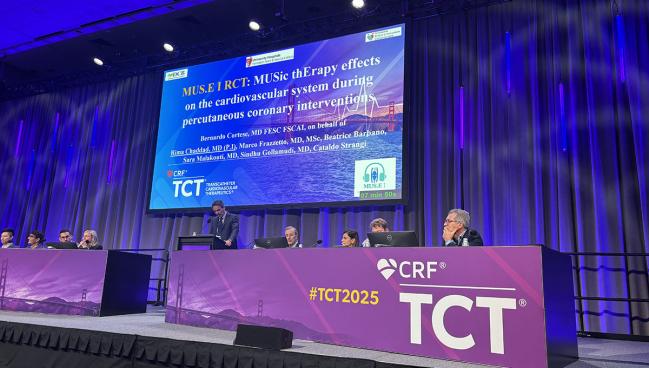
SAN FRANCISCO, CA—Music in the cath lab appears to have a beneficial impact on the patients’ cardiovascular health, according to the results of a small pilot study.
Music therapy administered before and during PCI significantly cut postprocedural mean systolic blood pressure when compared with a control group in which music wasn’t played.
Music also appeared to have a positive effect on pain levels measured immediately after the procedure as well as on postprocedural heart rate, reported investigators today during the WorldLink Forum at TCT 2025.
Senior investigator Bernardo Cortese, MD (University Hospitals Harrington Heart & Vascular Institute, Cleveland, OH), said music therapy “is a safe, affordable, and effective nonpharmacological intervention to reduce cardiovascular stress.” Moreover, he added, “patients love it [and] nurses love it.”
Maciej Lesiak, MD, PhD (Poznan University of Medical Sciences, Poland), who commented on the study during the session, praised the investigators, emphasizing that the physiologic rationale underpinning music in the cath lab is quite solid.
“This is not a soft science,” he said. “We know that music increases parasympathetic tone and dampens cortisol and catecholamine release. In other words, it helps patients’ hearts, literally and figuratively, to find a more pleasant rhythm.” Equally important, the intervention requires no cost and no training. “It starts with just a playlist, and I think this is a great idea,” said Lesiak.
Kintur Sanghvi, MD (Virtua Health, Princeton Junction, NJ), one of the panelists during the session, also praised the researchers for “thinking outside the box” and having a holistic focus on patient care.
Solid Physiologic Rationale
To date, there is some evidence that music therapy reduces anxiety among patients undergoing cardiac procedures. In one meta-analysis, the use of music therapy reduced anxiety and enhanced postprocedural heart rates, systolic blood pressure, and respiratory rates in patients undergoing a range of cardiac procedures. In another focused solely on PCI, music therapy reduced anxiety and discomfort, but had no impact of other specific measures, such as heart rate and blood pressure.
The cath lab is a stressful environment for patients, and that can provoke physiological responses, such as an increase in sympathetic tone and increased cortisol levels, blood pressure, and heart rate, said Cortese. There are also studies linking high levels of anxiety to poorer patient outcomes.
The pilot study, known as MUS.E I, included 100 patients (mean age 67 years; 81% male) randomized to one of three arms: music therapy for 30 minutes before PCI and during the procedure, music therapy for 30 minutes before PCI alone, and standard care (no music in the cath lab). The playlists, which were designed by a music therapist based on the patients’ preferences, included opera (4.0%), jazz (14.0%), pop (28.0%), nature sounds (11.0%), and classical (9.0%).
Music therapy before and during PCI was linked to significantly lower mean postprocedural systolic blood pressure, the study’s primary endpoint, compared with those randomized to no music and those randomized to music therapy before PCI alone (mean 120 mm Hg vs 134 mm Hg and 134 mm Hg, respectively; P = 0.02). There was no significant difference in blood pressure in those randomized to music therapy before PCI alone and in those randomized to standard care.
Pain levels, heart rate, and troponin levels were all lower in those randomized to music—both when used before and during PCI and before PCI alone—when compared with standard therapy. Cortese cautioned against overinterpreting the reduction in troponin in such a small study, noting it might be a play of chance.
Researchers have already begun plans for the next trial, which will include patients with more complex lesions, including chronic total occlusions, said Cortese. That study will focus on comparing music therapy before and during PCI versus a control group without music therapy and data will be collected in a more comprehensive manner. The hope is that, if effective, music could be used in lieu of opioids to reduce patient’s pain levels after PCI, as well as improve postprocedural cardiac parameters.
Cortese said there are also hopes to one day investigate whether the use of virtual reality tools could also improve postprocedural outcomes after PCI.

Michael O’Riordan is the Managing Editor for TCTMD. He completed his undergraduate degrees at Queen’s University in Kingston, ON, and…
Read Full BioSources
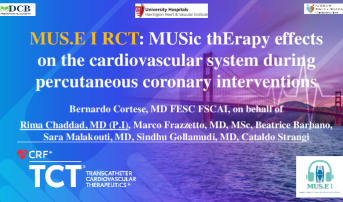
Cortese B, et al. MUS.E I RCT: Music therapy effects on the cardiovascular system during percutaneous coronary interventions. Presented at: TCT 2025. October 25, 2025. San Francisco, CA.
Disclosures
- Cortese reports no relevant conflicts of interest.
- Sanghvi reports grant/research support and consulting payments/honoraria from Recor Medical and Medtronic.
- Lesiak reports consulting/honoraria/speaker’s bureau payments from Abbott, AstraZeneca, Boston Scientific, Biotronik, Terumo, Boehringer Ingelheim, and Pfizer. He reports grant support/research contracts from Meril.
Related News


Comments