DanGer Shock: Impella Tied to Better Survival Even 10 Years Later
The post-hoc analysis can’t tease out what’s driving the long-term advantage, though some experts have possible explanations.

MADRID, Spain—Ten years after experiencing STEMI complicated by cardiogenic shock, patients treated with the Impella CP device (Abiomed) continue to have a survival advantage over those receiving standard care, long-term follow-up from the DanGer Shock trial suggests.
The widely anticipated study, for its main analysis, showed a 26% relative reduction in all-cause mortality at 180 days with the mechanical circulatory support (MCS) device versus standard care alone. Since then, further analyses of the data have delved into nuances related to the eligible population, bleeding, hemodynamics, and renal function, with the field continuing to hash out exactly how to apply the trial’s findings.
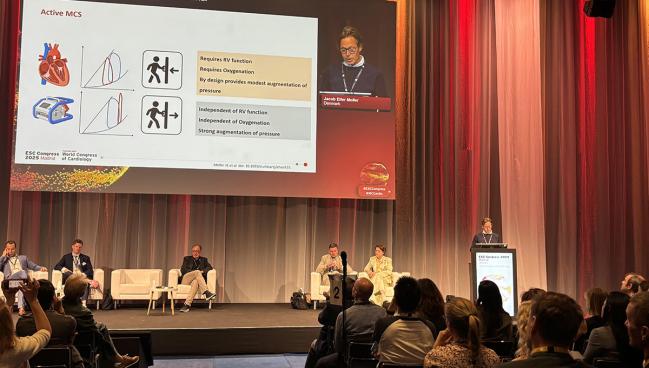
Recently, at the European Society of Cardiology Congress 2025, DanGer Shock investigator Jacob Eifer Møller, MD, PhD, DMSc (Copenhagen University Hospital – Rigshospitalet, Denmark), presented data showing that the survival benefit has continued to hold—though exactly why isn’t certain.
Earlier reports have drawn attention to the widening of survival curves in DanGer Shock that’s visible 30 days after the initial intervention, he said in the Late-Breaking Clinical Science session. “How can something you do for 72 hours seem to affect what is going on after 30 days? This has been discussed heavily. It also made it much more important to see what is going on after [180 days].”
How can something you do for 72 hours seem to affect what is going on after 30 days? Jacob Eifer Møller
For the 10-year analysis, which was simultaneously published as correspondence in the New England Journal of Medicine, the DanGer Shock researchers reviewed medical records, telephone interviews, and national death registries to find information on all-cause death among trial participants. Unfortunately, no details on cause of death were available, Møller noted.
A decade after randomization, 52.5% of the Impella group and 68.8% of the standard-care group had died (HR 0.70; 95% CI 0.54-0.92). “The proportional hazards were stable during follow-up, so it didn’t seem like the effect disappeared [over time],” said Møller.
In terms of survival, he asked, “what does the patient gain?” The median time to death was 577 days with the MCS device and 61 days with standard care, Møller reported. Even more strikingly, the mean difference between the two groups in number of days alive at 10 years was estimated at 600 days, he said. “This is quite powerful, I think, in communication [with] the patients.”
Overall the results point to a “lasting effect” of the Impella CP pump that extends beyond the index population, Møller concluded, adding that it’s important to keep in mind that use of this therapy can result in complications. “This is a reason why we can’t extrapolate these data to patients that are less sick,” he stressed. “We selected super sick patients with a very specific phenotype. Here it works.”
Session co-moderator Holger Thiele, MD (Heart Center Leipzig at University of Leipzig, Germany), observed that, previously, the longest reported follow-up in an RCT of MCS in cardiogenic shock was 6 years in the IABP-SHOCK II trial, which he led. He asked how the mortality rates in DanGer Shock compared with those data.
The absolute mortality difference between Impella and standard care seen at 180 days was sustained at 6 years, said Møller. If anything, over longer-term follow-up, “the signal now is more robust,” he added.
“It would be nice to have the causes of death,” Thiele stressed. “If you see a curve which is nearly flattened over time”—as seen for mortality in DanGer Shock but not IABP-SHOCK II—“this is surprising. . . . That’s the reason why it would be interesting to know what’s happening there.”
Getting to the ‘Why’
Srihari Naidu, MD (Westchester Medical Center, Valhalla, NY), president of the Society for Cardiovascular Angiography & Interventions, said that the vast majority of patients in both arms had died by 10 years so there were few available to follow. “That being said, the data do seem to show that the survival advantage with using Impella was sustained and, in fact, it looks like the curves might continue to separate after patients survive and are discharged from the hospital,” he said.
This advantage isn’t surprising, Naidu told TCTMD, because there’s increasing evidence that patients with more severe shock do worse after discharge.
“Not all survivors are the same. Just because you survive cardiogenic shock, it doesn’t mean you’re going to follow the same trajectory as every other survivor,” he emphasized, adding, “If you have a more severe case of shock that you survived from, chances are you had more damage to different organs during that process, and that damage will probably reset you at a lower point in your life expectancy than someone who didn’t have that kind of damage.”
Patients in DanGer Shock who received Impella “probably had a more rapid clearance of lactate, and improvement in end-organ function and perfusion quicker than the patients who did not have that [support],” Naidu explained. It’s not necessarily unique to the device itself, he added, but rather illustrates how these hemodynamic factors can be dealt with to improve outcome.
Naidu will soon be launching a new benchmark in shock management—a door-to-lactate clearance (DLC) of 24 hours—with the hopes of reducing severity and reaping downstream benefits.
Not all survivors are the same. Srihari Naidu
Daniel Burkhoff, MD, PhD (Cardiovascular Research Foundation, New York, NY), in an email to TCTMD, harkened back to the 1999 SHOCK trial, which he noted is the only other study to show a survival benefit with a treatment aimed at cardiogenic shock.
SHOCK showed a persistent improvement in survival with early revascularization through an average of 6 years’ follow-up, he commented. “So, there seems to be a common theme between the SHOCK and DanGer study results, that shock patients treated earlier with an effective treatment do not experience excessive long-term risk in the face of a more invasive strategy; there is also a suggestion that patients treated with the up-front, more ‘aggressive’ strategy also fare better in the long term.”
Navin K. Kapur, MD, chief medical and scientific officer of Abiomed, said that in today’s “post-DanGer era,” the company is seeking to better understand what constitutes best clinical practices with Impella.
Exactly how to define this “remains highly variable across different practice settings and shock phenotypes,” he told TCTMD in an emailed statement. “For this reason, we have launched the Observational Assessment of Support with Impella Best Practices in Acute Myocardial Infarction Complicated by Cardiogenic Shock (OASIS-AMICS) prospective study, which will test which clinical practices best reduce overall adverse event rates and improve survival.”

Caitlin E. Cox is Executive Editor of TCTMD and Associate Director, Editorial Content at the Cardiovascular Research Foundation. She produces the…
Read Full BioSources
Møller JE, Beske RP, Engstrøm T, et al. Long-term outcomes of the DanGer Shock trial. N Engl J Med. 2025;Epub ahead of print.
Disclosures
- Møller reports receiving research grants from Abiomed and the Novo Nordisk foundation as well as serving on advisory boards for Boston Scientific and Magenta.
Related News


Comments