HI-PEITHO: Catheter-Directed Therapy Bests Anticoagulation in Intermediate-Risk PE
The intervention group had a 61% lower risk of decompensation and other hard outcomes at 7 days.

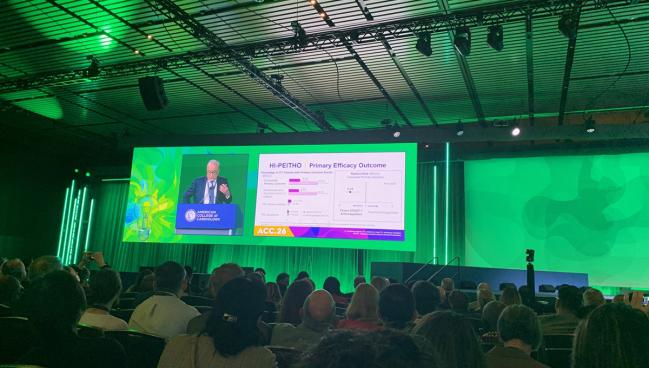
NEW ORLEANS, LA—Patients with acute intermediate-risk pulmonary embolism (PE) have better short-term outcomes with ultrasound-facilitated, catheter-directed fibrinolysis plus heparin-based anticoagulation compared with anticoagulation alone, according to results of the HI-PEITHO trial.
At 7 days, the primary composite endpoint of PE-related death, cardiorespiratory decompensation or collapse, or symptomatic PE recurrence was 61% lower in the intervention group compared with controls (P = 0.005), a difference largely driven by a lower rate of cardiorespiratory decompensation or collapse, with no excess risk of bleeding, noted Stavros V. Konstantinides, MD (University Medical Center of the Johannes Gutenberg University, Mainz, Germany), in a media briefing prior to the presentation.
This translated to a number needed to treat of 16 to prevent one primary endpoint event.
The study was presented in a late-breaking trials session at the American College of Cardiology 2026 Scientific Session and simultaneously published in The New England Journal of Medicine, with lead author Kenneth Rosenfield, MD (Massachusetts General Hospital, Boston).
Twelve years ago, the PEITHO trial showed that full-dose systemic fibrinolytic therapy reduced clinical deterioration, but with much more hemorrhagic stroke and extracranial bleeding, which dissuaded clinicians and guideline writers from recommending it.
Jay Giri, MD, MPH (University of Pennsylvania Perelman School of Medicine, Philadelphia), a member of the writing committee for the 2026 joint clinical practice guideline for the evaluation and management of acute pulmonary embolism in adults, said HI-PEITHO is probably the most important clinical study that’s been performed in those 12 years in the intermediate-risk PE population.
“There’s a tremendous amount of uncertainty in how to manage them because these are patients who are not so sick that they’re crashing and burning in front of you and where you feel an imperative to act to prevent the spiral, but also not well enough that you feel like you can send them home in 24 hours,” he told TCTMD.
He described the 544-patient HI-PEITHO population as “slightly enriched” and with far stricter enrollment criteria than PEITHO, adding that the trial is the first of its kind to compare the intervention and anticoagulation with a large enough sample size to be relevant to treatment decisions. While the lack of a bleeding signal is reassuring, he noted that the inclusion criteria for HI-PEITHO were so strict that approximately 87% of those screened were not randomized.
In his presentation, Konstantinides said “the aim of this specific criteria was to place more focus on patients who would be sick enough to really need some sort of advanced treatment.”
In the media briefing, Geoffrey Barnes, MD (University of Michigan, Ann Arbor), co-vice chair of the 2026 PE guidelines, said the study largely confirms what a lot of people in the PE world have suspected, which is that the use of catheter-based interventions, including catheter-based thrombolysis, improves patient outcomes.
“I think one of the most critical elements from this that we as clinicians need to be careful about is not to extrapolate these findings to a much broader set of patients,” he added.
According to Giri, it’s difficult to say what percentage of acute intermediate-risk PE patients would resemble those in the trial, but more granularity from the HI-PEITHO investigators will be welcome in the future to better characterize the enrolled patients.
That granularity is a key part of the recent PE guidelines, which established acute PE clinical categories ranging from A (subclinical) through E (cardiopulmonary failure). Additionally, patients may fall into subgroups within those categories.
Barnes said the HI-PEITHO cohort largely looked like patients who fall into category D. This group includes patients with incipient cardiopulmonary failure, which can include transient hypotension (D1) or normotensive shock (D2).
“These are the patients for whom we’re most concerned [they] are going to decompensate,” Barnes noted. “So, using this therapy in that more select population is going to best align with the trial outcomes, and that’s what I would encourage clinicians to think about.”
To TCTMD, Konstantinides said while the trial developed its criteria prior to publication of the guidelines, he thinks patients would indeed fit within the D1 and D2 categories, as well as C3, which are symptomatic patients with elevated risk scores, a positive troponin, and an enlarged RV.
But, Konstantinides said these labels represent a “snapshot in time” and may not be an accurate reflection of their condition throughout the treatment period.
“You may have indeed more patients that now are classified as C3, but they may become D1 in a couple of hours or minutes and be eligible for the trial. So, I believe there is overlap with D1 and D2 [and] there’s also some overlap with C3,” he said.
Barnes stressed that not all C3 patients require an acute intervention, especially since they likely would not all be enrolled in the HI-PEITHO trial. “Focusing more on that D category is where, to me, this seems like it’s not perfectly aligned, but that’s sort of generally where I would start thinking about this for patients,” he said.
HI-PEITHO Results
The HI-PEITHO investigators randomized 544 patients (mean age 58.2 years; 42.6% women) from 59 sites in the United States and Europe who had intermediate-risk pulmonary embolism, defined as a ratio of right ventricular end-diastolic diameter to left ventricular end-diastolic diameter of 1.0 or higher, an elevated troponin level, and at least two indicators of cardiorespiratory distress. The mean duration of acute PE was 3.7 days. The mean National Early Warning Score (NEWS) was 6 at baseline. Those assigned to the intervention group underwent ultrasound-facilitated, catheter-directed thrombolysis (EkoSonic; Boston Scientific) within 2 hours of randomization.
After the device was placed into the pulmonary artery in intervention-group patients, the mean total infusion duration was 7 hours and the mean total dose of alteplase was 8.85 mg in those with catheter placement in one pulmonary artery and 16.92 mg for those with catheter placement into both the right and left arteries. Unfractionated heparin was the most commonly used anticoagulant (71.6% of patients in the intervention arm and 55.7% in the control arm).
At 7 days, cardiorespiratory decompensation or collapse occurred in 3.7% of the intervention group versus 10.3% of the control group (RR 0.4; 95% CI 0.2-0.7). This endpoint was defined as at least one of the following: cardiac arrest or indication for cardiopulmonary resuscitation; signs of shock; need for extracorporeal membrane oxygenation, intubation or initiation of noninvasive mechanical ventilation; or a NEWS that rose to or persisted at 9 or higher, as confirmed by two consecutive measurements.
Of the 38 total cases of cardiorespiratory decompensation or collapse, the only criterion that was met in 15 of them (14 in the control group and 1 in the intervention group) was a NEWS of 9 or higher at least 24 hours after randomization.
Three of six deaths that occurred in the intervention group through 30 days were PE-related, as was one of three deaths in the control group. Recurrence of PE at 7 days occurred in 0.4% of both the intervention and control arms, corresponding to one case each.
Major bleeding, as defined by the ISTH within 72 hours, 7 days, and 30 days after randomization, and as defined by the GUSTO criteria within 7 days, were not significantly different between treatment groups. No instances of intracranial bleeding were seen in either group.
The rate of escalation to rescue therapy for documented cardiorespiratory decompensation was 2.9% among the intervention arm and 9.2% in the control arm.
At 30 days, all-cause mortality rates were 1.8% in the intervention arm and 1.1% in the control arm, with no differences in the rate of serious adverse events.
In an accompanying editorial, Alex C. Spyropoulos, MD (Donald and Barbara Zucker School of Medicine at Hofstra/Northwell, Hempstead, NY) and Suresh Vedantham, MD (Washington University School of Medicine, St. Louis, MO), say that while the use of NEWS at a threshold of 9 to indicate decompensation “enhanced the reproducibility of the trial results and reduced expectation bias in an open-label trial design,” the score isn’t widely used in North America. Additionally, they say, “whether it represents a clinically relevant surrogate for decompensation, as well as whether it was applied similarly in both treatment groups, is uncertain.”
To TCTMD, Giri said while it may not be widely used, it is an organic score that can be used at the bedside rather easily.
“We’re looking at things like respiratory rate, oxygen saturation, systolic blood pressure, pulse, temperature, and then their general consciousness levels. This is codifying the nursing assessment a little more tightly. We’re normally assessing all these things anyway,” he said.
“Hitting the NEWS score of 9 is what drove this primary endpoint,” Giri added. “The next piece will be the dissemination of how you actually educate everyone on the score . . . and we may all need to think through what this means and if we think this is a good cutoff in these patients. I think it is.”
Discussant Joshua A. Beckman, MD (UT Southwestern Medical Center, Dallas), said the results bring PE therapy into the future.
“The treatment does not have an excess of statistically significant bleeding, and the composite outcome is improved. How it’s placed in routine therapy I think still needs to be discussed among the community, and I’m really interested to see the physiologic outcomes as they come in the next several months,” he added.

L.A. McKeown is a Senior Medical Journalist for TCTMD, the Section Editor of CV Team Forum, and Senior Medical…
Read Full BioSources
Rosenfield K, Klok FA, Piazza G, et al. Ultrasound-facilitated, catheter-directed fibrinolysis for acute pulmonary embolism. N Engl J Med. 2026;Epub ahead of print.
Spyropoulos AC, Vedantham S. Advanced therapy for intermediate-risk pulmonary embolism. N Engl J Med. 2026;Epub ahead of print.
Disclosures
- The study was funded by Boston Scientific.
- Giri reports consulting for Boston Scientific, Striker, Inari Medical, and Endovascular Engineering.
Related News



Comments