Loberamisal Scores a Rare Win for Stroke Neuroprotection
A therapy to offer all patients who come in within 48 hours of stroke onset would be game changer, Lauren Sansing says.

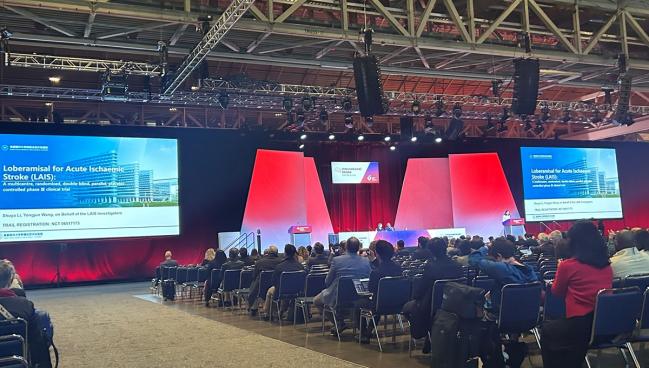
NEW ORLEANS, LA—Loberamisal, a novel neuroprotectant, improves functional outcomes among patients with acute ischemic stroke when given within 48 hours of symptom onset, the phase III LAIS trial shows.
At 90 days, the proportion of patients with an excellent functional outcome—modified Rankin Scale score 0-1—was 69.7% in patients receiving loberamisal and 56.4% in those receiving placebo (risk ratio 1.24; 95% CI 1.12-1.36), Shuya Li, MD (Beijing Tiantan Hospital, Capital Medical University, China), reported here at the International Stroke Conference (ISC).
There were no differences in safety outcomes between groups.
“These findings support further investigation for loberamisal as a novel neuroprotective therapy for acute ischemic stroke,” Li said.
Reacting to the findings, Bijoy Menon, MBBS, MD (University of Calgary, Canada), vice chair of ISC 2026, told TCTMD, “I’m really excited. There’s been no large neuroprotectant trials that have been positive.”
Prior trials, including ESCAPE-NA1, in which Menon took part, have tested single-target neuroprotectant agents administered earlier after stroke onset. Loberamisal, on the other hand, works on two targets—it inhibits post-synaptic density protein 95 and acts on the α2-GABA receptor pathways, thereby reducing neuronal excitability and neuroinflammation and reducing depression and anxiety.
“We think neuroprotection trials fail because we don’t have the right models, but maybe it’s the right targets and maybe it’s dual targets or triple targets, like in oncology,” Menon said.
But he pointed out a conceptual difference between loberamisal and other neuroprotectants that have failed in clinical trials. Loberamisal was given up to 48 hours after stroke onset in patients who mostly did not receive acute treatments, whereas others—including nerinetide in ESCAPE-NA1—have been administered earlier on in patients undergoing endovascular therapy.
Loberamisal “is a drug that has been given in stroke patients who many of them are not candidates for these treatments or turned up late,” Menon said. “This is in that spectrum of neuroprotection/neurorecovery. So that’s how potentially this drug is working, which is a great thing because I’ve always felt like these drugs might actually work across the continuum.”
The LAIS Trial
Though reperfusion therapy—ie, IV thrombolysis and endovascular thrombectomy—remains the foundation of treatment for acute ischemic stroke, many patients may not be eligible for or have access to these interventions. Neuroprotectants have been studied as a means to improve outcomes further, but the field has seen a string of failed clinical trials.
Loberamisal (NeuroDawn Pharmaceutical) has mechanisms of action that are geared toward both mitigating ischemic brain injury and addressing mood disorders that commonly afflict stroke survivors. In a phase II dose-finding trial, the agent was well tolerated and showed some signs of efficacy in patients with acute ischemic stroke.
LAIS, conducted at 32 sites in China, was designed to further assess the efficacy and safety of loberamisal. Investigators randomized 997 patients (median age 63 years; 66% men) with acute ischemic stroke presenting within 48 hours of symptom onset to loberamisal 40 mg administered as 1-hour IV infusion once daily, or to placebo for 10 days. Patients who received or were scheduled to undergo endovascular thrombectomy were excluded.
The median NIHSS score at baseline was 8, and the median time from symptom onset to treatment initiation was 25 hours. Only 17% received thrombolytic therapy.
The improvement in functional outcomes obtained with loberamisal was consistent across subgroups. There were no differences between trial arms in the proportion of patients who had a change in NIHSS score of at least 4 points at either 10 or 30 days, or at day 90 in Barthel Index scores, which assess functions of daily living such as feeding, bathing, and dressing.
An exploratory analysis showed that loberamisal significantly reduced the percentage of patients with severe depression and moderate-to-severe anxiety at 90 days.
In terms of safety, there were no significant differences between groups, though loberamisal was associated with lower rates of serious adverse events (8.6% vs 10.7%) and all-cause mortality (1.2% vs 2.0%). There were no suspected unexpected serious adverse reactions in either group.
There’s been no large neuroprotectant trials that have been positive. Bijoy Menon
Lauren Sansing, MD (Yale School of Medicine, New Haven, CT), chair of meeting, said the results look “really promising,” adding that “we haven’t had a big win in the neuroprotectant space.”
The trial was relatively large, with nearly 1,000 patients, had a long treatment window, and showed substantial benefit for patients, she noted. “I’m excited about this one, and I think this hopefully will also rejuvenate the neuroprotection space and get more compounds going to . . . large global trials.”
Despite the availability of effective acute therapies for stroke, only a small proportion of patients actually get them, Sansing pointed out.
“Most stroke patients are still treated with secondary prevention and physical therapy, and [we] focus on recovery for them,” she said. “Having something to offer all patients that come in within 48 hours would be a game changer.”
Both Sansing and Menon said, however, that additional trials in broader populations around the world are needed to confirm the results.
“I’m hoping that now that we have this first proof-of-concept trial that they would like to do a larger study across diverse populations, and maybe also understand niches,” Menon said, adding that there is an open question about the impact of earlier administration of loberamisal.
“I think there’s still more to learn, but it opens up an avenue that we have not had as yet with positive signals,” Menon said.

Todd Neale is the Associate News Editor for TCTMD and a Senior Medical Journalist. He got his start in journalism at …
Read Full BioSources
Li S. Loberamisal for acute ischaemic stroke (LAIS): a multicentre, randomized, double-blind, parallel, placebo-controlled phase III clinical trial. Presented at: ISC 2026. February 6, 2026. New Orleans, LA.
Disclosures
- The trial was funded by NeuroDawn Pharmaceutical.
- Li reports no relevant conflicts of interest.
Related News

Comments