More Data on Tricuspid Valve Interventions Reassure, yet Questions Remain
The real-world Evoque and new TRILUMINATE findings provide an “extension” from the pivotal trials, Dharam Kumbhani says.

SAN FRANCISCO, CA—Proponents of transcatheter tricuspid valve interventions for severe tricuspid regurgitation (TR) are reassured by new real-world and extended trial data presented here today at TCT 2025, but only longer-term follow-up will truly answer questions around safety and efficacy, they say.
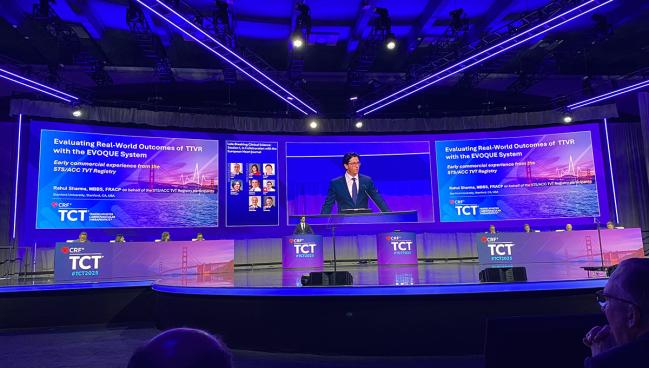
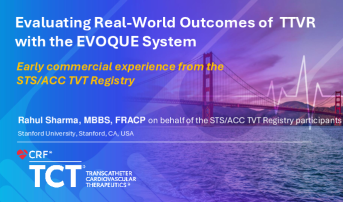
During a late breaking clinical science session, Rahul Sharma, MBBS (Stanford University, Palo Alto, CA), presented data on Evoque from the STS/ACC TVT Registry showing a 30-day all-cause mortality rate of 3.1% among more than 1,000 patients—major bleeding and new pacemaker rates were 1.3% and 14.9%, respectively.
“The first US real-world experience confirms the clinical and quality-of-life benefits of the Evoque system across a broad patient population treated at multiple centers,” he said.
Similarly, Jonathan G. Schwartz, MD (Sanger Heart and Vascular Institute – Atrium Health, Charlotte, NC), presented 30-day data from more than 800 patients enrolled in the TRILUMINATE pivotal trial and continued access study showing an all-cause mortality rate of 0.5%. Here, major bleeding occurred in 3% and new pacemakers were required in 0.2%.
There’s been no shortage of debate around the benefits of tricuspid transcatheter edge-to-edge repair (T-TEER) with the TriClip device (Abbott) and transcatheter tricuspid valve replacement (TTVR) with the Evoque device (Edwards Lifesciences), which were approved by the US Food and Drug Administration in 2024 based on the results of the TRILUMINATE Pivotal and TRISCEND II trials respectively. Each intervention has an effect on health status, but neither has yet been shown to reduce the risk of harder clinical endpoints, such as hospitalizations for heart failure and mortality.
This has led some to question their widespread use in clinical practice.
Still, he continued, long-term data are needed and will “would really drive how things pan out in the long run. But I think where we are right now in the landscape of things, these are both very innovative and [provide] a lot of reassurance.”
The new results presented here at TCT represent an improvement from the experience in the initial trials where cardiovascular mortality at 30 days was 3.2% in TRISCEND II and 0.6% in TRILUMINATE.
STS/ACC TVT Registry Results
The Evoque data set included 1,034 patients (mean age 77.1 years; 69.1% female) who had an attempted implant with the device between February 2025 and March 2025. A similar proportion of patients had primary (41.2%) and secondary TR (43.2%), while 9.4% had pacemaker-induced TR and 6.1% had other etiologies. Almost half (48.4%) had been hospitalized for heart failure in the past year.
Median procedure time was 103 minutes, and device implant success was 98.4% with eight patients (0.8%) converted to surgery. Median hospital length of stay was 2 days, and most patients were discharged home (93.8%).
At 30 days, cardiovascular mortality (2.0%) accounted for most of the fatalities. The 1.3% rate of major or life-threatening bleeding was “pleasingly much lower” than what was observed in TRISCEND II, Sharma said.
“It’s also important to point out that the criteria for bleeding through the registry was much more stringent than the MVARC criteria,” he noted. “So, in addition to these being numerically lower than what we saw in TRISCEND II, this is a more inclusive definition. I think those results are even better than what the numbers suggest.”
Sharma said device embolization and migration were “exceedingly rare,” each occurring in less than 1% of the population.
Researchers observed a significant improvement in TR reduction, with 97.7% of patients having mild or lower TR by 30 days. They also saw improved positive RV remodeling from baseline as shown by an improvement in end-diastolic mid RV diameter (3.9 vs 3.6 cm; P = 0.003) and RV systolic pressure (41.1 vs 33.8 mm Hg; P < 0.001). The study was limited by missing and site-reported echocardiographic data, Sharma acknowledged.
NYHA functional class and KCCQ scores improved in patients from baseline to 30 days (P < 0.001 for both). Also, there were no differences in outcomes between patients with (n = 349) and without pacemakers (n = 685) at baseline.
“This speaks to the generalizability of this technology across a broader population of patients, including those that have an existing pacemaker,” Sharma said.
Most patients were on diuretics both at baseline (83.9%) and at discharge (79.4%). Anticoagulation increased from baseline (68.1%) to discharge (94.2%) due to the Evoque protocol, which requires 6 months of treatment. Antiplatelets also increased from baseline (36.1%) to discharge (43.9%), and this was mostly driven by the addition of aspirin.
“The data were very pleasing and very reassuring,” Sharma told TCTMD. “This is early commercial experience, and . . . there was a learning curve even for those of us in the trial with this device.”
In that context, he continued, the pacemaker rates are on par with what has been observed following TAVI. “I think that really helps to benchmark that in terms of what’s acceptable, and so I think we were very pleased to see those pacemaker rates come down.” In the trial, Sharma said, it’s possible clinicians were “jumping the gun a little bit . . . to put pacemakers in these patients and we’ve now learned in which patients we can watch and wait and observe.”
David Cohen, MD (St. Francis Hospital & Heart Center, Roslyn, NY, and Cardiovascular Research Foundation, New York, NY), who moderated the press conference, asked about how many of these patients underwent “prehab” prior to their procedure to improve right ventricular function, often through aggressive inpatient diuresis, in the days leading up to their procedure.
“That’s highly variable [and] that’s site dependent, and so we don’t have that data,” Sharma said.
During the press conference, Azeem Latib, MD (Montefiore Medical Center, Bronx, NY), agreed that the new data are “very reassuring,” though he worries about underreporting, especially with regard to new pacemakers and bleeding. “But I do think it sets a new bar,” he said. “We were concerned about the price of valve replacement and the price of getting rid of all the TR. We may all need to start rethinking our algorithms about how we treat these patients.”
Additionally, Latib continued, more information is needed on thrombosis. “To me, that’s going to be the Achilles’ heel of valve replacement [and] figuring that out. And maybe we can fix it, but we need to know more about it,” he stressed.
TRILUMINATE Findings
The TRILUMINATE study included 847 patients with attempted TriClip implantation (mean age 79 years; 59% female)—285 patients from the device arm of the randomized trial, 200 patients from the single-arm trial, and 412 from the continued access study. Most (90%) had functional TR and 26% had been hospitalized for heart failure in the prior year.
Implant success was 98.7% and the mean number of clips used per patient was two. Most patients had anterior or septal leaflet clips. Mean procedure time was 146 minutes and the median length of hospital stay was 1 day.
Schwartz said the results were “very reassuring,” with 82% of patients having moderate or less TR at 30 days (P < 0.001). Additionally, KCCQ improved by 17 points over the same time frame (P < 0.001).
Major adverse events were minimal at a 30-day rate of 0.6%, including 0.4% cardiovascular mortality and 0.2% new-onset renal failure. Major bleeding was logged in 3.0%, and device embolization occurred in 0.1%. Single leaflet device attachment happened in 6.7%, and there were no instances of device thrombosis. The rate of heart failure hospitalization at 30 days was 3.0%.
Schwartz showed similarly positive findings among patients with transvalvular CIED leads that can complicate the procedure.
When patients were stratified by center case volume, procedural and safety outcomes improved with experience.
“This is the largest analysis of early T-TEER experience to date,” Schwartz said. “TriClip is very safe and effective with a significant improvement in quality of life at 30 days with very low rates of mortality, heart failure hospitalization, bleeding, conduction disturbances, or device thrombosis in 30 days. It’s also now been shown [that] it’s quite safe and effective in patients with electronic devices in place.”
As for how these data might affect the decision-making process between T-TEER and TTVR, it’s still unclear.
Schwartz said the protocol at his institution is to first screen for TriClip—which is a fit for between 75% and 80% of their population—and then move to Evoque if they aren’t candidates. The decision is also “largely driven by reimbursement.” The large “footprint” that MitraClip has across hospitals also has enabled a wider uptake of TriClip, he said. “It’s the same device essentially.”
Having access to quality imaging and dedicated structuralists can affect this conversation, according to Schwartz. “If you have the same two or three people that are always there for each case, you kind of learn together and you get into a routine and the same person doing the screening study is the one that’s in the procedure,” he said. When that’s not an option, “I think that may lead to more patients screen failing for [Tri]Clip.”
This is still the beginning, Schwartz emphasized. “We only have 30-day data. As this expands to more centers and we do more cases, then I think we’re going learn a lot more.”

Yael L. Maxwell is Senior Medical Journalist for TCTMD and Section Editor of TCTMD's Fellows Forum. She served as the inaugural…
Read Full BioSources
Sharma RP. Evaluating real-world outcomes of TTVR with the EVOQUE system. Presented at: TCT 2025. October 26, 2025. San Francisco, CA.
Schwartz JG. Lessons learned from 800+ patients treated with tricuspid TEER: the TRILUMINATE pivotal trial. Presented at: TCT 2025. October 26, 2025. San Francisco, CA.
Disclosures
- Sharma reports receiving consulting fees from Edwards Lifesciences.
- Schwartz reports receiving grant/research support from Abbott, Edwards Lifesciences, and W.L. Gore and consultant fees/honoraria from Abbott, AngioDynamics, Biosense Webster, Boston Scientific, Edwards Lifesciences, Medtronic, Philips, Siemens, and W.L. Gore.
- Kumbhani report no relevant conflicts of interest.
- Cohen reports receiving grant/research support from Abbott Vascular, Boston Scientific, Edwards Lifesciences, Corvia, Ancora, Philips, Therox, and Cathworks and consultant fees/honoraria from Abbott Vascular, Boston Scientific, Edwards Lifesciences, Medtronic, and Ancora.
- Latib reports receiving consultant fees/honoraria from Abbott, Boston Scientific, Edwards Lifesciences, Medtronic, Philips, Tioga, NeoChord, and Nyra and grant/research support from Concept Medical.
Related News

Comments