Multiarterial CABG Improves Survival Regardless of Strategy
The study supports “more is more” when it comes to arterial conduits until additional RCT data arrive, researcher says.

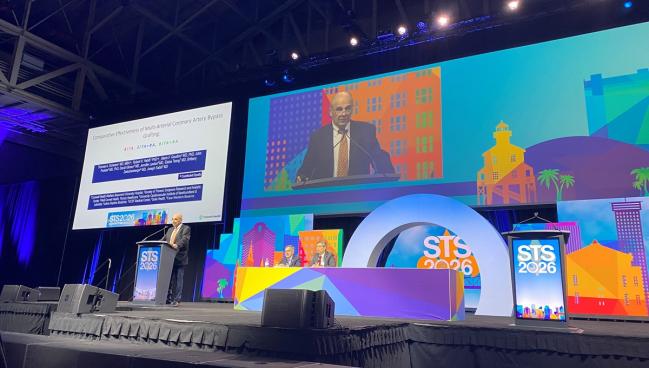
NEW ORLEANS, LA—Among patients with multivessel coronary artery disease receiving CABG surgery, researchers found comparable survival outcomes with either bilateral internal thoracic artery (BITA) grafting or single internal thoracic artery (SITA) plus radial artery grafting.
Moreover, adding an additional radial arterial conduit to BITA grafting is associated with up to a 12% survival benefit above that seen with BITA alone or SITA plus radial grafting over 15 years.
“What this reassures and encourages in surgeons is that if you are a BITA grafter, continue, if you’re a radial artery grafter, continue,” said Thomas Schwann, MD (Corewell Health East, Royal Oak, MI), who presented the findings on Saturday at the 2026 Society of Thoracic Surgeons (STS) Annual Meeting. “But the most optimal graft strategy is, I think, more is more—more arterial grafts are associated with better survival. And the more that we utilize those multiarterial grafts, whatever strategy or whatever configuration, clearly has an impact on long-term survival.”
Several studies have now shown the benefits of using multiple compared with single arterial grafts in current CABG practice, though this technique remains underused. Also, some debate has brewed among cardiac surgeons regarding the optimal type of multiarterial grafting, and research in this area is limited.
The new data should help bring the surgical community together, said Gianluca Torregrossa, MD (Main Line Health, Philadelphia, PA), who was in the audience. “We have observed over the last 5 years in the literature a form of contention between the radial and BITA, and . . . your beautiful presentation [shows] multiarterial bypass grafting is effectively beneficial for our patients,” he said in discussion following the presentation. “This is a kind, collaborative effort among cardiac surgeons.”
Strategy Comparisons
For the analysis, Schwann and colleagues looked at 172,007 patients undergoing isolated CABG with multiple arterial grafting from the STS Adult Cardiac Surgery Database between 2008 and 2023. All patients were linked with data from the National Death Index and/or Centers for Medicare and Medicaid Services.
Overall, 47.5% of the cohort received SITA plus radial grafting, 44.5% received BITA grafting, and 8.0% received BITA plus radial grafting. Throughout the study period, total multiple arterial grafting increased from about 10% to 16% of CABG cases, which was driven by an uptick in radial artery use particularly after 2017. Patients receiving BITA plus radial artery grafting were slightly younger than those in the BITA and SITA plus radial groups (59.3 vs 61.2 vs 61.8 years) and they were also more often male (88.4% vs 84.8% vs 83.7%).
BITA plus radial artery grafting involved generally longer surgical times and less on-pump CABG, but these metrics were comparable in the BITA and SITA plus radial arms. Rates of total arterial revascularization were 19.9% in the BITA group, 25.0% in the SITA plus radial grafting group, and 65.0% in the BITA plus radial group.
Perioperative outcomes were “uniformly excellent” across all three groups, Schwann reported. Operative mortality ranged from 0.9% to 1.1% among the cohorts, and deep sternal wound infection rates—though slightly higher in both BITA groups at 1.1% compared with 0.6% in the SITA plus radial arm—were low. Between 7.7% and 8.0% of patients were readmitted within 30 days, and mean postoperative length of stay ranged from 6.27 to 6.4 days.
Unadjusted rates of survival through 15 years were lowest in the BITA plus radial arm (log rank P < 0.001). In propensity-matched analyses comparing SITA plus radial to BITA alone, there was no difference in 15-year survival (adjusted HR 1.00; 95% CI 0.97-1.02); the findings were consistent in patients with either two- and three-vessel disease. Additionally, the SITA plus radial approach showed a benefit toward early survival, especially among patients 70 years and older, while BITA alone showed a late survival benefit, especially among patients younger than 60 years.
Comparing BITA with and without radial grafting, there was a clear advantage to adding the third conduit with regard to 15-year survival (adjusted HR 1.11; 95% CI 1.06-1.17), and this was most notable in younger patients within the first 5 years of surgery. Moreover, the same survival benefit was observed with radial grafting added to BITA compared with SITA (adjusted HR 1.12; 95% CI 1.07-1.18).
‘Moving in the Appropriate Direction’
The observational design is a limitation of the study, Schwann acknowledged, but “this is an important contribution in informing optimal graft selection as we await randomized data from the ROMA trial.”
While ROMA is randomizing patients to receive CABG with multiple or single arterial grafting, audience member Marc Ruel, MD (University of Ottawa, Canada), commented that the study likely won’t be able to provide robust data regarding specific arterial grafting strategies. “This is as good as it gets, and it will be for a very long time,” he said.
“Real data analysis reflecting real practice patterns across the nation is going to be important and should be able to guide optimal decision-making as we struggle as to what is the best strategy moving forward with patients with multivessel coronary disease,” Schwann said. “The journey has been long and kind of slow, but nevertheless, it is moving in the appropriate direction.”

Yael L. Maxwell is Senior Medical Journalist for TCTMD and Section Editor of TCTMD's Fellows Forum. She served as the inaugural…
Read Full BioSources
Schwann TA. Long-term comparative effectiveness of bilateral internal thoracic artery versus radial artery based multi-arterial bypass grafting. Presented at: STS 2026. January 31, 2026. New Orleans, LA.
Disclosures
- Schwann reports no relevant conflicts of interest.
Related News



Comments