New TAVI Explant Risk Model Reflects Growing Experience
Outcomes after the surgery are improving, but researchers caution that it remains risky.
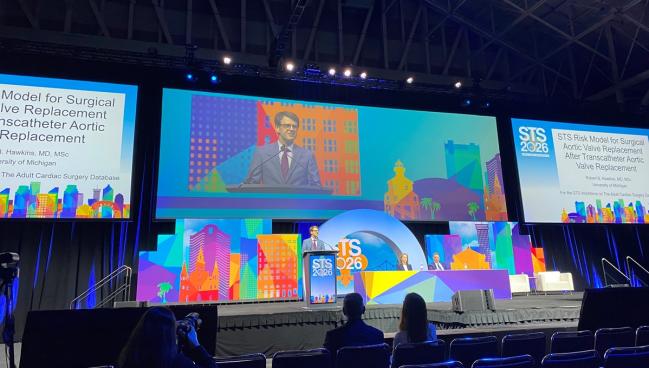
NEW ORLEANS, LA—A risk model based on data from the Society of Thoracic Surgeons (STS) Adult Cardiac Surgery Database (ACSD) can accurately predict an individual’s need for surgical explant following TAVI, according to a new analysis.
Outcomes with this fastest-growing cardiac surgery have improved over time, the findings show, though researchers say it remains riskier than first-time surgical AVR.
“TAVR explant volume is increasing exponentially, outcomes are improving dramatically, and a large portion of isolated SAVR after TAVR cases now qualify as low risk,” said Robert B. Hawkins, MD (University of Michigan, Ann Arbor), who presented the findings yesterday at the 2026 Society of Thoracic Surgeons (STS) Annual Meeting. “Concomitant procedures do add risk and can be addressed with reasonable outcomes. In summary, the new STS risk models for SAVR after TAVR applied to nearly all TAVR cases can provide accurate and important information for both heart teams and patients.”
Over the decade-long study period, the number of SAVR following TAVI cases increased twelvefold: from 104 in 2015 to 1,294 in 2024. Overall operative mortality was 14.4%, but the rate decreased by about 3% annually.
With recent data showing an uptick of TAVI cases performed in younger patients, the implications of these results are important when considering lifetime management of aortic valve disease, according to Hawkins.
“We need to work backwards from this risk model,” he said. “Insights we can take need to go back to the first decision—not the second valve decision, but the first valve decision. We can clearly see that concomitant pathologies are a real problem and represent high risk for TAVR explant. So we need to be very careful in our selection for TAVR for patients who might otherwise be well served in a surgery-first approach if you can address many of these other pathologies up front.”
To TCTMD, STS program chair Marc Pelletier, MD (Yale School of Medicine, New Haven, CT), said, “The data tells us that in general, it’s still a relatively high-risk procedure.” Outcomes with isolated SAVR after TAVI might be improving, but it’s not easy to predict when a simpler TAVI explant might turn into something more complex involving other concomitant procedures, he added.
The good news is “we’re getting better at something that we’re having to do more often,” Pelletier said. “On the bad side, it remains that there are still a lot of these patients that are sicker—often that’s partly the reason they got a TAVR in the first place for a lot of them—and there may be a lot that we have to do. And when you know you’re going have to do a lot of extra things, you should be expecting that it may be a higher-risk procedure.”
Model Development
To develop the risk-prediction model, the researchers looked at 5,708 TAVI explant cases (mean patient age 71 years; 39% female) performed across 697 US programs, including 40% that were isolated SAVR after TAVI. Of the remaining 60%, these included concomitant aortic (34%), mitral (21%), CABG (16%), and tricuspid (6%) procedures. Cases were evenly distributed according to acuity.
Operative mortality varied by complexity of the operation. It was lowest in isolated SAVR cases (8.2%) and highest in those who received concomitant root procedures (24.9%).
Among the 23% of cases that included patients who might have been candidates TAV-in-TAV procedures instead, mortality decreased by about 3.5% annually over the study period.
The risk model improved upon the prediction of prior STS models in this space, said Hawkins. In addition, it was well calibrated for both isolated SAVR and SAVR plus concomitant procedures as well as across a range of patient and procedural subgroups.
‘Opening Pandora’s Box?’
Gorav Ailawadi, MD (University of Michigan), who was in the audience, pondered how the data might be used by cardiologists, not just surgeons. “I think we’ve done a great job as a group, as a society to improve this pretty morbid operation through better techniques, better patient selection,” he said during a discussion after the presentation. “Do you envision this opening Pandora’s box further?”
Former STS President Thomas MacGillivray, MD (MedStar Washington Hospital Center, Washington, DC), said that while outcomes have been getting better, there’s still room for improvement.
“The concern is that with this information right now, how will it be used?” he said. “I dare say that with our structural cardiology colleagues, I don’t think they look at this data and say: ‘We shouldn’t be doing TAVR.’ What they’re saying, potentially, is: ‘We should be doing TAVR explants.’”
In addition to incorporating this risk model into early decision-making, potentially before TAVI, Hawkins also said there is still work to do to improve TAVI explanation outcomes. While the field has “done very well” for patients receiving isolated SAVR after TAVI, “we probably have room for improvement in terms of teaching each other and improving on our outcomes [for more] complex cases.”
Ailawadi suggested the possibility of linking the STS ACSD with the TVT Registry “to go back to the first decision and try to understand if that was the right decision.” Another member of the audience, Michael Bowdish, MD (Cedars-Sinai Medical Center, Los Angeles, CA), said that STS leadership “has been involved” in talks enabling linkage of the two large databases, but there’s no timeframe.
The “clarion call” from these data, MacGillivray believes, is for surgeons to continue improving TAVI explant to ensure even better outcomes going forward.
Hawkins agreed. “How this data is utilized is going to largely depend on your heart team and your relationship with your cardiologists,” he said.

Yael L. Maxwell is Senior Medical Journalist for TCTMD and Section Editor of TCTMD's Fellows Forum. She served as the inaugural…
Read Full BioSources
Hawkins RB. STS risk model for surgical aortic valve replacement after transcatheter aortic valve replacement. Presented at: STS 2026. January 29, 2026. New Orleans, LA.
Disclosures
- Hawkins reports no relevant conflicts of interest.
Related News

Comments