Night Float, Simulated: A Missing Piece of Cardiology Fellowship
One fellow felt CV training lacked a key element—practicing the chaos of a night on call—so he created a program from scratch.
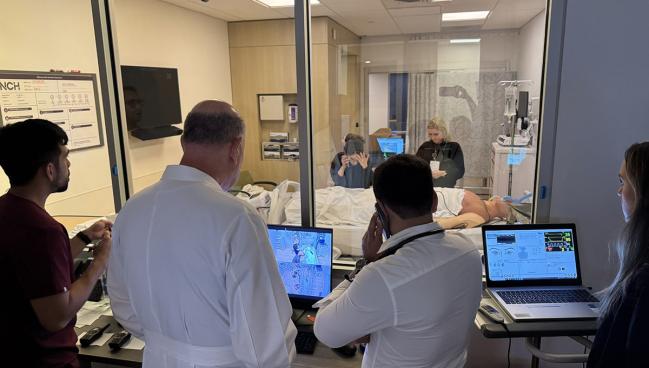
Photo credit: Daniel Hanna, MD
You’re barely a week into cardiology fellowship. It’s 2:17 AM. The pager goes off—again. One call is about a new-onset atrial fibrillation with rapid ventricular response. Another is someone wanting you to urgently assess a possible tamponade. Somewhere else, a post-CABG patient is hypotensive and the nurse can’t get ahold of anyone. And you still haven’t made it to the ED consult from an hour ago. You’re being pulled in four directions at once in a hospital you barely know, trying to figure out who to call, where to go, and what matters most.
You’re not just managing cases—you’re managing controlled chaos. You don’t know the culture yet. The building is a maze. You can’t remember which elevators to take. You have badge access to every room in the hospital—except the one with consistently decent coffee.
That was the kind of night I wanted to simulate for new fellows before they inevitably go through something similar.
Our “Night On Call” program, based at a state-of-the-art simulation center, is designed to prepare our six incoming cardiology fellows each year for the real-world demands of overnight call. We run sessions seasonally to reflect the natural rhythms of clinical volume—more intense during peak months and more reflective during the slower June to November period.
As a first-year fellow, I created this simulation not because I had all the answers, but because I was overwhelmed in those first few night shifts. There isn’t a handbook for navigating the clinical, logistical, and emotional weight of being the “fellow on call.” Because of that, I wanted to create a space where we can rehearse the chaos before lives are on the line.
It gave new fellows a taste of the culture by illustrating how attendings interact, how senior fellows can be a lifeline, and how we support each other when things get tough. Daniel Hanna
The idea came from my time as a medicine chief, where running simulation scenarios for the internal medicine residency was a regular part of the curriculum. It always struck me how effective those sessions were, not just for clinical knowledge, but for communication, confidence, and team dynamics.
When I transitioned to cardiology fellowship, I realized we didn’t have anything like that to prepare new fellows for the unique challenges of night float and I wondered why. We’re expected to make critical decisions early on, often without much guidance. There’s plenty of learning by doing, but not enough learning by rehearsing. So, I decided to build it myself.
‘Confidence Before the Real Pager Starts Buzzing’
I designed the simulation to mirror that experience: a pager going off, a few rapid-fire consults, and a mock attending rounding in real time. My program executed it for the first time earlier this month.
The feedback blew me away. Within minutes of wrapping up the sim, people were saying how real it felt—how helpful it was to practice communicating under pressure and to learn the preferred workflows of our hospital.
The best part? The attendings had just as much fun as the fellows. They weren’t simply observing but rather changing vital signs and clinical statuses in real time while the fellow was still in the room, simulating the unpredictability of a true night on call. Watching them push the fellows in a healthy, constructive way by throwing in curveballs and escalating the situation just enough to challenge them made for an incredibly dynamic learning environment. It turned into this rare moment where everyone, regardless of level, was fully engaged in the process of teaching and learning.
And it wasn’t just about the medicine. It gave new fellows a taste of the culture by illustrating how attendings interact, how senior fellows can be a lifeline, and how we support each other when things get tough. That kind of nuance that includes how to call a consult without sounding unsure and how to say “I don’t know” without losing credibility is hard to teach on rounds. But simulation gives you the space to try, stumble, and get better.
Having nurses present made the whole experience more authentic. These are the same people our fellows will call at night, coordinate with on the floors, and rely on during emergencies. Having them interact in this practice setting by figuring out how to communicate clearly, respectfully, and efficiently was just as valuable as managing the clinical scenarios. It’s one thing to read about “closed-loop communication” on a slide and another to practice it with a seasoned night nurse who’s seen it all. In the end, I think we hit on something that’s been missing in cardiology fellowship: a chance to ease into chaos instead of being thrown into it.
If you’re a senior fellow or attending reading this, I’d encourage you to think about what scared you most in those early days. Then build a sim around it. Because the goal isn’t to catch mistakes, it’s to build confidence before the real pager starts buzzing.
Hanna would like to add a note of thanks to all the cardiology attendings at his institution for their unwavering support, including Mazen Albaghdadi, MD; Luis Paz Rios, MD; and Michael Flynn, MD, as well as Viviana Navas, MD, his program director; Robert Cubeddu, MD, president of the Rooney Heart Institute; and Doug Harrington, DO, chair of the of NCH Judith and Marvin Herb Family Simulation Center.

Daniel Hanna, MD, is a first-year general cardiology fellow at NCH Rooney Heart Institute in Florida, where he also completed…
Read Full BioRelated News

Comments