Novel Cerebral Protection Device Matches Up Well With Sentinel in TAVI
The question remains: what will it take to prove that any protection device is having a meaningful impact on stroke risk?

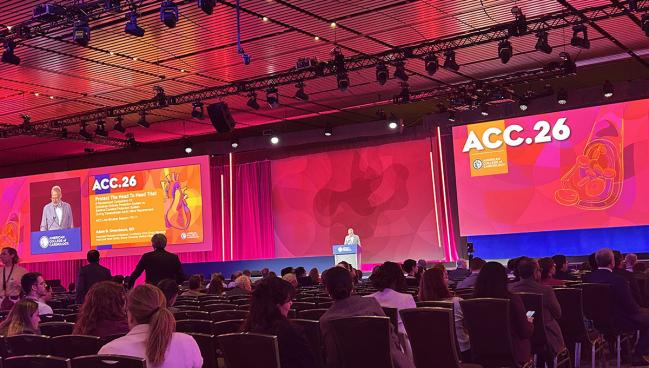
NEW ORLEANS, LA—The novel Emboliner protection device (Emboline) provides comparable results to those obtained with the Sentinel cerebral protection system (Boston Scientific) when used during transfemoral TAVI, the PROTECT H2H trial shows.
With higher technical and procedural success, as well as a greater amount of debris capture, the Emboliner provided noninferior results in terms of the rate of major adverse cardiovascular and cerebrovascular events at 30 days (4.5% vs 5.0%; P = 0.0004 for noninferiority), Adam Greenbaum, MD (Emory University Medical Center, Atlanta, GA), reported here at the American College of Cardiology 2026 Scientific Session.
Safety according to VARC-2 criteria was similar with the two devices, with a 30-day stroke rate of 2.0% in the Emboliner group and 2.1% in the Sentinel group (P = 0.0001 for noninferiority).
“Further studies with this device are planned for use in . . . procedures with higher embolic risks, such as valve-in-valve, bicuspids, [and] leaflet modification,” Greenbaum said.
Speaking with TCTMD, Anna Bortnick, MD, PhD (Montefiore Einstein, Bronx, NY), said the data showed that the Emboliner traps debris and can be deployed then removed safely and easily.
The Emboliner provides more comprehensive protection versus the Sentinel, with high procedural success, Bortnick said, noting, however, that the PROTECT H2H trial was conducted at experienced centers with seasoned operators. “If we take that technology and we disseminate it further in a bigger efficacy study, will the procedure success still be as high? Is it as easy to use in everybody’s hands? These are going to be questions that would be answered in a different study,” she commented.
And taking a step back, she added, “Does that give someone an advantage if they have that protection in the TAVR procedure?”
“A lot of operators, they just want to have anything, but we need to also think about cost and the amount of complexity that this adds,” Bortnick said, pointing out, too, that using the protection device itself could possibly create debris that will travel to the brain.
Researchers have been trying to answer the efficacy question for years, all while the use of embolic protection during TAVI has remained variable and hotly debated. Trials have not been able to prove that the devices reduce risk of stroke. In both the PROTECTED TAVR and BHF PROTECT-TAVI trials, which together randomized more than 10,000 patients, use of the Sentinel device failed to prevent strokes in the first few days after TAVI.
Despite the data, many operators continue to deploy embolic protection devices to avoid TAVI-related stroke, which Greenbaum described as “still the most feared complication” of the procedure. The concept makes sense—trap debris that would otherwise travel to the brain and avoid cerebrovascular problems.
“Any embolic debris is neutral at best. Likely harmful, right? So, it’s intuitive that if you could put a device in that is safe . . . then it should be beneficial. We just need to prove it,” Greenbaum said during a media briefing.
The PROTECT H2H IDE Trial
The US Food and Drug Administration-approved Sentinel device captures debris by covering two of the three major arteries that supply the cerebral vasculature. Emboliner, on the other hand, provides more complete coverage. The self-expanding, two-layer nitinol mesh device lies across the aortic arch to protect all three major vessels and also includes a basket in the descending aorta to intercept material flowing downstream. An access port allows for devices to move through the filter without the loss of embolic protection.
PROTECT H2H was an investigational device exemption (IDE) trial conducted at 11 sites in the United States, five in Germany, and two in Brazil. Investigators initially randomized 522 patients (mean age 79 years; 34% women) who were undergoing transfemoral TAVI to have either the Emboliner or Sentinel placed during the procedure. After exclusion of patients in whom device implantation was not attempted, mostly due to anatomic reasons, there were 485 patients for the modified intention-to-treat population.
Patient characteristics indicated a relatively typical TAVI cohort, with atrial fibrillation in about one-quarter and a history of stroke in about 10%. A mean STS score of about 3.5% reflected an intermediate-risk cohort.
Most patients (71%) underwent TAVI with a balloon-expandable prosthesis, with the rest treated with self-expanding devices. Though total TAVI time was significantly longer in the Emboliner arm (median 72 vs 59 minutes; P = 0.001), Greenbaum said there was “not really much difference in terms of procedural/technical details.”
The primary safety and efficacy endpoint was 30-day MACCE (all-cause death, stroke, or stage 3 acute kidney injury). Event rates were low and similar in the two groups. There were five deaths and five strokes in each group, along with one case of acute injury in the Emboliner arm and three in the Sentinel arm.
There were no significant differences in life-threatening or major bleeding complications or vascular complications between the Emboliner and Sentinel groups.
The investigators dug into the stroke results, and although there were no significant differences between devices, within the first 24 hours after TAVI there was only one stroke in the Emboliner arm and four in the Sentinel arm. “That’s something that at least intrigues me,” Greenbaum said.
Among patients who had the assigned protection device placed during the procedure, the Emboliner captured higher numbers of particles ≥ 150 µm in size (median 93 vs 31) and total particles (median 1,575 vs 801 P < 0.0001 for both).
The rate of technical success, defined as having both baskets of the Sentinel device expanded or three-vessel coverage with the Emboliner without a serious adverse event attributed to the device, was higher in the Emboliner group (95.9% vs 87.1%; P = 0.0005), as was procedural success defined by a technically successful result plus a lack of MACCE tied to the device at 72 hours (93.8% vs 85.1%; P = 0.0018).
Those differences were observed despite the fact that “none of us really had any experience with Emboliner, whereas we all knew how to put in Sentinel,” Greenbaum said.
Seeking Proof of Stroke Protection
There is no question that embolic protection devices are trapping debris during TAVI procedures, but there are no randomized, controlled data showing that they reduce strokes.
The problem, Bortnick told TCTMD, is that there are multiple etiologies of stroke. Some events might be caused by a shower of material related to TAVI itself, to late embolization of material originating from the implanted valve, and some might be caused by clots related to atrial fibrillation. Not all of those issues can be addressed by using a protection device during the TAVI procedure.
Even so, “we often will use Sentinel because we also have this same desire to avoid stroke in any way we can,” Bortnick said.
She acknowledged, however, that “the data hasn’t been strongly in favor. We just don’t have anything else. But now we have this new tool, and we’re going to see moving forward whether it performs better and that will really help us understand is it a device design issue or are we just not putting our finger on exactly what the stroke etiology is, and maybe it’s one of these other mechanisms that’s more important.”
There’s also a challenge with selecting the right endpoint for trials, Greenbaum said, indicating that after the first day or two, it’s difficult to attribute strokes to the procedure because other things are going on with the patients that could be causing the events. “These devices are designed to protect events during the event,” he said. “The problem is if you go to a 24-hour endpoint, then you just have a lower event rate. You need a much larger population. But I think with the right endpoint, I do think these devices would show benefit in terms of stroke.”

Todd Neale is the Associate News Editor for TCTMD and a Senior Medical Journalist. He got his start in journalism at …
Read Full BioSources
Greenbaum AB. Protect the Head to Head Trial: a randomized comparison of Emboliner embolic protection system vs Sentinel cerebral embolic protection system during transcatheter aortic valve replacement. Presented at: ACC 2026. March 29, 2026. New Orleans, LA.
Disclosures
- The trial was funded by Emboline.
- Greenbaum reports receiving consulting fees/honoraria from Edwards Lifesciences, Medtronic, and Transmural Systems; having an ownership/partnership/principal interest in Transmural Systems; and serving on a speakers’ bureau for Abbott.
Related News


Comments