NT-proBNP Provides Info on Who Will Fare Well After Tricuspid TEER
Patients already had high NT-proBNP levels at baseline, though, raising questions about the quality of GDMT, Nancy Sweitzer says.

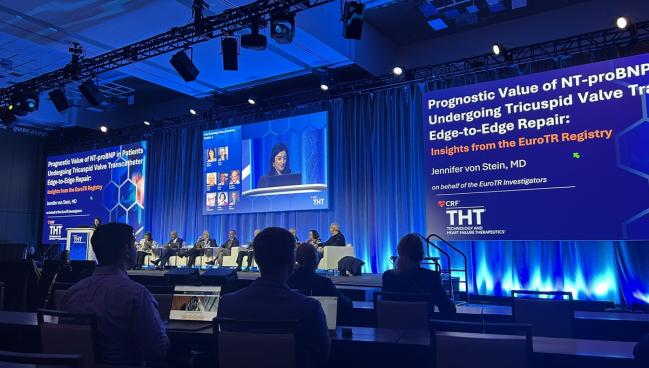
BOSTON, MA—Baseline levels of NT-proBNP, as well as early changes in levels of the biomarker, provide prognostic information among patients with severe tricuspid regurgitation (TR) undergoing transcatheter edge-to-edge repair (TEER), according to an analysis of the EuroTR registry.
Higher initial levels and greater increases within the first 30 days after the procedure are independently associated with a heightened risk of a composite of all-cause mortality or a first heart failure (HF) hospitalization at 2 years, Jennifer von Stein, MD (University of Cologne, Germany, and Cardiovascular Research Foundation, New York, NY), reported here at THT 2026.
Referring to baseline NT-proBNP values and early changes, von Stein said that “integrating both measures may offer a simple and clinically applicable risk-stratification tool.”
However, Nancy Sweitzer, MD, PhD (WashU Medicine, St. Louis, MO), who commented on the results for TCTMD, questioned why NT-proBNP levels—the median at baseline was 2,415.0 pg/mL—were so high. “It makes me wonder how aggressively they had been initiated on really good GDMT [guideline-directed medical therapy] prior to T-TEER,” said Sweitzer.
“I’m not sure those were optimally managed patients,” she continued, noting that a similar phenomenon was seen in the MITRA-FR trial evaluating use of the MitraClip (Abbott) in patients with functional mitral regurgitation. “The patients going for those MitraClips weren’t optimally managed and the outcomes weren’t very good.”
In the United States, many patients who are being referred for T-TEER are not on optimal doses of GDMT, Sweitzer indicated.
“I get these patients referred in for tricuspid valve [intervention], and the problem has nothing to do with the tricuspid valve. The heart failure is completely untreated. And [GDMT is] the intervention that should occur,” she said.
In the current study, 93.3% of patients were on a loop diuretic, 57.4% a renin-angiotensin-system inhibitor, 84.7% a beta-blocker, 43.9% a mineralocorticoid receptor antagonist, and 26.0% a sodium-glucose cotransporter 2 inhibitor.
The findings were published simultaneously online in JACC: Cardiovascular Interventions.
The EuroTR Registry
Prior studies, including results from the TRILUMINATE pivotal trial, have indicated that T-TEER improves symptoms, and 2-year follow-up data have suggested that it also reduces HF hospitalizations, in patients with symptomatic severe TR. However, “outcomes still remain heterogeneous, with a [nonnegligible] percentage of patients still suffering from symptoms and repeat heart failure hospitalizations after T-TEER, highlighting the need for improved risk stratification,” von Stein said.
In the current study, she and her colleagues evaluated whether NT-proBNP, which has well-established relationships with prognosis in patients with HF, as well as those with aortic stenosis and mitral regurgitation, could also provide important prognostic information in patients undergoing an intervention for TR.
The EuroTR registry collects data from 30 European centers on patients undergoing a transcatheter intervention for tricuspid disease. The researchers’ analysis included 2,282 patients (median age 80 years; 54% women) who had NT-proBNP levels available.
Patients were divided into tertiles based on NT-proBNP levels: ≤ 1,674, 1,675-3,743, and > 3,743 pg/mL. Those in the higher tertiles tended to have more comorbidities, more advanced biventricular remodeling, more severe TR, and worse LVEF, along with higher rates of prior HF hospitalization and NYHA class III/IV symptoms.
T-TEER was associated with improvement in NYHA functional class, although patients in the highest NT-proBNP tertile were less likely to have at least a one-class improvement (adjusted OR per log10 increase 0.63; 95% CI 0.48-0.84). They were also less likely to achieve residual TR grade ≤ 2+ after the procedure (81.4% vs 86.3% and 82.9% in the bottom two tertiles; P = 0.04).
An increase in baseline log10-transformed NT-proBNP was associated in a continuous fashion with a greater risk of the composite of all-cause mortality or a first HF hospitalization at 2 years (adjusted HR 1.62; 95% CI 1.29-2.04).
In the first 30 days after the procedure, the median NT-proBNP level increased modestly overall from 2,380 to 2,641 pg/mL, with increases observed in the bottom two tertiles and a decline seen in the patients with the highest baseline levels, “a pattern that suggested a strong baseline dependency and also partial regression to the mean effects,” von Stein said.
The degree of TR reduction was not associated with the change in NT-proBNP early after T-TEER.
Von Stein et al also performed a landmark analysis that included patients who were free from events at 40 days and had NT-proBNP measurements at both baseline and 30 days. In these 668 patients, increases in both baseline NT-proBNP and the early trajectory of NT-proBNP remained independently associated with a higher risk of mortality or HF hospitalization at follow-up.
Based on this information, the researchers developed a simple risk-stratification scheme to aid in assessing prognosis:
- Low-risk (low baseline NT-proBNP plus ≤ 30% increase)
- Intermediate-risk (high baseline NT-proBNP or > 30% increase)
- High-risk (high baseline NT-proBNP plus > 30% increase)
The event-free survival rates were 36%, 59%, and 76% in the high-, intermediate-, and low-risk groups, respectively (log-rank P <0.001).
In a discussion after the presentation, one panelist questioned the utility of knowing the relationship between early changes in NT-proBNP after T-TEER and later clinical outcomes since the information cannot be used to select patients for the procedure initially.
Von Stein noted that patients are routinely followed up at 30 days. Knowing their level of risk based on baseline NT-proBNP and the early trajectory at that point may spur closer follow-up or referral to HF clinics for optimization of GDMT as well as reassessments of LV and RV function and the procedural results, she said.

Todd Neale is the Associate News Editor for TCTMD and a Senior Medical Journalist. He got his start in journalism at …
Read Full BioSources
Von Stein J, von Stein P, Kresoja K-P, et al. Prognostic value of NT-proBNP in patients undergoing tricuspid valve transcatheter edge-to-edge repair: the EuroTR registry. JACC Cardiovasc Interv. 2026;Epub ahead of print.
Disclosures
- Data collection for the Hamburg patients in the registry was supported by a grant from the German Heart Foundation.
- Von Stein reports lecture honoraria from Edwards Lifesciences.
- Sweitzer reports no relevant conflicts of interest.
Related News



Comments