OCEANIC-STROKE: Asundexian Prevents Recurrent Strokes, With No Added Bleeding
The “truly groundbreaking” results expand the tool kit for secondary stroke prevention, one expert says.

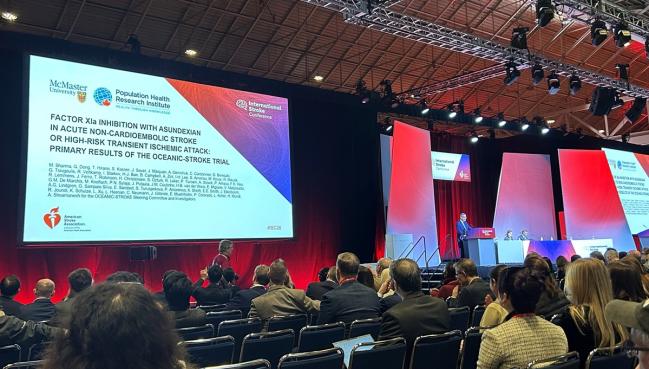
NEW ORLEANS, LA—Adding the factor XIa inhibitor asundexian (Bayer) to antiplatelet therapy tops antiplatelet therapy alone for preventing ischemic strokes in patients with acute noncardioembolic stroke or high-risk TIA without increasing bleeding, full results of the OCEANIC-STROKE trial show.
Through 2 years of follow-up, the rate of ischemic stroke was 6.2% among those who received the novel oral anticoagulant and 8.4% among those who received placebo (cause-specific HR 0.74; 95% CI 0.65-0.84). The absolute risk reduction was 1.9% by 1 year, equating to a number needed to treat of 53.
“The curves diverged early, and that divergence continued throughout the treatment period,” noted Mike Sharma, MD (McMaster University and Population Health Research Institute, Hamilton, Canada), who reported the results here at the International Stroke Conference.
On the other hand, the occurrence of ISTH major bleeding, the primary safety outcome, was no different between trial arms.
Sharma said “this ability to uncouple hemostasis from thrombosis” is what makes factor XIa an attractive drug target.
Richa Sharma, MD (Yale School of Medicine, New Haven, CT), who was not involved in the study, told TCTMD the trial is “very groundbreaking for us clinicians who take care of stroke patients because it expands our armamentarium of secondary stroke prevention tools that we can offer our patients as an adjunctive therapy without incurring the competing risk of hemorrhage.”
The ability to reduce recurrent strokes, she added, “is so meaningful, because then we ensure that our patients are living longer, disability-free lives after their initial stroke.”
The OCEANIC-STROKE Trial
The design of OCEAN-STROKE was informed by the multiple phase II studies showing that asundexian provided more than 90% inhibition of factor XIa at peak and trough concentrations without increasing major bleeding when compared with placebo, with or without background antiplatelet therapy.
OCEAN-STROKE was a phase III trial conducted at 702 sites across 37 countries and regions. Investigators enrolled 12,237 patients (mean age 68 years; 34% women) with acute noncardioembolic stroke (with an NIHSS score of 15 or less) or high-risk TIA (ABCD2 score of 6 or 7) who had a history of atherosclerosis or evidence of plaque or nonlacunar stroke on imaging. All participants were planned for either single (37%) or dual antiplatelet therapy (63%). Patients with a history of atrial fibrillation (AF) or another cardioembolic source of stroke requiring anticoagulation were excluded.
The index event was an ischemic stroke in 95% of patients; 27.4% of the cohort underwent IV thrombolysis and/or endovascular thrombectomy for acute treatment. The most common TOAST stroke subtype was large-artery atherosclerosis (41%), followed by stroke of undetermined etiology (29%) and small-vessel occlusion (22%). More than one-fifth of patients (22%) had a prior stroke/TIA. Median NIHSS score at baseline was 2, with 30% of patients having a score greater than 3.
The curves diverged early, and that divergence continued throughout the treatment period. Mike Sharma
Investigators randomized patients within 72 hours of symptom onset to asundexian 50 mg once daily or placebo. The reduction in ischemic stroke observed with active treatment was consistent across various subgroups.
Asundexian also reduced several secondary outcomes, including all strokes (6.6% vs 8.8%; HR 0.74; 95% CI 0.65-0.84), disabling/fatal stroke (2.1% vs 3.0%; HR 0.69; 95% CI 0.55-0.87), cardiovascular death, MI, or stroke (9.2% vs 11.1%; HR 0.83; 95% CI 0.74-0.92), and all-cause mortality, MI, or stroke (10.5% vs 12.3%; HR 0.85; 95% CI 0.77-0.95).
There was no significant difference between the asundexian and placebo groups in the rate of ISTH major bleeding (1.9% vs 1.7%; cause-specific HR 1.10; 95% CI 0.85-1.44) or any other safety events, including ISTH major or clinically relevant nonmajor (CRNM) bleeding, CRNM bleeding, symptomatic intracranial hemorrhage, hemorrhagic stroke, fatal bleeding, or minor bleeding.
Richa Sharma highlighted some issues to consider when thinking about where asundexian might fit if it’s ultimately approved by the US Food and Drug Administration. For instance, there is a lack of information on the durability of treatment over the longer term and on whether patients will have to remain on asundexian for life.
The cost of new medications and affordability are always concerns as well, she noted.
And finally, it will be important to “pick the right patient population for whom this would be a safe drug,” she said, citing key exclusion criteria from the trial like end-stage renal disease requiring dialysis and a history of AF. “We would not prescribe this for our secondary stroke prevention population in whom A-fib is detected.”
Overall, Richa Sharma expressed excitement about the potential opportunity presented by asundexian.
“We are often struggling with wanting to continue antiplatelet therapy longer than what’s been written in the guidelines and tested thus far. Usually we limit it to up to 3 months in patients with stroke because of intracranial atherosclerosis or 21 to 30 days with a minor stroke,” she explained. “This gives us an option to be able to provide a second [antithrombotic] therapy longitudinally without incurring the risk of bleeding. And I think that is something that has been a gap in our clinical tool kit.”

Todd Neale is the Associate News Editor for TCTMD and a Senior Medical Journalist. He got his start in journalism at …
Read Full BioSources
Sharma M. Factor XIa inhibition with asundexian in acute non-cardioembolic stroke or high-risk transient ischemic attack: primary results of the OCEANIC-STROKE trial. Presented at: ISC 2026. February 5, 2026. New Orleans, LA.
Disclosures
- Bayer AG sponsored the study and provided funding for editorial support.
- Sharma reports consulting for Bayer, Regeneron, and Anthos; receiving research funding for OCEANIC-STROKE from Bayer paid to his institution; receiving research funding from BMS and Janssen; and serving on an endpoint review committee for AtriCure.
Related News



Comments