OPTION: IV Tenecteplase Boosts Outcomes Late After Non-LVO Stroke
Although additional trials in more diverse populations are needed, the results are promising, experts say.

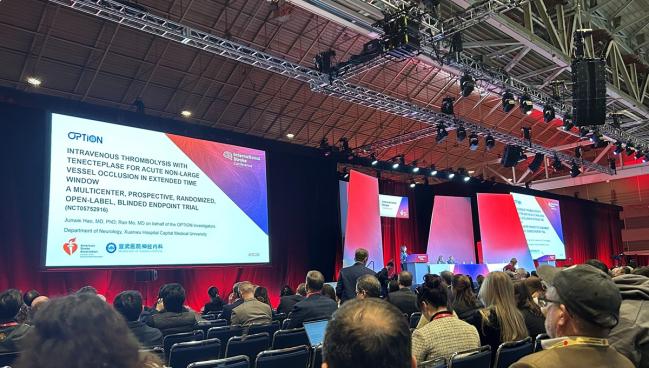
NEW ORLEANS, LA—Intravenous tenecteplase (TNKase; Genentech) improves functional outcomes versus standard care when administered 4.5 to 24 hours after onset of an acute ischemic stroke not caused by a large-vessel occlusion (LVO), according to the results of the randomized OPTION trial.
The proportion of patients achieving an excellent functional outcome—modified Rankin Scale score 0-1—at 90 days was 43.6% in the tenecteplase arm and 34.2% in the control arm (adjusted risk ratio 1.32; 95% CI 1.08-1.61), Ran Mo, MD (Xuanwu Hospital, Capital Medical University, Beijing, China), reported here at the International Stroke Conference (ISC).
That benefit came at the cost of a higher rate of symptomatic intracranial hemorrhage within 36 hours (2.8% vs 0; P = 0.004), but as a whole the results “support extending the thrombolysis time window in this patient population,” Mo said.
The findings were published simultaneously online in JAMA,
Lauren Sansing, MD (Yale School of Medicine, New Haven, CT), chair of ISC 2026, told TCTMD that the types of patients included in this trial have not typically been treated with tenecteplase, so this represents a promising option for them.
Bijoy Menon, MBBS, MD (University of Calgary, Canada), vice chair of the meeting, added that the “clearly positive” trial will be “one more step in our effort to actually change guidelines and practice.”
The caveat, however, is that the trial included only Asian patients, he commented to TCTMD, calling for additional trials to understand the risks and benefits in more diverse populations around the world. “But I feel quite positive that this is going to push the envelope further in us treating these patients up until 24 hours when there’s no other option—if thrombectomy is not available,” said Menon.
In both early and late time windows, endovascular thrombectomy is the go-to treatment for eligible patients with LVO strokes, but the procedure is not always possible. The TRACE-III trial showed that in patients with LVOs presenting from 4.5 to 24 hours after stroke onset who were not able to undergo endovascular treatment, administration of IV tenecteplase improved functional outcomes.
More than half of acute ischemic strokes, however, are caused by non-LVOs. In this population, IV thrombolysis has been shown to be beneficial within the first 4.5 hours after symptom onset, with uncertainty about the risks and benefits in later time windows.
The OPTION trial, conducted at 48 centers in China, examined the impact of tenecteplase among patients with acute non-LVO strokes presenting 4.5 to 24 hours after stroke onset who had salvageable brain tissue identified on CT perfusion imaging. Eligible participants had a disabling stroke (NIHSS score 6-25 or NIHSS score 4-5 plus a disabling deficit) and no plan to undergo endovascular treatment.
Investigators randomized 566 patients (median age 68 years; 34.6% women) to IV tenecteplase 0.25 mg/kg (maximum dose 25 mg) or standard medical treatment, which included antiplatelet therapy. The median NIHSS score at baseline was 7, and patients were randomized a median of 12 hours from when they were last seen well.
Patients treated with IV tenecteplase were significantly more likely to achieve an excellent functional outcome at 90 days, with similar results across subgroups. Reperfusion at 24 hours (37.7% vs 28.8%; P = 0.03) and an early clinical response at 24 hours (11.4% vs 5.0%; P = 0.007) also were better with tenecteplase.
Though all cases of symptomatic intracranial hemorrhage occurred in the tenecteplase group, there were no significant differences between the treatment and control arms in mortality (5.0% vs 3.2%; P = 0.28) or moderate or severe systemic bleeding (0.7% in both groups; P = 0.99) at 90 days.
The investigators note that symptomatic intracranial hemorrhage occurred in two of the 21 patients who had CT hypodensities larger than the core defined by perfusion imaging. “Careful evaluation of noncontrast CT hypodensity is advisable, especially when considering the late-window thrombolytic therapy,” Mo said.
Menon said that degree of functional improvement observed in OPTION is enough to justify the increase in the rate of symptomatic intracranial hemorrhage, which was quite low.
“Overall, I just feel that trial result seems to suggest that there is value in giving thrombolysis,” he said, reiterating the need for additional evidence.

Todd Neale is the Associate News Editor for TCTMD and a Senior Medical Journalist. He got his start in journalism at …
Read Full BioSources
Ma G, Mo R, Zuo Y, et al. Tenecteplase for acute non-large vessel occlusion 4.5 to 24 hours after ischemic stroke: the OPTION randomized clinical trial. JAMA. 2026;Epub ahead of print.
Disclosures
- OPTION was sponsored by Xuanwu Hospital, Capital Medical University, and supported by the Beijing Hospitals Authority Clinical Medicine Development of special funding support and the China Shijiazhuang Pharmaceutical Company (CSPC) Recomgen Pharmaceutical (Guangzhou) Co LTD, which also provided the study drug.
- Mo reports no relevant conflicts of interest.
Related News



Comments