ORBITA-CTO: PCI Reduces Angina Symptoms in Sham-Controlled Trial
In carefully selected patients with CTOs, symptom-driven PCI does provide a benefit when done by experienced operators.

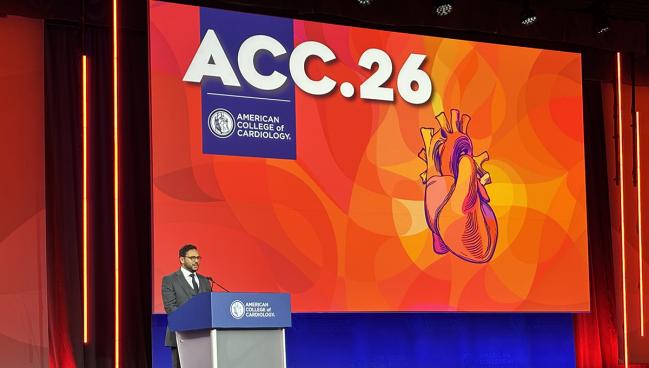
NEW ORLEANS, LA—Treating patients with chronic total occlusions (CTOs) with PCI significantly reduces angina symptoms, according to the results of the first placebo-controlled trial in this population.
Compared with patients who underwent a sham procedure, those with a single-vessel CTO who underwent revascularization had a significantly improved angina symptom score and a reduction in angina frequency, reported the ORBITA-CTO investigators today at the American College of Cardiology 2026 Scientific Session.
John Davies, MBBS, PhD (Essex Cardiothoracic Centre/Mid and South Essex NHS Foundation Trust, England), the study’s senior author, said the findings “separate the placebo effect from the true treatment effect” in patients with CTOs.
“It proves that CTO PCI improves angina symptoms, which is immediate, sustained, and consistent,” he added. “This supports symptom-driven PCI in carefully selected patients, through the heart team selection, in centers with specialist CTO operators.”
Speaking during the late-breaking clinical trial session, J. Dawn Abbott, MD (Brown University Health, Providence, RI), said that roughly 20% of patients undergoing angiography have a CTO and only a minority receive CTO PCI. Lower success rates, high complications, and a lack of data showing benefit are all factors, but there have been new techniques, technology, and training for CTO procedures over the past few years.
However, “until today, we still had the unanswered question of what is the true placebo-adjusted benefit of CTO PCI,” Abbott said.
If we want to know whether CTO PCI truly works, we must also test it under blinded conditions. Sarosh Khan
Sergio Waxman, MD (RWJ Barnabas Health, Newark, NJ), who wasn’t involved in the study, said the small trial adds to the existing body of evidence supporting CTO PCI for angina relief, but cautioned that ORBITA-CTO enrolled a very selective population.
“These are patients with just a single-vessel CTO and no other significant coronary artery disease,” he told TCTMD. “The trial was very well conducted, obviously, just an incredible design, and they were meticulous in trying to adjust for all different confounding variables. My only comment would be the generalizability of the results. It’s also a very selected group of operators as well.”
He said that CTO PCI should still be reserved for centers of excellence with dedicated CTO operators. “I don’t know that it’s quite ready for prime time for everybody,” he said. “Having said that, I think the results are encouraging for some patients in terms of symptomatic relief.”
Sarosh Khan, MBBS (Essex Cardiothoracic Centre/Mid and South Essex NHS Foundation Trust), who led the trial, also noted that these were very experienced operators, with the two treating physicians performing at least 200 CTOs each year.
ORBITA-CTO
Most available evidence backing revascularization of CTO lesions is from observational and open-label trials, “where the placebo effects may contribute to symptom improvement,” Khan said.
In the 2021 US guidelines for coronary artery revascularization, PCI for CTOs in patients with refractory angina on medical therapy has a relatively weak recommendation (class 2b, level of evidence B), a reflection of the uncertainty around symptom relief with the procedure.
“The original ORBITA trial fundamentally changed how we interpret symptom outcomes after conventional non-CTO PCI,” said Khan. “If we want to know whether CTO PCI truly works, we must also test it under blinded conditions.”
The study included patients with a single-vessel CTO with evidence of ischemia and viability, a J-CTO score ≤ 3, symptoms of angina or equivalent despite medical therapy, and suitability for PCI based on an assessment by the multidisciplinary heart team.
It proves that CTO PCI improves angina symptoms, which is immediate, sustained, and consistent. John Davies
Upon enrollment, symptoms were assessed and patients were trained to use the ORBITA application to record daily angina symptoms throughout the trial. Patients then had their antianginal therapy optimized (at least three standardized units of medication), and once that therapy was achieved, they reported their angina symptoms 1 week before baseline assessments and randomization. Those without symptoms were excluded. On the day of randomization to PCI or the sham control, all antianginal medications were stopped, although they could be reintroduced during the 24-week blinded follow-up phase.
In all, 418 patients were assessed for eligibility, with 112 meeting the inclusion criteria. In the end, 56 patients were enrolled, with 25 ultimately randomized to PCI and 25 to the sham procedure. The median age was 64 years, and most patients were male. Dual arterial access was used in all procedures, and successful crossing of the lesion was achieved in 96% of those in the CTO PCI group.
CTO PCI was significantly more likely to improve the angina symptom score at 6 months compared with the sham procedure (OR 4.4; 95% CI 1.6-12.7). On average, those treated with PCI had about 30 more days free from angina than those in the sham arm.
The PCI-treated patients also had larger improvements in domains of angina frequency, physical limitations, and disease-specific quality of life. The physician-assessed CCS class, with the doctors blinded to the procedure, was also improved in the PCI arm. There was no difference in use of antianginal medications in the 6 months after the procedures.
No Clocks Anywhere
Khan said the rationale for excluding patients with J-CTO scores of 4-5 was that these complex lesions are very challenging and the investigators wanted to avoid a significant failure rate in a trial designed to address whether PCI improves symptoms. Both he and Davies noted that J-CTO lesions ≤ 3 still represent a challenging cohort.
“I wouldn’t want anyone to think that these weren’t difficult lesions,” said Davies. “About 30% of the cases did require a retrograde approach.”
My only comment would be the generalizability of the results. It’s also a very selected group of operators as well. Sergio Waxman
Like prior ORBITA trials, investigators took extraordinary steps to ensure patients remained blinded during and after the procedure. Upon admittance to hospital, they were told to turn off phones and electronic devices, and all wore headphones for auditory isolation during the case.
“All of them had heavy IV sedation, and they spent quite a lot of time drowsy or asleep,” Davies specified. “We removed all the clocks from everywhere—from the lab, the corridors, the wards—and all of the patients stayed overnight.”
Davies said that during the sham procedure, the operators went through the motions to mimic PCI.
“We spent an hour with the placebo group pretending to do an angioplasty,” he told TCTMD. “All the usual movements, packets of things being brought to the table, etc. In addition, we gave two 1-minute infusions of IV adenosine in the placebo group to try and mimic some symptoms so that they thought they might be having something done. We did absolutely everything that we could to blind them.”
In an editorial accompanying the study, Ziad Ali, MD, DPhil (St. Francis Hospital and Heart Center, Roslyn, New York), says that “what ORBITA-CTO ultimately provides is clarity. It demonstrates that the benefit of CTO PCI is not purely an artifact of expectation.”

Michael O’Riordan is the Managing Editor for TCTMD. He completed his undergraduate degrees at Queen’s University in Kingston, ON, and…
Read Full BioSources
Khan S, Sajjad U, Fawaz S, et al. A randomized, placebo-controlled trial of chronic total occlusion percutaneous coronary intervention in stable angina – ORBITA-CTO. JACC. 2026;Epub ahead of print.
Ali Z. ORBITA-CTO opens the door. JACC. 2026;Epub ahead of print.
Disclosures
- ORBITA-CTO was an investigator-led trial sponsored by Mid and South Essex NHS Foundation Trust and funded by a research grant from Abbott Vascular.
- Khan reports speaker fees from AstraZeneca and Vascular Perspectives.
- Davies reports research grants from Abbott and Terumo; and consulting fees from Vascular Perspectives, Philips, Medtronic, Nipro, Shockwave Medical, and AstraZeneca.
- Ali reports institutional grants from Abbott, Abiomed, Acist Medical, Boston Scientific, CathWorks, Medtronic, Haemonetics, Philips, Shockwave Medical, and SpectraWAVE; personal fees from Boston Scientific and Shockwave Medical; and equity from Elucid, Lifelink, SpectraWAVE, and Vital Connect.
Related News

Comments