PREVUE-VALVE Charts the Prevalence of Valve Disease in the United States
Reaching participants through retail pharmacies, the study speaks to how much VHD goes underrecognized—with a few surprises.

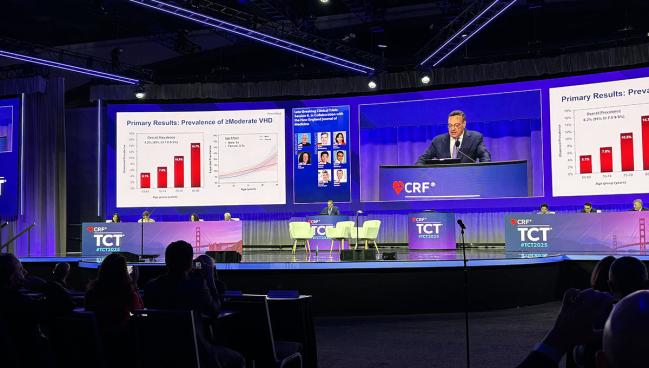
SAN FRANCISCO, CA—At least 10 million older people—nearly two-thirds of them women—in the United States have mild or greater valvular heart disease (VHD), according to the investigator-initiated PREVUE-VALVE study, which leveraged retail pharmacies across the country to try to understand how widespread VHD actually is and who it affects.
The results were released today during a late-breaking clinical trial session at TCT 2025.
“With the aging population, we know the incidence and prevalence of valvular heart disease are increasing in the United States as well as around the developed world,” David J. Cohen, MD (Cardiovascular Research Foundation, New York, NY, and St. Francis Hospital and Heart Center, Roslyn NY), told the media at a TCT press conference. “Despite a number of novel treatments for valve disease, patients often remain untreated or treated too late.
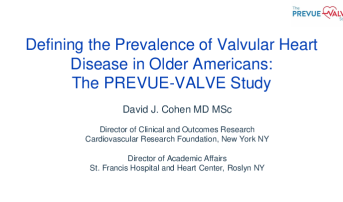
“In order to optimize screening efforts and provide patient access to these therapies, we need to understand the true prevalence of valvular heart disease–how much there is,” he continued.
“But all studies previous to this have had important methodological limitations that preclude getting a truly accurate assessment of the prevalence,” said Cohen. These include reliance on convenience samples, such as patients referred for clinical echocardiography, as well as cohorts that don’t accurately represent the proportion of women, the elderly, and minorities in the population.
You can’t really start to talk about undertreatment until you know how much disease there is out there. David J. Cohen
It’s been well established that VHD has a diversity problem when it comes to the range of patients enrolled in research studies and the types treated in the real world.
Yet the evidence for that phenomenon has been derived from cohorts of patients already diagnosed with VHD, with studies measuring how many of them receive treatment, Cohen explained to TCTMD. By helping to understand the true VHD burden in the US population, researchers can see that “we still have work to do, but it may not be as much work as we thought.”
Many of the individuals in this study were asymptomatic, Cohen pointed out, though he said that many cases don’t yet merit treatment and instead should first be monitored.
“You can’t really start to talk about undertreatment until you know how much disease there is out there,” said Cohen.
Roxana Mehran, MD (Icahn School of Medicine at Mount Sinai, New York, NY), who moderated the press conference, agreed the findings have implications for clinical practice. “What I’m most excited about is the fact that there are many we could prevent needing valve replacement if we get them sooner,” she said, noting that “great medical therapy” is available.
PREVUE-VALVE
PREVUE-VALVE recruited participants ages 65 to 85 years (57.1% female, 14.8% Black, 9.4% Hispanic) via the databases of CVS and Walgreens retail pharmacies throughout all 50 US states by using email, mail, and text messaging. After initial screening, 3,000 people had an at-home visit that involved undergoing 12-lead ECG and echocardiography, with the results analyzed by independent core laboratories.
The study, designed to capture the diversity of the US patient population, also collected blood samples, health status assessments, and self-reported medical history. All participants received a $25 Amazon gift card as an incentive.
Overall prevalence of moderate or greater VHD was estimated at 8.2%. Tricuspid regurgitation was most common (3.7%), followed by aortic stenosis (3.1%), mitral regurgitation (2.0%) and aortic regurgitation (0.7%). VHD prevalence rose progressively with age: 5.1% at 65-69 years, 7.0% at 70-74 years, 10.5% at 75-79 years, and 14.7% at 80-85 years.
Including mild-to-moderate VHD, overall prevalence was 18.4%, again increasing with age: 12.1% at 65-69 years, 15.9% at 70-74 years, 23.3% at ages 75-79 years, and 31.4% at 80-85 years. Tricuspid regurgitation remained the most common condition, with a prevalence of 10.7%
When adjusted for age and sex, Black individuals were less likely to have VHD compared with white individuals (OR 0.79; 95% CI 0.64-0.98). The gap was mainly seen in aortic valve disease. The same imbalance was not seen for Hispanic individuals (OR 0.85; 95% CI 0.66-1.10).
“However,” Cohen noted, “these differences that we observe only explain about half of the undertreatment rate seen [for minority patients] in US practice.”
At least 4.7 million people ages 65 to 85 years, 59% of them female, have moderate or greater VHD and at least 10.6 million, 63% of them female, have more than mild VHD in the United States, an analysis using census data revealed. By the year 2060, the prevalence of moderate or greater VHD is expected to rise by 1.8 million, driven by growth set to occur in patients ages 80 to 85 years.
“Importantly, many of these [people], based on the observations in our study, are completely unaware of these conditions,” said Cohen.
Perhaps even more relevant, though, is that PREVUE-VALVE shows the power of using novel approaches to get a true estimate of disease prevalence, he added. “I’m hopeful that application of these concepts to future clinical trials can greatly enhance their generalizability to the full spectrum of affected individuals.”
PREVUE-VALVE will be the source reference for the epidemiology of valve disease in America for decades to come. Bernard Prendergast
Bernard Prendergast, MD (Cleveland Clinic London, England), the trial’s discussant in the Main Arena, predicted “PREVUE-VALVE will be the source reference for the epidemiology of valve disease in America for decades to come.”
It “sets a new gold standard” for how to conduct such research at a national level, he added.
The data showing an unexpectedly lower prevalence in Black versus white individuals are “reassuring and help explain the relative rates of undertreatment by means of interventional options for patients with valve disease in the US,” Prendergast said, though “there are of course other explanations and these merit equal attention.”
He said he hopes these results “will drive improved access to diagnostic imaging, formal programs for screening, the wider applicability of surgical and transcatheter treatments, and the maturation of much-needed heart valve metrics.”
Session panelist Dharam Kumbhani, MD (UT Southwestern Medical Center, Dallas, TX), praised PREVUE-VALVE for contributing “a new paradigm for what preventive cardiology may look like” in the future, but asked about how best to scale up these efforts and prioritize individuals for screening efforts.
Cohen pointed to the potential for artificial intelligence-informed ECGs and biomarkers, which also are under study, to guide screening. The key, he said, will be “understanding where we can make a difference. . . . If we can’t change the natural history of these conditions, then there’s no point in screening for them.”

Caitlin E. Cox is Executive Editor of TCTMD and Associate Director, Editorial Content at the Cardiovascular Research Foundation. She produces the…
Read Full BioSources
Cohen DJ. Defining the prevalence of valvular heart disease in older Americans: the PREVUE-VALVE study. Presented at: TCT 2025. October 27, 2025. San Francisco, CA.
Disclosures
- PREVUE-VALVE was an investigator-initiated study sponsored by the Cardiovascular Research Foundation. Financial support was provided by grants from Edwards Lifesciences, Abbott, and Philips.
- Prendergast reports no relevant conflicts of interest.
Related News



Comments