PROCTOR: PCI of Failed Bypass Grafts Tops Native-Vessel PCI, With Caveats
The saphenous vein grafts treated in the RCT were relatively straightforward, while the native vessels were largely CTOs.

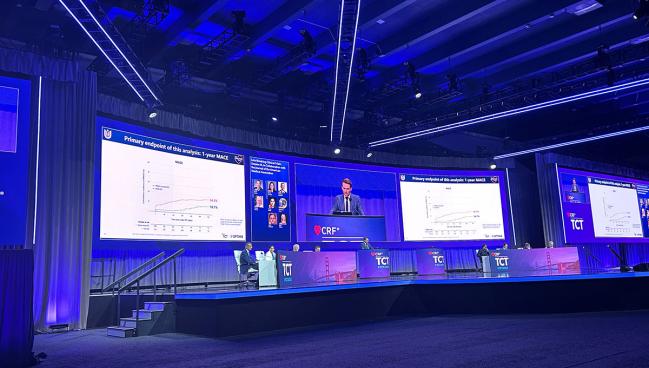
SAN FRANCISCO, CA—For patients with failed saphenous vein grafts (SVGs) after CABG, performing PCI to open up the graft appears to be the better course of action over intervening on the bypassed native coronary artery, at least when treatment of the SVGs is relatively straightforward, the results of the randomized PROCTOR trial show.
At 1 year, the rate of major adverse cardiovascular events was higher among patients who underwent native-vessel PCI versus those who underwent SVG PCI (34.3% vs 18.7%; HR 2.14; 95% CI 1.25-3.65), with the difference driven primarily by an increase in PCI-related MIs, according to Ruben de Winter, MD (Amsterdam University Medical Center, the Netherlands).
There was no difference in the risk of all-cause mortality, he reported here at TCT 2025.
PROCTOR is the first randomized controlled trial to explore different PCI options for failed bypass grafts, de Winter said during a press conference, noting that the results, published simultaneously online in JACC, run counter to observational data showing better outcomes with native-vessel versus SVG PCI.
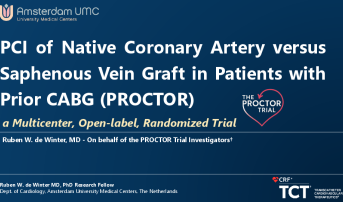
“In that regard, I think these results were surprising,” he said. “And then again, it’s important to note that these were relatively straightforward saphenous vein graft lesions compared to highly complex native coronary occlusion lesions.”
Experts agreed that the selection of patients in the trial is a key factor to consider when interpreting its results. Because investigators excluded patients who had undergone CABG within the past year, STEMI or NSTEMI with ongoing ischemia, and various high-risk SVG features, the population consisted of patients with grafts that would be relatively easy to treat. On the other hand, chronic total occlusions (CTOs) were present in more than eight out of every 10 patients in the native-vessel PCI group, presenting a more formidable challenge for operators.
“When you do a randomized trial like this, you’re sort of picking really, really difficult natives and probably more straightforward vein grafts, so it’s important to recognize that,” said Ajay Kirtane, MD (NewYork-Presbyterian/Columbia University Irving Medical Center, New York, NY), who moderated the press conference.
PROCTOR challenges the dogma that once a bypass graft starts to fail, the native arteries should be opened, Sanjit Jolly, MD (McMaster University, Hamilton, Canada), told the media. “But I think the caveat or the wrinkle,” he added, “is you’re comparing a little bit of apples to oranges.”
The PROCTOR Trial
After CABG, many patients—up to 60% by 15 years—will experience recurrent angina symptoms and ischemia related to bypass graft failure and progression of disease in the native coronary arteries, which can lead to repeat coronary angiography and revascularization. Current guidelines from the United States and Europe say it’s reasonable to perform PCI to open the bypassed native coronary artery rather than the bypass graft in patients presenting with graft failure after CABG. But, until now, there have been no randomized trials to address the question.
PROCTOR, conducted at 14 centers in Europe, included patients who had undergone CABG presenting with graft failure, significant SVG stenosis (> 50%), and a clinical indication for revascularization based on a heart team discussion. PCI with a second-generation DES was deemed technically feasible for either the SVG or native artery in all patients.
Investigators randomized 220 patients (mean age 73 years; 84% men), with a mean time between CABG and PCI of 18 years. There were high rates of diabetes (45%), prior PCI (61%), and prior MI (53%). Most patients randomized to native-vessel PCI (83%) had a CTO.
It’s important to note that these were relatively straightforward saphenous vein graft lesions. Ruben de Winter
The initial PCI attempt was not successful in 18% of patients in the native-vessel group and 10% of those in the SVG group. However, overall technical success—achievement of revascularization after the initial or crossover strategy, including repeat attempts—was similar in both (92% and 93%, respectively). Compared with SVG PCI, native-vessel PCI required more stents (mean 2.7 vs 1.3), a longer total stent length (median 84 vs 23 mm), a longer fluoroscopy time (median 55 vs 11 min), and a higher contrast volume (median 220 vs 100 mL; P < 0.001 for all).
The primary MACE endpoint included all-cause mortality, nonfatal MI in the target coronary territory (including PCI-related MI during the index procedure), or clinically driven revascularization in the target coronary territory. There was no significant difference in mortality between the native-vessel and SVG PCI groups (5.6% vs 3.6%; HR 1.59; 95% CI 0.45-5.64), but PCI of the native vessel carried higher risks of MI in the target coronary territory (22.6% vs 11.7%; HR 2.12; 95% CI 1.08-4.17) and clinically driven revascularization in the target territory (18.4% vs 9.1%; HR 2.19; 95% CI 1.02-4.72).
PCI-related MI was much more frequent in the native-vessel PCI group (13% vs 1%; HR 14.85; 95% CI 1.95-112.96).
Awaiting Longer-Term Outcomes
The findings should be interpreted in the context of certain limitations, de Winter said. For one, the trial was stopped after only 220 of a planned 584 were enrolled due to issues with funding and slow enrollment, limiting statistical power to detect differences in secondary endpoints and subgroup analyses. In addition, PROCTOR was an open-label trial that included a select population of patients.
“Importantly, these findings apply to patients in whom both PCI strategies were considered technically feasible by the heart team in a cohort with a high prevalence of complex native CTO lesions,” de Winter said. “These results challenge current guidelines at 1-year follow-up. However, long-term follow-up will be essential to determine whether the early clinical advantage observed with SVG PCI will be maintained over time.”
Shrilla Banerjee, MBChB, MD (Surrey and Sussex Healthcare NHS Trust, England), a panelist during de Winter’s presentation in the Main Arena, said these results are surprising, adding that she expects the MACE curves to cross at 3 or 5 years “because the sustainability of SVG PCI is known to be poor.”
Still, she said, the trial is “going to make me think a little bit more about what I do.”
Subhash Banerjee, MD (Baylor Scott & White Health, Dallas, TX), the lead discussant for the trial, said PROCTOR “is a very, very important trial because it now could fundamentally change our practice paradigms.”
He agreed that the selection of patients could have led to simpler treatment in the SVG PCI arm, noting that registry data on the patients who were not included will provide important insights.
Despite the limitations, he said, “these data of yours are going to have practice-changing implications” and are likely to impact guidelines.

Todd Neale is the Associate News Editor for TCTMD and a Senior Medical Journalist. He got his start in journalism at …
Read Full BioSources
De Winter RW, Hoek R, Walsh SJ, et al. PCI of native coronary artery versus saphenous vein graft after prior bypass surgery: a multicenter, randomized trial. JACC. 2025;Epub ahead of print.
Disclosures
- PROCTOR was funded by Abbott Vascular International BVBA.
- De Winter reports grant/research support from Abbott Vascular International BVBA.
Related News



Comments