Revathy Sampath-Kumar, MD
Spurred by her grandfather’s MI to pursue a career in medicine, this fellow finds inspiration in outcomes research.
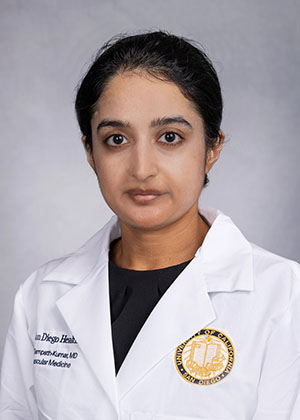 Revathy Sampath-Kumar, MD, is an interventional cardiology fellow at the University of California San Diego, where she also earned her undergraduate degree in biomedical engineering and completed her internal medicine and cardiovascular disease training. Prior to earning her medical degree at Wake Forest School of Medicine (Winston-Salem, NC), she served as a research associate for the California Institute for Biomedical Research (La Jolla, CA). She has been heavily involved in cardiovascular outcomes research, developing institutional databases to study coronary and structural valve interventions as well as heart failure. Sampath-Kumar collaborates internationally on clinical research, and she mentors medical students and residents through the Society for Cardiovascular Angiography and Interventions and the American College of Cardiology. She has been recognized with multiple awards for research, leadership, teaching, and clinical excellence, and intends to pursue a career in academic interventional cardiology, specializing in structural heart disease with a research focus on valvular heart disease.
How did you first become interested in medicine and cardiology?
I was born in rural South India and am the first physician in my family. My interest in medicine was shaped by my grandfather, a railroad laborer who passed away at home from an untreated myocardial infarction. Only as an undergraduate did I recognize the preventable nature of his death—a realization that drove me toward a degree in biomedical engineering and eventually into medicine. My first experience in the cath lab as a medical student solidified my career path. I saw firsthand how technological advancements—from stents to transcatheter valves—allow us to provide definitive, percutaneous interventions without the need for surgery. The ability to perform these life-altering procedures and witness a patient recover is incredibly gratifying.
How have your family members reacted to your career choice?
My family is proud of my career path, and they respect the discipline and sacrifices this field requires. They often look to me for medical advice, and I have been able to help them navigate the healthcare system and manage their cardiovascular health. This has taught me how to bridge the gap between complex medical terminology and the patient perspective in my clinical practice through clear, empathetic communication.
Where do you see yourself in 5 years?
In 5 years, I see myself established in an academic career as a structural interventionalist, balancing a high-volume clinical practice with meaningful research. I am committed to mastering my procedural skills to ensure the best possible outcomes for my patients. I plan to expand my research in registry-based outcomes studies and continue to foster international collaborations. Furthermore, I aim to pursue leadership roles in clinical trials and am dedicated to increasing the enrollment of women in interventional cardiology trials. Ultimately, I aspire to be a leader and mentor who advances discovery in structural heart interventions and inspires the next generation of women in the field.
Why does outcomes research, specifically, interest you?
What interests me most is the ability to analyze real-world data, as registries capture all-comers populations, revealing what is happening in the broader community, outside of high-resource clinical trial sites. I enjoy identifying modifiable procedural factors—often simple, everyday practices—that can be adjusted to improve patient outcomes.
For example, my work on peak activated clotting time (ACT) during PCI demonstrated that therapeutic yet high ACT levels in transfemoral-access PCI are associated with increased bleeding complications and short-term mortality. I have also applied this focus to structural heart disease. At TCT 2025, I presented our work showing that prosthesis-patient mismatch is associated with an increased risk of hemodynamic valve deterioration and valve failure following TAVR, emphasizing the importance of preimplant prevention.
I have also scaled my research internationally through an ongoing collaboration with Lund University in Sweden. By comparing US and Swedish PCI registry data, we found that despite vastly different procedural approaches, patient outcomes remained comparable. These global insights have deepened my interest in leveraging large-scale data to drive clinical discoveries and optimize standards of care.
Can you tell us about one of your most meaningful clinical interactions?
One of my most meaningful clinical interactions involved the longitudinal care of a patient suffering from torrential tricuspid regurgitation. Despite optimal medical management, she faced recurrent hospitalizations for volume overload, spending nearly half the year in the hospital. Witnessing the physical and mental toll of her valvular heart disease highlighted the clinical importance of quality-of-life metrics in clinical trials. We ultimately referred her for a transcatheter tricuspid valve replacement. Her story is a powerful reminder of how structural heart innovation provides hope for patients who previously had few options.
What are the biggest challenges facing interventional cardiology fellows right now?
The field is evolving at a pace that requires an immense degree of technical and cognitive versatility. Balancing high-volume procedural training with research, teaching, and longitudinal patient care is a significant challenge. However, the rigor of the interventional fellowship is necessary to develop the essential foundation for our practice in order to deliver the highest quality of care for our patients.
What’s the best piece of advice you’ve ever gotten from a mentor?
I have had the opportunity to work on many complex cases with our cath lab director, Dr. Ehtisham Mahmud, whose mentorship has been invaluable. He has taught me that in high-acuity situations, an effective leader remains calm and provides clear, decisive direction to the team. He always has the next several steps mapped out, and that combination of meticulous planning and poise is a quality I will carry with me throughout my career.
If you weren’t a physician or researcher, what could you see yourself doing?
I would be a journalist. I wrote for my college newspaper, contributing to the opinion section and reviewing music and film. I have always enjoyed the writing process, which is a significant reason I am drawn to clinical research. Both fields require rigorous investigation and the ability to communicate findings with clarity. I value the process of interviewing, engaging with diverse perspectives, and synthesizing information into an impactful narrative.
How do you like to spend your time outside of the cath lab and hospital?
Living in San Diego, I am fortunate to be surrounded by incredible natural scenery. I enjoy running along the beach or hiking local trails, and to stay centered, I prioritize meditation and yoga. I also listen to business and leadership podcasts, which have provided translatable skills to effectively lead a team in the high-pressure environment of the cath lab.
Do you have any advice for trainees following in your footsteps?
The path to interventional cardiology is rigorous, but it is an achievable goal, even if it feels out of reach at first. It is an incredibly rewarding career where you directly impact the lives of your patients daily. If you remain disciplined in your training, follow your passion, and never stop refining your clinical judgement and technical skills, you will succeed. We need your talent and dedication in this field.
What her nominator, Pam Taub, MD (UC San Diego Medical Center), says:
Dr. Revathy Sampath-Kumar is an exceptional interventional cardiology fellow. She has been actively involved in clinical research since her residency and has published numerous outstanding papers. Her recent work explores the connection between cardiometabolic disease and interventional cardiology. Most recently, she led a study investigating the impact of cardiometabolic risk factors on the longevity of TAVR valves.
To nominate a stellar cardiology fellow for the Featured Fellow section of TCTMD’s Fellows Forum, click here.

Yael L. Maxwell is Senior Medical Journalist for TCTMD and Section Editor of TCTMD's Fellows Forum. She served as the inaugural…
Read Full Bio
Comments