SAVE-PCI: Small-Bore Percutaneous VAD Matches IABP in High-risk PCI
The NyokAssist device, from China, had few adverse outcomes by 30 days. More devices—and more trials—are on the way.

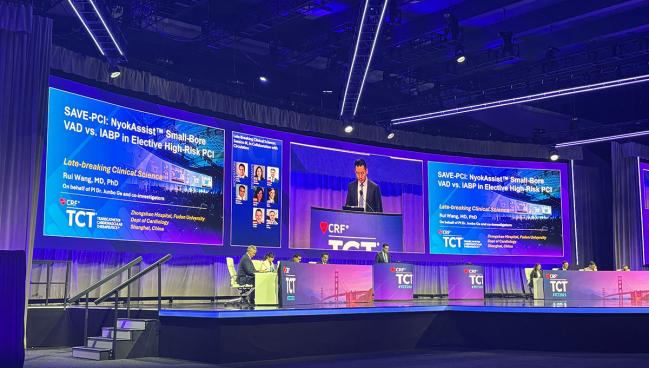
SAN FRANCISCO, CA—A novel percutaneous ventricular assist device (pVAD) appears to offer comparable safety to an intra-aortic balloon pump (IABP) when offering hemodynamic stabilization in elective, high-risk PCI, according to the prospective randomized SAVE-PCI trial.
Presented in a late-breaking session at TCT 2025, 30-day results with the NyokAssist pVAD (MagAssist) showed similar rates of MACCE compared with IABP and few adverse events in Chinese PCI patients.
NyokAssist features an “external motor design to reduce device costs and eliminate heat-related blood damage,” its manufacturer says. It was granted breakthrough device status by the US Food and Drug Administration in 2023.

Bleeding complications have been a consistent concern with currently available pVADs, which require large-bore access. But as investigator Rui Wang, MD, PhD (Zhongshan Hospital, Shanghai, China), told the media at a TCT press conference, NyokAssist has a small-bore 9-Fr insertion profile. This “enables smooth device insertion, navigation, and withdrawal,” he explained, adding that the pump has a slower rotational speed as well.
Holger Thiele, MD (Heart Center Leipzig at University of Leipzig, Germany), who discussed the results in the Main Arena following their presentation, pointed out that the study is now—after BCIS-1 and PROTECT II—the third randomized trial of hemodynamic support in high-risk PCI. It has several strengths, among them a complete lack of vascular complications, but it also is relatively small and includes patients that aren’t as high risk as its predecessors, said Thiele.
Looking ahead, he noted that data from the PROTECT IV and CHIP-BCIS3 trials will help inform the debate over which form of support is best.
SAVE-PCI
Researchers enrolled 236 hemodynamically stable patients undergoing nonemergency, high-risk PCI across 11 centers in China. All either had three-vessel CAD, were slated for PCI in an unprotected left main coronary artery, and/or were set to undergo PCI on the last patent coronary conduit. Study participants were randomized to receive support from the pVAD or IABP. Ultimately, 117 out of 118 patients randomized to the pVAD received the device, with 30-day follow-up available for 113 patients. In the IABP arm, the numbers were 116 and 115, respectively.
At baseline, characteristics—patient, procedural, and lab parameters—were well balanced between the two groups except for a higher proportion of males in the pVAD arm (90.6% vs 76.7% in the IABP arm; P = 0.004). Vascular closure was left to operator discretion and involved a mix of Angio-Seal (Terumo), ProGlide (Abbott), manual compression, and other methods. There were no vascular complications in either group.
The question is: who do you need them in, and can you save lives? Sanjit Jolly
At 30 days, rates of MACCE were similar in the pVAD and IABP groups (4.4% vs 2.6%), as were its individual components of mortality (0.9 vs 1.7%), repeat revascularization (none in either arm), TIA (0.9% vs 0), stroke (0.9% vs 0.9%), and MI (1.8% vs 0; P = NS for all).
Major adverse events were rare. There was one case of acute renal failure in each arm, as well as one case of ventricular arrythmia requiring cardioversion and one cardiac pulmonary resuscitation among the pVAD patients. There was no aortic valve insufficiency exacerbation, hemolysis, hemorrhage, or major vascular complications.
Wang said that 90-day follow-up in the study is ongoing. It’s possible that the pVAD may prove superior to IABP, he noted, adding that while he’d love to compare NyokAssist against Impella (Abiomed), the latter device is not yet available in China.
Awaiting PROTECT IV
Ajay Kirtane, MD (NewYork-Presbyterian/Columbia University Irving Medical Center, New York, NY), said the area of high-risk PCI has sparked a lot of interest.
“On the backdrop of this [Chinese study], there are numerous percutaneous VADs for hemodynamic support that are currently about to launch trials in the United States as well,” he told TCTMD. Like Thiele, he said the PROTECT IV trial will provide clarity on the difference between Impella and IABP in high-risk PCI.
Sanjit Jolly, MD (McMaster University, Hamilton, Canada), in the media briefing, agreed that hemodynamic support’s future in high-risk PCI hinges on whether PROTECT IV shows an improvement in clinical outcomes. “The average Canadian interventionalist will say, ‘In the vast majority of cases, I don’t need to put in a $20,000 pump. I can probably use no support or use a balloon pump in selected cases.’
“I think that certainly the VAD devices provide more support,” Jolly continued. “The question is: who do you need them in, and can you save lives?”
If it’s a matter of life and death, the added expense isn’t a concern, but if it’s about having a smaller tube in the groin and lowering the risk of vascular complications, “as a patient and payer, I don’t want to pay that,” Jolly commented. He predicted that as more devices are developed by more manufacturers, competition will help bring costs down.

Caitlin E. Cox is Executive Editor of TCTMD and Associate Director, Editorial Content at the Cardiovascular Research Foundation. She produces the…
Read Full BioSources
Wang R. SAVE-PCI: NyokAssist small-bore VAD vs. IABP in elective high-risk PCI. Presented at: TCT 2025. October 28, 2025. San Francisco, CA.
Disclosures
- Wang and Thiele report no relevant conflicts of interest.
- Kirtane reports grant/research support from Medtronic; Abbott, Boston Scientific Corporation, Amgen, Cathworks, Siemens, Philips, Recor Medical, Spectranetics, Cardiovascular Systems Incorporated, Chiesi, Opens, Zoll, Regeneron, Neurotronic, Biotronik, Bolt Medical, Magenta Medical, Canon, SoniVie, Shockwave Medical, and Abiomed.
- Jolly reports consultant/honoraria/speaker’s fees from Teleflex, Penumbra, Asahi, Abiomed, and Shockwave Medical, as well as grant/research support from Boston Scientific.
Related News


Comments