SOLVE-TAVI: Patient Sex, for the Most Part, Doesn’t Sway Outcomes by Valve Type
Women had better self-care at 5 years with self-expanding valves, raising questions about lower gradients and stroke impacts.


WASHINGTON, DC—Despite their distinct clinical and anatomic characteristics, men and women with severe aortic stenosis and intermediate-to-high surgical risk largely have similar long-term outcomes after TAVI whether they receive a self-expanding or balloon-expandable valve, according to a 5-year analysis of the SOLVE-TAVI trial.
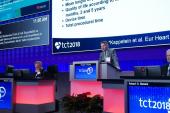
“At long-term follow-up, the self-expanding valves and balloon-expandable valves demonstrate overall comparable clinical efficacy and durability, and the relative performance of both valves was consistent in men and women, suggesting that the valve selection should primarily be guided by anatomical and procedural characteristics rather than by sex,” said Serdar Farhan, MD (Lenox Hill Hospital Northwell Health, NY), in his presentation this week at CRT 2026.
For men, rates of stroke, including disabling stroke, were numerically higher with the balloon-expandable compared with self-expandable valves, but the differences did not reach statistically significance. In women, however, stroke rates were 12% in the balloon-expandable arm versus 0.9% in the self-expanding arm (P = 0.011), and disabling stroke rates were 9.5% and 0.9%, respectively (P = 0.024).
Farhan noted that a signal for more stroke with the balloon-expandable compared with self-expanding valves has been apparent since the earliest analysis of SOLVE-TAVI, when the rates were 4.7% versus 0.5% among trial participants (P = 0.01).
Right now, Farhan said investigators believe differences in stroke risk with the two valves in men and women is “very likely to be a chance finding because the stroke rates overall were lower than in several other trials of similar risk category.” It also may be related to high rates of pre- and postdilation of balloon-expandable valves at the time of the trial.
The researchers also looked at several quality-of-life (QoL) measures like mobility, self-care, engaging in usual activities, pain, and anxiety, seeing mostly similar results for men and women, with one exception. While men had similar levels of self-care at long-term follow-up with either valve type, women reported better self-care 5 years after receiving a self-expanding valve than they did with a balloon-expandable valve.
Valve selection should primarily be guided by anatomical and procedural characteristics rather than by sex. Serdar Farhan
SOLVE-TAVI was one of the first head-to-head studies looking at the safety and efficacy of two competing valves. The trial enrolled 447 patients in Germany who were randomized to TAVR using either the self-expanding Evolut R (Medtronic) or balloon-expandable Sapien 3 (Edwards Lifesciences). At 5 years, 438 patients had available follow-up. The 214 men had a mean age of 81 years, while the 224 women had a mean age of 82 years. Compared with men, women had higher rates of frailty, higher STS scores, and lower incidence of CAD.
Among men, rates of the primary endpoint (a composite of all-cause death, stroke, moderate/severe paravalvular leak, permanent pacemaker implantation, or annular rupture) were 73.5% with self-expanding valves and 69.2% with balloon-expandable valves (log-rank P = 0.193). In women, the rates were 63.8% and 57.3%, respectively (log-rank P = 0.775).
All-cause mortality, however, was higher overall in men than women (53.9% vs 43.7%; P = 0.041).
Among the secondary endpoints, no significant interaction was observed between sex and assigned valve type for severe paravalvular leak, permanent pacemaker implantation, life-threatening or major bleeding, VARC-2 clinical efficacy, or VARC-2 time-related valve safety.
Hypothesis-Generating Signal
The SOLVE-TAVI investigators used the EQ-5D questionnaire to collect QoL data. While the results were fairly uniform for men, more women who received the self-expanding valve reported a self-care score of 1 at 5 years, indicating no problems with self-care, than those who received the balloon expandable valve (48.5% vs. 24.2%).
”The most interesting thing is the results in women out to 5 years, because it’s very similar to the SMART trial,” noted panelist David Cohen, MD (Cardiovascular Research Foundation, New York, and St. Francis Hospital, Roslyn, NY).
“One of the things we’ve been wondering is whether these gradients, which are reliably lower with the self-expanding valve, translate into something clinically, whether it’s differences in durability or whether it’s differences in mortality, and you didn’t see any mortality difference,” he added. ”In fact, the curves crossed and the mortality was actually a little bit higher in the women treated with the self-expanding valve.”
Farhan called the self-care finding “provocative,” adding that while it might reflect lower gradients, he considers it hypothesis-generating at best.
To TCTMD, Cohen said it also might make sense that if more women in the balloon-expandable arm had a disabling stroke, those in the self-expanding arm may have a better grasp on their self-care at 5 years by comparison, but for now it’s an interesting observation, especially in anticipation of the 3-year results from the SMART trial later this year.
He added that the SOLVE-TAVI investigators and others should be commended for collecting long-term data that encompasses QoL areas that are important for patients.
“These patients care more about quality of life than they care about dying and they don’t want to have a stroke because that removes their quality of life, too,” he said “Quality of life is by far the dominant concern of these patients and it’s why so many of them want TAVR because they get back to doing things quicker and they know they don’t have that many years ahead of them.”

L.A. McKeown is a Senior Medical Journalist for TCTMD, the Section Editor of CV Team Forum, and Senior Medical…
Read Full BioSources
Farhan S. Long-term outcomes of women and men undergoing self-expanding versus balloon expandable valves: a sex-specific analysis of the SOLVE-TAVI trial. Presented at: CRT 2026. March 9, 2026. Washington, DC.
Disclosures
- Farhan reports no relevant conflicts of interest.
Related News


Comments