SPIRIT-HF: Spironolactone’s Benefit Still Uncertain in HF With Preserved, Mildly Reduced EF
The trial enrolled just half of its planned patients, leaving spironolactone’s role in HFpEF and HFmrEF still up in the air.

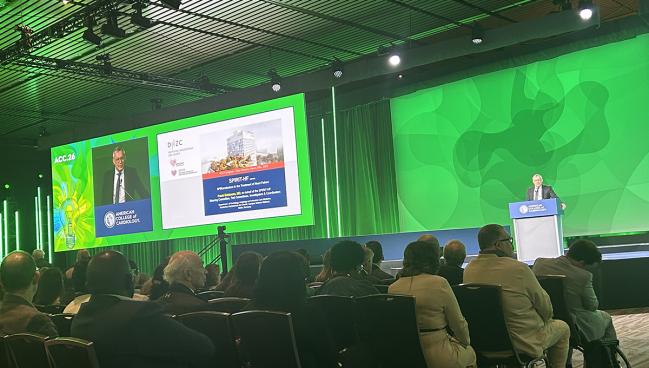
NEW ORLEANS, LA—Spironolactone did not improve clinical outcomes in patients who had heart failure with either mildly reduced or preserved ejection fraction (HFmrEF and HFpEF, respectively) in the SPIRIT-HF trial, but the results are not considered definitive since fewer than half of the planned number of patients were included in the study.
Through 2 years, the rate of cardiovascular death or total HF hospitalizations (primary endpoint) per 100 patient-years was 10.9 among patients treated with the steroidal mineralocorticoid receptor antagonist (MRA) and 8.2 among those who received placebo, a nonsignificant difference (rate ratio 1.32; 95% CI 0.79-2.21), Frank Edelmann, MD (Deutsches Herzzentrum der Charité, Berlin, Germany), reported here at the American College of Cardiology (ACC) 2026 Scientific Session.
The trial was hit hard by the COVID-19 pandemic, resulting in a reduction in funding that hampered enrollment and led to a much lower number of primary endpoint events. There were also high rates of treatment discontinuation, possibly related to the side effects of spironolactone.
“Hence, SPIRIT-HF is an underpowered trial that could not adequately test its primary hypothesis,” Edelmann concluded, adding that patients with HFmrEF and HFpEF “may benefit from spironolactone if they tolerate the drug without the need for withdrawal.”
That, however, needs to be confirmed in future studies, he said, noting that SPIRRIT, a registry-based trial in Sweden and the United States, is ongoing, with the plan to enroll 2,000 patients with HFpEF.
Commenting on the SPIRIT-HF results at a media briefing, Biykem Bozkurt, MD, PhD (Baylor College of Medicine, Houston, TX), said the community had hoped that the trial would provide a more-conclusive answer about the clinical efficacy of spironolactone in this population after positive signals were seen in the Americas cohort of TOPCAT.
Since it was underpowered, with a 65% likelihood of a type II error, “we cannot talk about efficacy for [the] primary or any of the secondary endpoints,” she said, noting that even if the trial had enrolled its intended sample size, it likely still would have lacked the statistical power to provide a conclusive result.
The SPIRIT-HF Trial
Steroidal MRAs like spironolactone have established benefits in patients who have heart failure with reduced ejection fraction (HFrEF), but the effects are less certain in patients with higher ejection fractions. The overall result of the TOPCAT trial of spironolactone in patients with HFpEF was neutral, although the drug appeared to improve outcomes among the subset of patients enrolled in the United States, Canada, Brazil, and Argentina. Currently, there are class 2b recommendations to consider MRAs in patients with HFmrEF and HFpEF in US and European HF guidelines.
The SPIRIT-HF investigators intended to provide more definitive evidence on the impact of spironolactone in patients with ejection fractions of 40% or higher. Conducted at centers in Germany, the Netherlands, Austria, and France, the study included patients 50 years and older who had symptomatic HFmrEF or HFpEF (NYHA class II-IV), echocardiographic evidence of structural and/or functional cardiac abnormalities, and either a hospitalization for HF within the past 12 months or elevated NT-proBNP.
Investigators planned to enroll 1,564 patients but ultimately randomized 730 patients (mean age 76.3 years; 51.8% women) to spironolactone or placebo. Participants were well treated with HF medications at baseline.
The neutral result on the primary composite endpoint of CV death and total HF hospitalizations through 2 years was consistent across patient subgroups. There were no significant differences between the spironolactone and placebo groups in CV death (rate ratio 0.67; 95% CI 0.37-1.23), total HF hospitalizations (rate ratio 1.32; 95% CI 0.79-2.21), or total CV hospitalizations (rate ratio 1.36; 95% CI 0.99-1.86). Total all-cause hospitalizations through 2 years, however, were more common in the MRA group (41.6 vs 29.5 per 100 patient-years; rate ratio 1.40; 95% CI 1.07-1.83).
There was no difference between groups in the rate of all-cause death (rate ratio 0.96; 95% CI 0.57-1.61).
The event curves for the primary endpoint appeared to show that outcomes may have been better in the spironolactone group through the first several months of follow-up before the situation switched and outcomes worsened relative to placebo.
To explore what might have happened, the investigators examined the likelihood of premature discontinuation of study treatments, which occurred earlier in the spironolactone group. Half of MRA-treated patients had insufficient drug intake (ie, discontinuation or intake < 20%) at 21 months, whereas half of placebo-treated patients had insufficient treatment by month 31.
The high rate of discontinuation was at least partly explained by challenges introduced by the COVID-19 pandemic, but also by side effects of spironolactone, which was associated with increased rates of hypotension, hyperkalemia, and renal events (rate ratios of 1.75 to 3.49), Edelmann said.
In an on-treatment analysis that censored patients when they discontinued spironolactone or placebo, there remained no significant difference between trial arms in the primary endpoint, but the rate ratio was more favorable for spironolactone (rate ratio 0.94; 95% CI 0.49-1.79).
“There might be a beneficial effect of spironolactone in these patients if they are able to be on drug treatment,” Edelmann said at the media briefing. He reported, too, that when they combined the SPIRIT-HF results with those from the TOPCAT Americas cohort in a prespecified meta-analysis, MRA therapy appeared to have a benefit.
An Unresolved Question
After Edelmann’s presentation, study discussant Anu Lala, MD (Icahn School of Medicine at Mount Sinai, New York, NY), noted that “MRAs have transformed outcomes in heart failure with reduced ejection fraction, reducing mortality [and] morbidity and changing the natural history of the disease itself.”
There had remained a question, however, about whether those results could apply to HFmrEF and HFpEF, “where MR activation drives fibrosis, inflammation, and adverse outcomes,” she said, adding that TOPCAT left the issue unresolved.
Though the FINEARTS-HF trial demonstrated that finerenone, a nonsteroidal MRA, reduces the risk of worsening HF events and CV death in patients with HFmrEF and HFpEF, the question regarding the impact of steroidal MRAs like spironolactone remained without an adequate answer.
Lala agreed with others when saying that due to its limitations, SPIRIT-HF “doesn't necessarily answer the question. She added, however, that “it does not represent a failure of steroidal MRAs in this population” because it is inconclusive.
At the media briefing, Bozkurt said the ongoing SPIRRIT trial needs to enroll its full sample size to establish the impact of steroidal MRA therapy on HF hospitalizations. “Because right now, the verdict is not out [on] whether this is differential for nonsteroidal MRA compared to steroidal MRA,” she commented.

Todd Neale is the Associate News Editor for TCTMD and a Senior Medical Journalist. He got his start in journalism at …
Read Full BioSources
Edelmann F. SPIRIT-HF: spironolactone in the treatment of heart failure. Presented at: ACC 2026. March 29, 2026. New Orleans, LA.
Disclosures
- The German Center for Cardiovascular Research (DZHK) funded the trial.
- Bozkurt reports receiving consulting fees/honoraria from Abiomed, Amgen, AstraZeneca, Baxter International, Bayer, Boehringer Ingelheim, Cytokinetics, Daiichi Sankyo, Johnson & Johnson, Merck, Regeneron, Roche, Sanofi-Aventis, Cardurion, LivaNova, Novo Nordisk, and Renovacor; serving on a clinical events committee for Abbott; and serving on steering committees for Respicarida/Zoll and Vifor Pharma.
Related News


Comments