Tailored Testing and Care Ease Angina for MINOCA Patients: PROMISE
Having more-thorough workup uncovered an unexpected root cause and changed the treatment course for 76% of patients.

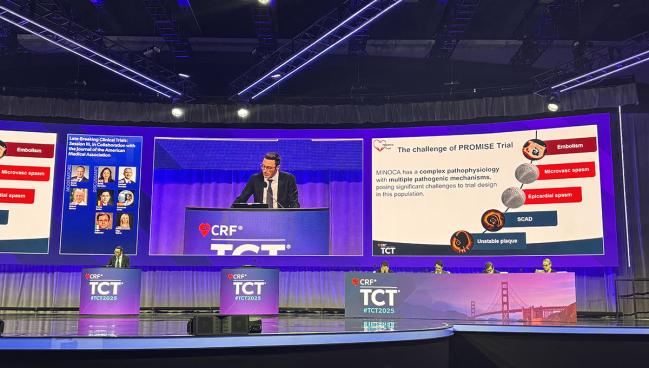
SAN FRANCISCO, CA—For patients with suspected myocardial infarction with nonobstructive coronary arteries (MINOCA), a strategy involving multifaceted exams to pinpoint the diagnosis and allow for targeted treatment outperforms the standard of care, results from the PROMISE trial suggest.
Although not powered to detect differences in hard events, the study found improvements in patient-reported measures of angina symptoms. It also documented the potential for a more-thorough workup to inform management.
Up to 10% of patients with MI undergoing coronary angiography have MINOCA, investigator Rocco A. Montone, MD, PhD (Fondazione Policlinico Universitario A. Gemelli IRCCS, Rome, Italy), told the media at a press conference. “Despite this incidence, we have no randomized data and current guideline recommendations are based only on observational studies and expert consensus.”

One reason why data are scarce, Montone explained, is because MINOCA has “a complex pathophysiology with multiple possible pathogenic mechanisms. This complexity has posed challenges to trial design in this population.” For PROMISE, which is the first randomized trial evaluating patients with MINOCA, researchers compared strategies rather than comparing one treatment versus another.
Evelyn Regar, MD, PhD (LMU Klinikum, Munich, Germany), said that without in-depth assessment, the mixed bag that is MINOCA doesn’t result in a refined diagnosis. Oftentimes patients with suspected MINOCA are simply dismissed when angiography doesn’t identify any blockages.
This lack of precision isn’t due to a lack of expertise or resources, however. “It’s maybe not very diplomatic, but it is a sort of laziness, because a lot of these technologies and test methods have been around for many, many years,” Regar commented to TCTMD. “What this trial does, and why I think it’s so exciting, is it reflects the paradigm shift that we see in interventional cardiology.”
The field is moving away from using angiography alone to first find stenotic lesions and then treat them towards using methods to identify pathophysiology, she said. Today’s tools are much better than those that came before, said Regar, and “we’re finally starting to use them.”
The results were presented today in a late-breaking clinical trial session at TCT 2025 and published in the European Heart Journal.
PROMISE
PROMISE originally was designed to include 180 patients, with that number reduced to 145 due to slow enrollment during the COVID-19 pandemic. In June 2024, 3 years into the study, the data and safety monitoring board recommended that investigators stop enrollment due to seeing a clear benefit with stratified treatment and potential harm with the standard of care.
Ultimately, the trial enrolled 100 patients (mean age 62 years; 48% female) with suspected MINOCA based on having acute MI (Fourth Universal Definition), lack of stenosis > 50% on angiography, and no alternative diagnosis for their clinical presentation. Researchers at four Italian centers randomized patients to receive either:
- Stratified treatment with advanced diagnostic workup to uncover the mechanism of MINOCA and treatment targeted to that underlying cause
- Standard of care involving assessment with coronary angiography (and cardiac magnetic resonance recommended) but no other exams and treatment for ACS (dual antiplatelet therapy [DAPT] or single antiplatelet therapy plus statins as well as a beta-blocker and/or ACE inhibitor if indicated)
Workup for the stratified group included four exams: optical coherence tomography to check for unstable plaque and spontaneous coronary artery dissection (SCAD), acetylcholine provocation testing to detect epicardial or microvascular spasm, cardiac MRI to confirm MI and rule out Takotsubo cardiomyopathy or myocarditis, and transesophageal echocardiography to check for embolism.
Based on the results of those tests, the MINOCA patients got tailored care. Those found to have unstable plaque received DAPT with or without PCI and statins, while those with SCAD received antiplatelet therapy with or without PCI and beta-blockers. Patients with epicardial or microvascular spasm received a calcium channel blocker, and those with embolism received anticoagulation. Patients whose diagnosis was undefined received standard ACS therapy.
MINOCA was confirmed in 45 patients assigned to stratified care and 47 of those assigned to standard of care. Baseline characteristics were well balanced between the two study arms.
No adverse events occurred as a result of the advanced workup in the stratified group. The most common diagnosis was epicardial spasm (35.6%), followed by atherosclerotic plaque instability (22.2%), SCAD (13.3%), coronary embolism (4.4%), and microvascular spasm (4.4%). Twenty percent of patients had an undefined diagnosis.
Doing in-depth exams led to reclassification in the suspected versus confirmed diagnosis for 75.5% of the stratified group. The change before versus after workup was significant for atherosclerotic plaque instability (from 60% to 22.2% of patients diagnosed; P < 0.001) and epicardial spasm (from 13.3% to 35.6% of patients diagnosed; P = 0.006). These reclassifications led to updates in which treatments patients would receive.
The between-group difference in the change in angina status, assessed by the Seattle Angina Questionnaire Summary Score (SAQ-SS) at 12 months, served as the PROMISE trial’s primary endpoint. Patients in the stratified group came out ahead for each of those measures.
MINOCA Strategy: Change From Baseline to 12 Months
|
|
Stratified |
Standard of Care |
P Value |
|
SAQ Summary Score |
12.3 ± 5.2 |
2.9 ± 9.5 |
< 0.001 |
|
SAQ Domains |
|||
|
Angina Limitation |
13.1 ± 11.5 |
5.2 ± 13.1 |
< 0.001 |
|
Angina Stability |
11.1 ± 18.9 |
-1.0 ± 18.8 |
< 0.001 |
|
Angina Frequency |
13.8 ± 10.9 |
2.7 ± 11.4 |
< 0.001 |
|
Treatment Satisfaction |
13.8 ± 10.9 |
5.8 ± 16.0 |
< 0.001 |
|
Quality of Life |
9.8 ± 17.8 |
2.0 ± 16.7 |
0.003 |
There were no statistically significant differences in MACE rates, or the individual components of all-cause mortality, nonfatal MI, stroke, rehospitalization for heart failure, or repeated coronary angiography, between strategies. However, there was a trend toward worse survival in the standard-of-care group versus the stratified group, which had two versus no cardiac deaths, respectively (P = 0.160)
The study does have two main limitations, said Montone. Its early termination precludes drawing conclusions about hard clinical endpoints, and its lack of blinding may have swayed patient-reported outcomes.
Shrilla Banerjee, MBChB, MD (Surrey and Sussex Healthcare NHS Trust, Redhill, England), discussant for the trial in the Main Arena, agreed with those limitations and added another: the potential cost implications of the diagnostic workup. But she also pointed to strengths, among them the high enrollment of women.
“As cardiologists, we all see MINOCA patients, but we should now be moving on from just considering to actually providing these tests,” especially vasospastic testing, she said.
Banerjee believes that clinical guidelines should be updated based on PROMISE, hopefully soon followed by other randomized trials. The 2023 European Society of Cardiology guidelines for acute coronary syndromes currently give a class I, level of evidence C, recommendation to follow a diagnostic algorithm to determine the underlying final diagnosis in suspected MINOCA, but she suggested this should be elevated to class I, level of evidence B.
Ajay Kirtane, MD (NewYork-Presbyterian/Columbia University Irving Medical Center, New York, NY), told TCTMD that it’s important to understand the root cause of MINOCA symptoms. Although it’s possible to treat some of these conditions without all the testing, patients still benefit psychologically from more certainty, he said.
“If you come into the hospital with a heart attack and someone says, ‘Your arteries look fine and we don’t really know what’s going on and we’re going to institute empiric therapy,’ that is a very different conversation than telling the patient, ‘We’ve done these tests and we think this is what’s going on,’” Kirtane commented.

Caitlin E. Cox is Executive Editor of TCTMD and Associate Director, Editorial Content at the Cardiovascular Research Foundation. She produces the…
Read Full BioSources
Montone RA, Cosentino N, Gorla, R, et al. Stratified treatment of myocardial infarction with non-obstructive coronary arteries: the PROMISE trial. Eur Heart J. 2025;Epub ahead of print.
Disclosures
- Montone reports no relevant conflicts of interest.
Related News



Comments