Ultrathin-Strut DES Performs Well vs Xience in Diabetic Patients: TUXEDO-2
One question, in light of FREEDOM, is how well new DES compare with CABG in patients with diabetes and multivessel disease.

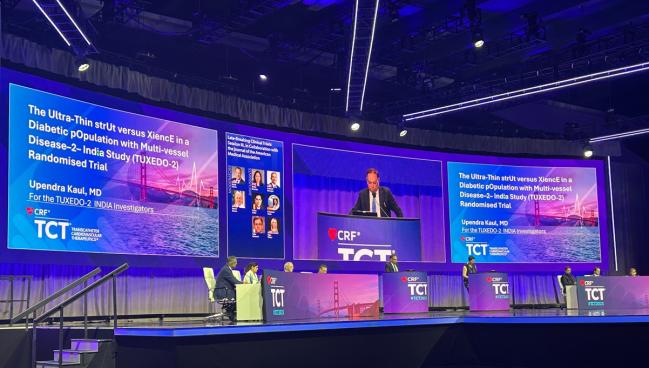
SAN FRANCISCO, CA—The ultrathin-strut Supraflex Cruz sirolimus-eluting stent (Sahajanand Medical Technologies) provides results that are noninferior to those obtained with the Xience family of everolimus-eluting stents (Abbott) in patients with diabetes and multivessel coronary disease undergoing PCI, according to results of the TUXEDO-2 trial.
The rate of target lesion failure at 1 year was 7.92% with Supraflex Cruz and 8.75% with Xience, with a between-group difference of -0.83% (95% CI -3.42%-1.76%) that falls within the noninferiority margin of 4.5% (P = 0.005).
The individual components of TLF (cardiac death, target-vessel MI, and ischemia-driven target lesion revascularization), as well as a number of secondary outcomes, occurred at similar rates in both arms of the trial, Upendra Kaul, MD (Batra Heart Centre, New Delhi, India), reported last week at TCT 2025.
The results indicate “comparable safety and efficacy” with the two stents, Kaul said.
The TUXEDO-2 Trial
Patients with diabetes often have multivessel coronary disease with complex lesions, and this group would typically undergo CABG based on the FREEDOM trial results. When they do undergo PCI, they have increased risks of restenosis and stent thrombosis.
Results of the TUXEDO-India trial, which Kaul reported a decade ago at TCT 2015, showed that a paclitaxel-eluting stent provided poorer outcomes compared with an everolimus-eluting stent in patients with diabetes who mostly had single-vessel disease. Since then, DES technology has improved—struts have gotten thinner and polymers and drug delivery have gotten better. That has resulted in lower rates of restenosis, stent thrombosis, and MI. But data remain limited on how these new-generation stents perform in complex patients with diabetes.
The TUXEDO-2 trial, performed at 66 centers in India, enrolled 1,800 patients (mean age 60 years; 72% men) with diabetes (nearly all type 2) and angiographically confirmed multivessel CAD (85% with triple-vessel and 15% with double-vessel disease). Patients were randomized to PCI with either the Supraflex Cruz with biodegradable polymer or one of the Xience stents with durable polymer, in addition to optimal medical therapy. Strut thickness is 60 µm with Supraflex Cruz and 81 μm with Xience. The mean duration of diabetes was 5.9 years.
Second-generation drug-eluting stents are better than first-generation drug-eluting stents, but this doesn’t mean that they are as safe and effective as surgery. Tullio Palmerini
Most patients presented with MI (59%), with another 20% having unstable angina and 21% presenting with chronic coronary syndrome. The mean SYNTAX score was 17.5, which places them in the low-risk category; 80% of patients had a score of 22 or less.
Procedural and angiographic characteristics were similar in the two arms. Device, lesion, and procedure success was over 99% in both groups.
In terms of medical treatment, similar proportions of patients in both groups were treated to an HbA1c < 7%, LDL cholesterol < 50 or 70 mg/dL, and blood pressure < 130/80 mm Hg. About 90% of patients received aspirin. In addition to the stent randomization, patients also were randomized in the 2x2 factorial trial to ticagrelor or prasugrel, with about 50% of patients ultimately taking ticagrelor, 45% taking prasugrel, and a small percentage taking clopidogrel.
The noninferior result in terms of TLF at 1 year was consistent across various subgroups. There were no significant differences between the Supraflex Cruz and Xience groups in cardiac death (3.56% vs 3.36%; P = 0.80), target-vessel MI (6.61% vs 7.54%; P = 0.40), ischemia-driven TLR (0.82% vs 1.07%; P = 0.44), all-cause death (4.00% vs 4.67%; P = 0.82), nonfatal MI (4.72% vs 6.45%; P = 0.10), MACE (8.69% vs 10.35%; P = 0.29), or stent thrombosis (0.67% vs 1.00%; P = 0.44). Results were consistent in the per-protocol analysis.
Comparison With CABG Still Needed
Tullio Palmerini, MD (University of Bologna, Italy), the discussant for the trial, said TUXEDO-2 is important because it addresses treatment of the clinically relevant population of patients with diabetes and multivessel coronary disease who are eligible for PCI. There was only a modest difference between the expected and observed event rates, meaning the trial was adequately powered, something that has not been true for many head-to-head RCTs of second-generation DES over the past decade, he added.
But Palmerini also highlighted some limitations, including the relatively low rates of physiological assessments (about 8%) and intravascular ultrasound (about 16%) in the trial, which is inconsistent with state-of-the-art PCI practices. Moreover, he said, the noninferiority margin was “somewhat wide.”
The lack of a comparison with CABG, the standard of care in this population, also is an important consideration, Palmerini indicated. In FREEDOM, bypass surgery reduced not only target-vessel MI and TLR, but also mortality at 5 and 10 years of follow-up compared with PCI.
“We agree with investigators that second-generation drug-eluting stents are better than first-generation drug-eluting stents, but this doesn’t mean that they are as safe and effective as surgery,” he said. “Therefore, a randomized trial is necessary to show noninferiority . . . of this stent compared to coronary artery bypass surgery.”
Kaul noted that a secondary objective of TUXEDO-2 is to pool the data from both arms of the trial and compare the results with performance goals derived from the CABG arm of FREEDOM through 5 years of follow-up.

Todd Neale is the Associate News Editor for TCTMD and a Senior Medical Journalist. He got his start in journalism at …
Read Full BioSources
Kaul U. The ultra-thin strut versus Xience in a diabetic population with multivessel disease–2–India study (TUXEDO-2) randomized trial. Presented at: TCT 2025. October 28, 2025. San Francisco, CA.
Disclosures
- The study was initiated by Batra Hospital and Medical Research Centre with an unrestricted research grant received from Sahajanand Medical Technologies (SMT), Surat, India.
- Kaul reports receiving a research grant from SMT.
- Palmerini reports receiving lecture fees from Abbott.
Related News

Comments