Voice Analysis Picks Up Patients at Risk for HF Hospitalization: COMMUNITY-HF
Vocal monitoring has the potential to identify HF patients with worsening congestion early and prevent acute decompensation.

MINNEAPOLIS, MN—A smartphone app that uses speech recognition technology to identify vocal changes signaling imminent fluid overload in patients with heart failure has good success with a low false-positive rate over 4 years of follow-up in the COMMUNITY-HF study.
The app (HearO; Cordio Medical) represents a noninvasive opportunity for remote monitoring of patients at risk for acute decompensated heart failure (ADHF) and would help prevent hospitalizations and save healthcare costs, researchers say.
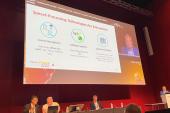
The new findings, presented during the first late-breaking clinical research session at the Heart Failure Society of America (HFSA) 2025 Annual Scientific Meeting by William T. Abraham, MD (The Ohio State University, Columbus), show the speech analysis technology had a sensitivity of 85.4% with a 14.6% false-negative rate when it came to identifying ADHF among almost 600 patients from the United States and Israel in 4-year follow-up.
“We have more data that confirms the utility of this approach to monitoring heart failure patients,” he told TCTMD. “But we’ve got to confirm these results in a more prospective way.”
Those curious about the technology won’t have to wait long, as Abraham said his team will be presenting the prospective validation DETECT-HF trial designed for US Food and Drug Administration approval at the upcoming American Heart Association Scientific Sessions in November.
A prior study, known as ACUTE, served as a proof-of-concept that the technology could differentiate between a “wet” voice as someone would have during a hospitalization for ADHF and a “dry” voice that a patient would have at the time of hospital discharge. Preliminary research has shown that the smartphone app successfully reduces acute decompensation events (either hospitalizations or medication changes) and improves quality of life over 2 years.
4-Year Findings
For COMMUNITY-HF, Abraham and colleagues followed 599 patients (71% male; mean age 69 years) who had stable HF with either reduced or preserved ejection fraction at risk for heart failure events from five US sites and 10 Israeli sites between March 2018 and March 2025. Mean baseline LVEF and NYHA class were 39.9% and 2.4, respectively. Half spoke Hebrew, while Russian (18.4%), Spanish (15.7%), English (9.3%), and Arabic (5.8%) made up the other languages.
Over 51 months of follow-up representing 360,420 patient-days, there were 89 heart failure events, defined as hospitalizations or medication changes, including 69 first events. Retrospectively analyzing voice recordings from 31 days prior to events, the researchers saw that the app was able to detect decompensation within an average of 24.9 days before hospitalization. Patients had 2.4 unexplained priority notifications or false alerts per year.
“The device demonstrates excellent usability with a simple and intuitive design that facilitates ease of use,” Abraham said. “Ongoing and future studies, in particular the DETECT-HF trial, will continue to define the role of speech in detecting heart failure events. And this approach has the potential to reduce heart failure hospitalizations and improve patient quality of life and economic outcomes through the detection and avoidance of heart failure hospitalizations.”
When I see my patient in clinic and then they present to the hospital with decompensation, you hear these changes in their voice. William T. Abraham
The development of Cordio HearO was a “light bulb” moment for Abraham, he said. “Because as a clinician, when I see my patient in clinic and then they present to the hospital with decompensation, you hear these changes in their voice. But those are the extremes from [being] stable to being hospitalized. . . . This is a way to detect that by recording it every day, which I can’t do with my patients.”
More than 90% of patients responded to a survey saying they understood the importance of daily recordings and did not find any difficulty or stress in doing so. Total patient adherence to daily recordings was 83.5%.
Additionally, the new data confirm that the language spoken by patients does not affect the performance of the app as patients serve as “their own controls.” DETECT-HF will include a larger population of English speakers with a range of accents, he noted.
‘A Whole New Population’
Commenting on the study for TCTMD, Carlos Santos-Gallego, MD, PhD (Icahn School of Medicine at Mount Sinai, New York, NY), said the app could be a helpful addition to caring for ‘frequent fliers’ who are often hospitalized for their heart failure.
Implantable sensors like CardioMEMS (Abbott) and HeartLogic (Boston Scientific) have proven helpful, he said, but they’re invasive by nature and patients sometimes run into reimbursement issues with them. An app like Cordio HearO could be useful across the spectrum of patients without an implantable sensor, and it could work as a fail-safe in those with a sensor by increasing the sensitivity of their monitoring and limiting any false-positive notifications. Another advantage of the app is it doesn’t require nurses or other support staff to input the data into patients’ electronic health records like the implantable sensors do.
“We can apply this to a much larger population, because there’s no risk of an invasive procedure,” Santos-Gallego said. “That opens a whole new population.”
Still, he said he’d like to see a larger clinical trial with longer follow-up before using the app in his clinical practice.

Yael L. Maxwell is Senior Medical Journalist for TCTMD and Section Editor of TCTMD's Fellows Forum. She served as the inaugural…
Read Full BioSources
Abraham WT. Development and training of a voice-based algorithm for heart failure monitoring: performance results from 599 patients over 4 years follow-up. Presented at: HFSA 2025. September 28, 2025. Minneapolis, MN.
Disclosures
- Abraham reports receiving consultant fees/honoraria from Abbott, AquaPass, Cordio Medical, CVRx, Relief Cardiovascular, Vectorious, White Swell, and Zoll Respicardia and holding an executive role/ownership interest in scPharmaceuticals, JNJ V-Wave, Cardiac Dimensions, and Bioventrix.
- Santos-Gallego reports no relevant conflicts of interest.
Related News


Comments