What Makes MedTech Great—or Not—and Envisioning Its Future
Experts gathered at the TCT MedTech Innovation Forum to discuss successes, failures, barriers, and solutions in healthcare.

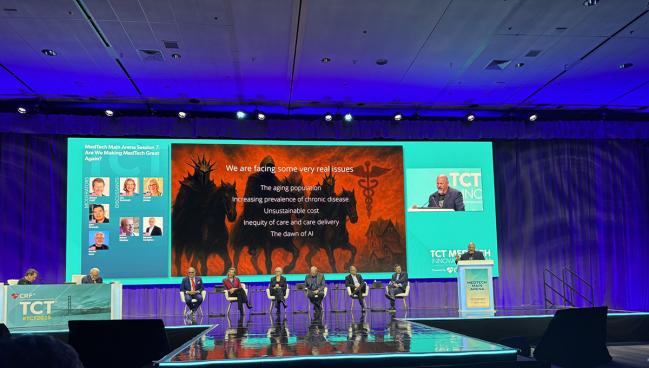
SAN FRANCISCO, CA—Medical technology, or MedTech, is currently at a crossroads thanks to the burst of innovation in artificial intelligence (AI) and other technological tools to augment clinical practice, with regulatory and other agencies struggling to keep pace. But what form MedTech will take is still being envisioned, according to experts.
This year’s TCT MedTech Innovation Forum featured a wryly named session: Are We Making MedTech Great Again? Those who took part explored not only the successes and failures already seen but also the barriers to progress, how to surmount them, and how best to ensure these advances reach patients.
Martin Leon, MD (NewYork-Presbyterian/Columbia University Irving Medical Center, New York, NY), who co-moderated the session, kicked things off by asking the audience for their views on “where MedTech is right now.” Among the various options in the survey—inspired, cautiously optimistic, frustrated, or hoping for a “full reboot”—replies were mixed though leaned positive, unsurprisingly given the audience’s interests.
Co-moderator Robert Califf, MD (Duke University Medical Center, Durham, NC), former commissioner of the US Food and Drug Administration, also pointed to the highs and lows.
“My thinking in all this is we’ve got to walk and chew gum at the same time. And I think we’re chewing gum really well. By that, I mean if you just step back a minute and look at what’s happened over the past 20 years, or even the last 5 years, the big common problems of revascularization, atrial fibrillation, valvular heart disease [have seen] amazing progress,” said Califf, adding, “I feel like we’re in an era right now refining those technologies and making them better. And that’s great. I’m all for it.”
When it comes to the “walking part,” however, Califf was much more skeptical.
“It’s getting more and more apparent, and almost every American knows it now, [that] we have the worst longevity and functional status of any high-income country in the world, and the gap is growing larger by the day,” he said.
This is not because the US lacks technology, but instead because some of the basics aren’t being handled. Cardiometabolic disease, which is one of the biggest drivers of poor health, isn’t a mystery to any cardiologist, said Califf. Part of the problem is the undersupply of primary care physicians, something he suggested might be overcome by connecting “technology with human team-based care that takes care of these very fundamental cardiovascular issues.”
All that said, “it’s hard to argue MedTech isn’t moving forward pretty quickly compared to what most people would expect,” he added. The question is whether the United States, which lacks funding for fundamental research, will be able to maintain its lead going forward.
Doing so will require creative thinking and real action, the session’s discussions made clear.
Leon, seeking input on the best path, outlined several options: “smarter devices and predictive analytics, patient-centered design solutions built around outcomes and experience, cross-industry convergence where MedTech meets pharma, biotech, etc, or new innovation models, faster risk-taking, leaner development, and smarter funding.”
For his part, said Leon, “I think we need one that’s all of the above.”
Cooperation was a strong theme throughout the daylong forum, itself a team effort that’s been led annually by the Cardiovascular Research Foundation (CRF) and Fogarty Innovation for the past 4 years. Later during TCT, the news came that the two nonprofits had taken a more formal step: a strategic merger. Each will retain its own name, with Fogarty Innovation “serving as CRF’s West Coast innovation hub,” according to a CRF press release.
The goal is “to create a unified platform for advancing transformative healthcare technologies” that will further early-stage innovation and enable breakthroughs to move more quickly into real-world practice, the announcement says.
The capability of the human brain and what we can do in the next 10 years is going to explode. Juan Granada
Juan Granada, MD, president and CEO of CRF (New York, NY), who co-moderated of the session, said he believes the US is doing quite well.
“We have the best healthcare system in the world. There’s no question,” he emphasized. “It pains me to see sometimes when they say, ‘Oh, the US is lagging behind and it’s actually worse than the rest of the world.”
Although the US has issues with lack of access, equity, and sufficient workforce, he said, the counterargument is the many novel therapies being developed here. “To be perfectly honest, we can actually talk about metrics and numbers and things like that, but [when] it comes down to access to technologies, to diagnosis, and to care, the US is actually one of the best systems in the world without any question, [in] my personal perspective.
“I am incredibly excited about what is coming because the capability of the human brain and what we can do in the next 10 years is going to explode,” said Granada, adding that the biggest challenge will be to identify what the most important needs are.
Growth Amid Hard Times
Louis Cannon, MD (BioStar Capital, Charlevoix, MI), among the array of presentations, shared his perspective as an interventionalist and investor. Predicting a “renaissance ahead,” he said the current era is a “Big Bang” for MedTech in healthcare.
“We’ve got AI and it’s going strong: 40% per year growth over the next 5 years,” Cannon said. “We’ve got smarter devices, we’ve got imaging, we’ve got autonavigation during our imaging, and we’ve got robotics . . . that can bring care to the patient instead of the patients to a brick-and-mortar hospital.”
This availability to extend care outside of the hospital setting is a key goal, said Cannon.
For example, about 800,000 strokes occur each year in the United States, but out of 5,500 hospitals, only a few hundred offer specialized stroke care, he said. Telerobotics can help in these circumstances, Cannon continued. “We need to be able to take care [of patients] a hundred miles away. It’s not fair for a patient in Michigan to be on an island and have to have the Coast Guard bring that patient in 2 hours to a critical care hospital that basically does nothing.”
Mariell Jessup, MD (University of Pennsylvania School of Medicine, Philadelphia), chief science and medical officer of the American Heart Association (AHA), said Cannon’s presentation raised a common theme.
“What we hear over and over at the American Heart Association, even at the level of basic discovery, is: ‘We can do all this and we can have wonderful technology, but we need implementation, implementation, implementation.’ It needs to get to the people,” she said. This can happen through revolutionary technologies or changes to systems of care, Jessup suggested, giving the example of aortic stenosis, where equitable access to treatment has proved challenging.
Califf countered, “Do you think that systems of clinical care can overcome the wealth disparities that we’re creating in this country, which I think are even worse [than] in the 1920s at this point? Access is not just a matter of having a doctor available. People are having trouble paying for food right now.”
“Of course, that’s true,” Jessup acknowledged. That said, evidence from the AHA’s Get With the Guidelines quality-improvement programs shows that while “it’s not simple to do, . . . more people get better care by trying to address systems,” she added.
There’s tremendous potential for us as an industry to be able to address those real pain points that we’re facing and really drive access, identifying patients earlier in the disease progression. Lisa Earnhardt
Lisa Earnhardt, MBA, executive vice president at Abbott (Abbott Park, IL), said that companies can play a role as a “solution provider” when it comes to workflow, the physician workforce, and other such concerns around equitable care.
“I do think there’s tremendous potential for us as an industry to be able to address those real pain points that we’re facing and really drive access, identifying patients earlier in the disease progression,” Earnhardt said, citing the potential for AI and predictive analytics to do not only that but also optimize procedures and ultimately offer chronic care management. The idea is to “take burden off the system and keep patients out of the hospital,” she noted.
Bernard Zovighian, CEO of Edwards Lifesciences (Irvine, CA), said he’s optimistic, especially if MedTech can learn from other industries how to move quickly but efficiently. He worried, though, that the current environment may be too conservative. “You start with a concept [then] by the time you bring it to patients, usually it’s 10 years. By the time it’s adopted by physicians around the world, it is an additional 10 years,” said Zovighian.
It Can’t All Rest on AI
Artificial intelligence will help further the “democratization” of healthcare, Robert Wachter, MD (University of California, San Francisco), said. Pointing to a recent study showing that “if a primary care doc simply did all the preventative things they were supposed to do by guidelines, that would take 27 hours a day,” he said. Creative technology, not expensive concierge medicine only available to few, can forge a path by enabling generalists to become specialists as needed for their patients.
That said, “the technology has to get better, but much more importantly, systems need to reengineer themselves around [it], and we don’t do that. Typically, we plunk the technology down into a dysfunctional system and expect it to change everything around,” Wachter added.
Califf, though, urged for regulatory “guardrails” as the field expands and agreed with Wachter that “you can’t sprinkle AI angel dust on the problem and solve it.” Public trust, he specified, is crucial. Medicine has made mistakes over the years when it comes to safety, among them thalidomide and the Dalkon Shield, and the message based on these experiences is that unchecked enthusiasm can lead to dangers society is unwilling to accept.
Additionally, not every hoped-for therapy pans out. “Nine out of 10 drugs that get into phase I don’t make it to market, because the risks exceed the benefits or you can’t make it safely,” he said. “This is a tough game where if you predicted failure every time, you would be right most of the time. And so if we loosen up too much, we’re going to hurt a lot of people, and we have to take that into account.”
This is a tough game where if you predicted failure every time, you would be right most of the time. And so if we loosen up too much, we’re going to hurt a lot of people. Robert Califf
Most investigators in the United States are ethical and take the appropriate precautions, but there must be a regulatory process in place that doesn’t let unscrupulously developed products slip through, he said. “The FDA, for the most part, is like a referee. It’s operating by a set of rules and making the judgment based on safety and efficacy,” with both those factors—but particularly safety—in mind.
Guardrails must be in place to “catch the cheaters” and keep people from naively doing dangerous things, Califf emphasized.
Leon said that clinician scientists are on the same page with regulators regarding safety. “I think most of the physicians who were involved in early-stage investigation [know] the compelling weight and burden of trying to deal with those issues,” he commented. “From my perspective, I think that the FDA has really been a great partner in trying to navigate what is . . . a very fine line, but, but you’ve got to have somebody doing it.”
Yet the sentiment in the session, among most attendees, was that the regulatory process was a bottleneck and the US was losing its edge.
Michael Jaff, DO, chief medical officer at Boston Scientific (Marlborough, MA), in his talk, envisioned a “new FDA for a new era.”
He, too, pointed to the strain in medicine. “We spend more on healthcare than most nations of the world,” without a lot to show for it, Jaff said, noting that US hospitals and health systems, counterintuitively, “are mostly living on razor thin margins.”
Physicians are under pressure as well, he said. “They’re becoming disenfranchised and demoralized, and it’s not only because they’re not getting paid enough.” With recent cutbacks to federal funding, many are concerned, too, about poor morale in the FDA workforce and how it might impact the speed with which new products are approved, Jaff continued.
That said, the agency has for the past few years been attempting to modernize its approach by allowing for approval of label expansions based on nonrandomized studies and real-world data, he said. The upward growth of MedTech, particularly AI, is inexorable, stressed Jaff, though alongside this “there has to be evolution of the regulatory framework, high-quality opportunities, and [emphasis] on appropriateness of care.”
Cannon, for his part, pointed out that slow regulatory processes mean that patients may suffer in a different way—from not having much-needed products on the market, an argument Califf found unpersuasive.
“For every [example] you give about hurting people by not having something available, there are many people who would’ve been hurt had the guardrail been let down,” said Califf. “So often we find the products, when the trials are done, just don’t cut the mustard. And it’s very hard to know that if you don’t get the evidence in the premarket phase—we keep learning that lesson over and over again.”
What’s needed is balance, he asserted. “We don’t know about the things that would’ve been beneficial had they not been stopped.”
Innovation Doesn’t Come Cheap
Andrew Cleeland, CEO of Fogarty Innovation (Mountain View, CA), kicked off his talk by clarifying that while it focused on the barriers MedTech faces to financing its effort, he indeed feels “incredibly optimistic” about the future.
To start, he said, “the essence of innovation is deeply understanding the problem and assessing if it really needs or is worth solving.” At the moment, this endeavor is “facing some very real issues,” Cleeland added.
MedTech is in a position to transform healthcare and save lives, Cleeland noted. “But it’s a long, costly process that involves navigating a complex, often fragmented landscape, far more intricate than most industries.” Typically, when getting a product to market, the “end user” and “decision maker” are one and the same. In contrast, “MedTech involves a diverse ecosystem of patients, families, physicians, providers, payers, regulators, investors, and acquirors—all with unique perspectives,” he explained.
Cleeland stressed that this complexity involves risk. For every 100 startups that get seed funding, only five will see their project come to fruition in clinical practice, he said. The time between the emergence of an idea and it being tested in a pivotal trial averages 5 years, with another 4.8 years between that trial and premarket approval. Reimbursement follows approximately 5.7 years later.
All of this is quite expensive at around $96 million to go through that process from start to finish, said Cleeland. Venture money is what allows innovation to occur, but according to Cleeland, returns for healthcare ventures are relatively modest, at around 1.34 times what’s invested. In comparison, investing in the S&P 500 over the past 5 years would have earned 11.6% annually. “It would’ve been simpler to put your money in one of those market-tracking accounts,” he commented.
MedTech faces the growing problem that the “math doesn’t work,” Cleeland said, arguing that the funding model needs to evolve.
This isn’t a bubble, not just a balloon. This is the Hindenburg. Peter Fitzgerald
Peter Fitzgerald, MD, PhD (Stanford University School of Medicine, CA), like Cleeland, pointed out that there’s reason for concern right now. Fully 70,000 AI companies are “fueling the hype” in MedTech, he said. “This isn’t a bubble, not just a balloon. This is the Hindenburg.”
The energy needs and investments driving the AI industry are substantial, so it’s important to prioritize those that will be best to medicine, stressed Fitzgerald. In doing so, “data are important,” he said. But it’s not just about numbers, Fitzgerald added. “You have to add context to get information, you have to interpret to get knowledge, and then you [must] have judgment to get wisdom.”
New technologies can help digest the healthcare data that’s, at the moment, often disarrayed and often siloed. AI in particular, Fitzgerald said, can help digest the onslaught of research findings and bring convenience to their application, such as through point-of-care devices.
“But we need to be a little bit careful. We need transparencies of these training sets and these [large language models]. There’s security problems as you bring in all these agents,” he said. “I think we have to have people that are the guardrails, and a system . . . has to be put up and that’s our responsibility. Ultimately, we’re going to provide better care with data and AI.”

Caitlin E. Cox is Executive Editor of TCTMD and Associate Director, Editorial Content at the Cardiovascular Research Foundation. She produces the…
Read Full BioSources
Various presentations. Are we making MedTech great again? Presented at: TCT MedTech Innovation Forum. October 25, 2025. San Francisco, CA.
Related News



Comments