Hints of a Mortality Benefit With TTVR at 2 Years TRISCEND II
The data are limited but suggest the tricuspid valve procedure can do more than improve health status, researchers say.

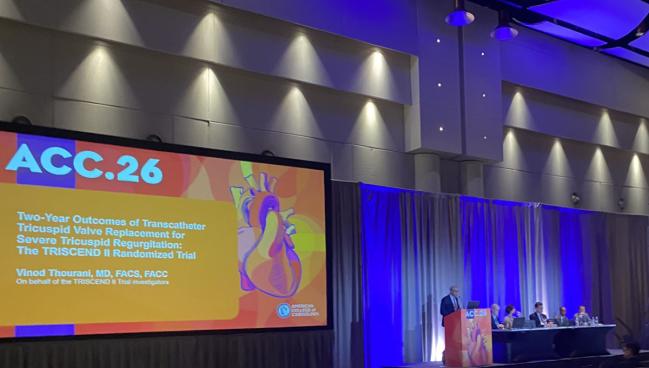
NEW ORLEANS, LA—Transcatheter tricuspid valve replacement (TTVR) remains safe and effective at 2 years for patients with severe tricuspid regurgitation (TR), with sustained improvements in quality of life, according to new data from the TRISCEND II randomized trial.
Intriguingly, a crossover analysis suggested that those who received the Evoque device (Edwards Lifesciences) had better survival over follow-up compared with those who did not.
With these new data, though limited, “I'm starting to feel a lot more comfortable saying that [TTVR] does help with mortality,” said Vinod Thourani, MD (Piedmont Healthcare, Atlanta, GA), who presented the findings last week at the American College of Cardiology 2026 Scientific Session. “Getting rid of tricuspid regurgitation is a benefit we've seen in surgery. Now we're starting to see it in interventional cardiology.”
The results are “incredibly provocative,” said Paul Sorajja, MD (Banner Health, Phoenix, AZ), who served as the discussant.
“We see that there are potential benefits for TR correction that go beyond quality of life, which was the initial reason for these trials being positive and also for commercial approval, and that's really, really important,” he said. The high rates of crossover in the pivotal trials “has limited our ability to understand what the endpoints at two years [mean], and what we saw today is that when we look at a modified intention-to-treat analysis versus a post-hoc subgroup analysis is that we're seeing some signs that patients do worse if they're not treated with the TTVR.”
Demand has soared for more long-term data on hard outcomes with tricuspid interventions, agreed Gilbert Tang, MD (Icahn School of Medicine at Mount Sinai), who was not involved in the study. The new findings “give us a little inkling into that,” he told TCTMD.
The tricuspid space has been challenged by an inability to show that TTVR, as well as transcatheter edge-to-edge repair (T-TEER), positively effect hard endpoints like all-cause mortality and hospitalization for heart failure. The US Food and Drug Administration approved TTVR with Evoque and TEER with TriClip devices (Abbott) based on data from the TRISCEND II and TRILUMINATE Pivotal trials that demonstrated meaningful effect on health status.
2-year Findings
TRISCEND II originally randomized 400 patients (mean age 79 years; 75% female) with symptomatic, severe TR to receive TTVR or not; by 2 years, researchers had complete data on 200 patients from the TTVR group as well as 28 who remained in the control group and 58 controls who crossed over to receive the procedure.
An intention-to-treat analysis comparing TTVR with controls demonstrated no differences in the rates of all-cause mortality (19.1% vs 25.3%; P = 0.192), hospitalization for heart failure (26.8% vs 32.3%; P = 0.312), or a composite that combined all-cause mortality or HF hospitalizations (36.0% vs 43.7%; P = 0.161).
However, when control patients were stratified by crossover status in an analysis landmarked at 1 year, those who did not crossover had a significantly higher rate of all-cause mortality at 2 years than those in the TTVR group (19.1% vs 44.9%; P < 0.001). There was also a lower risk of all-cause mortality or HF hospitalization with TTVR (36.0% vs 57.4%; P = 0.004), but no effect on HF hospitalization rates alone (26.8% vs 37.1%; P = 0.171).
There were no differences in stroke observed. While severe bleeding was more frequent in the TTVR group at 1 year, rates were higher among controls (including crossovers) between 1 and 2 years (5.5% vs 14.9%; P = 0.008). Additionally, rates of nonelective tricuspid reinterventions were higher at 2 years among controls (0.8% vs 3.8%; P = 0.047). Pacemaker rates were higher at 2 years cumulatively in the TTVR cohort compared with controls (19.7% vs 9.0%; P = 0.006).
TR grade improved both in those randomized to TTVR as well as those who crossed over—about 95% in each group had mild or less TR by 2 years (P < 0.001 for both). However, only 15.4% of those on optimal medical therapy alone reported mild or less TR over 2 years (P = 0.057).
Health status as defined by the Kansas City Cardiomyopathy Questionnaire overall summary score (KCCQ-OS) improved by 17.8, 19.6, and 14.1 points from baseline in the TTVR, crossover, and optimal medical therapy groups, respectively.
Lastly, a post-hoc sensitivity analysis with Bayesian modeling—which assumed that no withdrawal or crossover occurred—showed a lower 2-year rate of all-cause mortality with TTVR compared with controls (19.1% vs 29.4%; P = 0.03). The analysis demonstrated a 17.6-point improvement in KCCQ-OS with TTVR over 2 years with only a 1.9-point improvement among controls (P < 0.01).
Tang expressed concern about the increasing pacemaker rate observed in the TTVR group, especially given real-world data presented last year showing a 14.9% pacemaker rate at 30 days.
“That is something to keep an eye on,” he said.
Still, these data show that the valve works in eliminating TR, Tang added. “That's a good thing. Also, I think from a quality-of-life standpoint, . . . waiting 1 year to crossover doesn't penalize you necessarily. But from the replacement standpoint, unlike repair, it may preclude you from getting the therapy because of the anatomy potentially.”
Ultimately, he said, “if the mortality benefit is real, I think that's encouraging. But I think the safety still remains with repair over replacement. I think that is still a heart team decision and discussion with the patient about the pacemaker risk, if they’re pacemaker naive, bleeding risk and also, potentially, the need for anticoagulation because of the issue of valve thrombosis.”
Caveats and Implications
Notably, Thourani cautioned, “the study was powered for a composite primary endpoint at 1 year, not for individual components such as mortality and heart failure hospitalization.” Also, he said, “the post-hoc Bayesian analyses were not pre-specified.” For that reason, these results are hypothesis generating only.
All patients enrolled in TRISCEND II had anatomy suitable for TTVR, but symptoms in follow-up drove the need for crossover.
“When we did go back and look at the difference between crossover and non-crossover patients, we saw that the crossover patients had higher uses of diuretics, they felt worse, [and] they were in higher class III and IV heart failure,” Thourani said. “That gives you a sense that in some patients, . . . medical therapy really works and those patients felt better and didn't require the crossover.”
Sorajja pointed to a common criticism of the study in that the patient numbers get “really small” out to 2 years. “That just happens with a trial of this size,” he said. “How do we interpret what some of the safety concerns in the trial were in the beginning versus this potential long-term benefit when we have a cohort of just 22 patients for the comparison?”
Thourani acknowledged that if he could design the trial again, he’d want 1,000 patients in each arm, with no crossover allowed for 3-4 years. Still, he continued, “even with that small number, we showed a mortality benefit. But we as investigators still believe that we need to do something on top of that. Hence the Bayesian [analysis].”
While multiple options are now on the table for patients with severe TR, Sorajja asked how much of the benefit seen in the trial was related to the TR correction and how much to the device itself. “Does it matter how we get there in terms of seeing this potential benefit in 2 years or so?”
In the surgical literature, Thourani said it’s been proven that “the less TR you have, the longer you're going to live and the less hospitalizations you're going to have. I think that the reduction of the TR makes a lot of sense.” At the same time, more work needs to be done to determine which anatomies would benefit from TTVR over T-TEER, and vice versa, he added.
“Across the board, we want something that's reproducible,” Thourani continued. “We want something that's effective and we want it to be able to be done in 500 centers at least in the United States that are doing these procedures.”

Yael L. Maxwell is Senior Medical Journalist for TCTMD and Section Editor of TCTMD's Fellows Forum. She served as the inaugural…
Read Full BioSources
Thourani V. Two-year outcomes of transcatheter tricuspid valve replacement for severe tricuspid regurgitation: the TRISCEND II randomized trial. Presented at: ACC 2026. March 30, 2026. New Orleans, LA.
Disclosures
- Thourani reports receiving consultant fees/honoraria from Abbott Vascular, Artivion, Atricure, Edwards Lifesciences, and JenaValve and research grants from Abbott Vascular, Artivion, Atricure, Edwards Lifesciences, Trisol, and Medtronic.
- Tang reports receiving speaker’s honoraria and serving as a physician proctor, consultant, and advisory board member, in addition to having steering committee roles, for Medtronic and Abbott Structural Heart. He reports serving as an advisory board member for Boston Scientific, Anteris, Philips, Edwards Lifesciences, Peija Medical, and Shenqi Medical Technology.
- Sorajja reports receiving consultant fees/honoraria from 4C Medical, Abbott Structural, Boston Scientific, Evolution Medical, Medtronic, Philips, and Shifamed; other conflicts with Abbott Structural, Boston Scientific, Medtronic, and Vdyne; and serving on the speaker’s bureau for Abbott Structural and Medtronic.
Related News



Comments