At 3 Years, DCBs Still Less Safe Than DES in De Novo CAD: REC-CAGEFREE I
Follow-up over 10 years may show different patterns, and experts predict DCBs will likely be useful in certain populations.

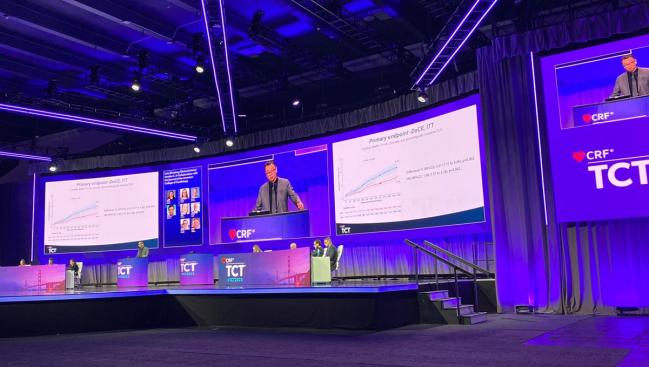
SAN FRANCISCO, CA—Yet again, a paclitaxel-coated balloon has failed to perform as well as a drug-eluting stent in treating de novo, noncomplex coronary lesions, according to additional follow-up of the REC-CAGEFREE I trial.
The new data, presented last week at TCT 2025, are in line with what was seen in the trial at 2 years with the drug-coated balloon (Swide DCB; Shenqi) compared with a sirolimus-eluting stent (Firebird2; MicroPort). The rate of a device-oriented composite endpoint (DOCE) at 3 years, which was comprised of CV death, target-vessel MI, and clinically and physiologically indicated TLR, was significantly worse with the DCB compared with the DES (8.2% vs 5.0%; HR 1.68; 95% CI 1.21-2.34).
Senior author Chao Gao, MD, PhD (Xijing Hospital, Xi’an, China), said the investigators plan to follow these patients through 10 years to see if any long-term differences emerge. “The longer-term [analysis] is more important to compare a balloon and a stent,” he said.
The question of how DCBs will fit into clinical practice remains unanswered. During a press conference, Robert Byrne, MBBCh, PhD (Mater Private Network, Dublin, Ireland), said: “I don’t think any of us think that we’re going work in a world that’s a 100% DCB or 100% DES. It would be a matter of seeing how it shakes out in the proportion cases where you might use DCB for avoiding a permanent implant.”
The recent SELUTION DeNovo trial, also presented at TCT 2025, tested a strategy that compared a sirolimus-coated balloon (Selution; Cordis) with provisional stenting against DES and found the DCB to be noninferior for the primary endpoint of target lesion failure at 1 year. Study designs differed, which precludes a direct comparison between the DCBs, although Byrne believes there are some lessons to be learned.
“For me it gets down to how much decrement in antirestenotic efficacy is acceptable for avoiding a permanent implant. If you look at REC-CAGEFREE I, you say that’s probably a study where that decrement in efficacy was too much,” he said. “If you look at SELUTION—and we’re still getting all of the data— . . . you say, well, maybe it’s a study where that decrement in efficacy is just about okay.”
Roxana Mehran, MD (Icahn School of Medicine at Mount Sinai, New York, NY), who moderated the press conference, agreed that DCBs and DES will both play a role.
“There’s going to be a happy medium where we find drug-coated balloons in our armamentarium of treating patients,” she said, encouraging all operators to learn to use them. “We cannot go to the mistake of what happened with drug-eluting stents when they first came out, where we just went from 0% use to like a 100% use with no real regard for imaging and everything else that we now have.”
REC-CAGEFREE I at 3 Years
The study, simultaneously published in JACC, randomized 2,272 patients (median age 62 years; 69.3% men) following successful predilatation of de novo coronary lesions to either DCB with the option of rescue stenting or standard DES PCI.
The overall difference in DOCE at 3 years was driven by TLR (4.2% vs 1.6%; HR 2.66; 95% CI 1.54-4.57), mainly elective revascularizations, as there were no differences observed in the individual endpoints of CV death or target-vessel MI. In landmark analyses, the rate of difference in DOCE decreased over time: from 1.69% at 0 to 1 year, to 1.1% at 1 to 2 years, and 0.58% from 2 to 3 years (P for trend = 0.023).
There was also a trend toward less bleeding with DCB vs DES (1.4% vs 2.6%; HR 0.55; 95% CI 0.3-1.02).
Subgroup analyses showed consistency with the main findings, with a trend suggesting patients without small-vessel disease fared better with DES (P for interaction = 0.076).
Commenting during the press conference, Philippe Généreux, MD (Morristown Medical Center, NJ), said he prefers using a DCB first, then bailout stenting if the result isn’t ideal. “I think we need more work to see which population will really benefit from this [and] to see where the DCB would succeed the most,” he said, “And it will most likely be in simple lesions.”
Imaging following the DCB PCI will also help predict which devices will fail, he added.
The DCB story continues to unfold, but Bruno Scheller, MD (Saarland University, Saarbrücken, Germany), who discussed the REC-CAGEFREE I findings in the Main Arena following their presentation, said the data confirm DCBs work as an alternative to DES in small vessels. “Overall, we have to learn in which situations stents do the best and in which situations DCBs may be a good alternative in the future,” he said. “At the end of the day, we have more and more patients with complex disease, . . . and that’s something we have to address in future trials.”

Yael L. Maxwell is Senior Medical Journalist for TCTMD and Section Editor of TCTMD's Fellows Forum. She served as the inaugural…
Read Full BioSources
Tao L, He X, Shen G, et al. Drug-coated balloon angioplasty versus upfront stenting for de novo CAD: 3-year follow-up of REC-CAGEFREE I trial. JACC. 2025;Epub ahead of print.
Disclosures
- The trial was funded by Xijing Hospital and Shenqi Medical.
- Gao reports no relevant conflicts of interest.
- Byrne reports receiving grant/research support from Abbott, Boston Scientific, Biosensors, and Translumina.
- Mehran reports receiving grant/research support from Abbott, Affluent Medical, Alleviant Medical, Amgen, AstraZeneca, BAIM, Beth Israel Deaconess Medical Center, Boston Scientific, Bristol-Myers Squibb, CardiaWave, CERC, Chiesi, Concept Medical, Daiichi Sankyo, Duke, Faraday, Idorsia, Janssen, MedAlliance, Cordis, CPC Clinical Research, Medtronic, NewAmsterdam Pharma, Novartis, Novo Nordisk, and Population Health; holding equity/stock in Elixir Medical, Stel, and ControlRad.
- Généreux reports receiving consulting fees from Abbott Vascular, Abiomed, Edwards Lifesciences, Haemonetics, Pi-Cardia, Puzzle Medical, Saranas, Shockwave Medical, Teleflex, and 4C Medical and holding equity in Puzzle Medical, Pi-Cardia, and Saranas.
- Scheller reports receiving consulting fees/honoraria from B. Braun and Medtronic and holding equity/stock in InnoRa.
Related News



Comments