Sirolimus-Coated Balloon Meets Mark in De Novo Lesions and ISR: SELUTION
The DCB is meant to address long-term stent-related complications and avoid adding yet another metal layer in ISR.

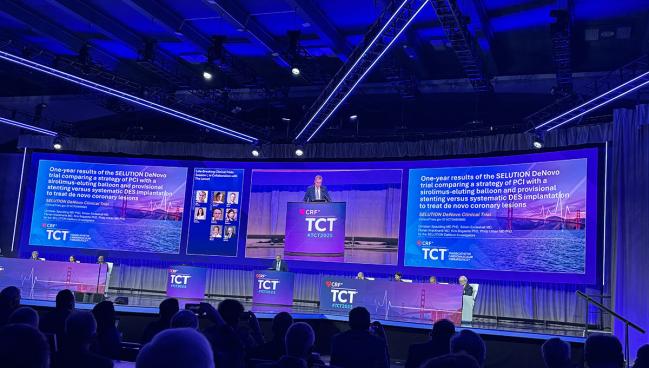
SAN FRANCISCO, CA—A treatment strategy that involves a novel sirolimus-eluting balloon (Selution; Cordis) performs as well as standard care when used to treat both de novo coronary artery disease and in-stent restenosis, according to two studies presented today as late-breaking trials at TCT 2025.
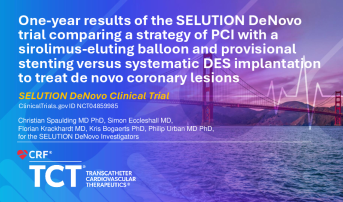
In the SELUTION DeNovo randomized trial, the drug-coated balloon (DCB) with provisional stenting was noninferior to PCI with a drug-eluting stent when it came to the primary endpoint of target vessel failure at 1 year.
In the smaller SELUTION4ISR study, the primary endpoint of target lesion failure at 1 year was not significantly different between patients with in-stent restenosis who were treated with the DCB and those treated with standard care that involved plain old balloon angioplasty or a DES.
Christian Spaulding, MD, PhD (European Hospital Georges Pompidou, Paris, France), who led the SELUTION DeNovo randomized trial, said the promise of DCBs in patients with coronary disease is in preventing the late complications seen even with today’s best stents.
“If you look at the long-term follow-up of studies with drug-eluting stents, you have a 2% to 4% annual rate of adverse events that is due to stent-related complications,” he told TCTMD. “Either very late stent thrombosis or new atherogenesis with new lesions: if you don’t implant a stent, theoretically, you could avoid having these complications.”
If you don't implant a stent, theoretically, you could avoid having these complications. Christian Spaulding
Through 1 year, though, the study at least shows the DCB compares favorably to the DES, said Spaulding.
Donald Cutlip, MD (Beth Israel Deaconess Medical Center, Boston, MA), who led SELUTION4ISR, said there is substantial reluctance from most operators to place an additional stent in patients with in-stent restenosis. In the US, the paclitaxel-coated balloon (Agent; Boston Scientific) is the only approved DCB for the treatment of in-stent restenosis. DES, however, remain recommended as the first-line approach in both European and US guidelines if a repeat PCI is planned.
Based on SELUTION4ISR, Cutlip said the sirolimus-coated device is a “safe and effective alternative to standard of care” for the treatment of ISR.
The SELUTION DCB has a proprietary phospholipid coating designed to facilitate uptake and retention of the drug in the tissue and “microreservoirs” that deliver sustained sirolimus release over 90 days.
Kevin Bainey, MD (University of Alberta/Mazankowski Alberta Heart Institute, Edmonton, Canada), who wasn’t involved in the studies, said the novelty here is the use of sirolimus.
“The paclitaxel story has had mixed results,” he said. “Now, the use of sirolimus in this platform, where it’s used with a biopolymer, to me, it appears that there’s better tissue concentration, which will help with the remodeling phase of the vessel. The concept of it appears very attractive in terms of how they’ve modified the technology to deliver the drug. And clinically, it appears to make sense.”
DCB in De Novo Lesions
So far, DCBs haven’t panned out in studies testing them in patients with de novo coronary disease. There are data suggesting the devices might perform well when used in patients with small-vessel disease, but the large REC-CAGEFREE I trial, which included a broad population of patients with de novo disease, found that the paclitaxel-coated balloon was associated with worse outcomes compared with a DES.
SELUTION DeNovo included patients with reference vessel diameters of 2.0 to 5.0 mm, with no limit of the number of lesions or vessels. Those with chronic total occlusions, left main disease, previous PCI, or saphenous vein grafts were excluded, as were those with STEMI or unstable NSTEMI. The DCB strategy involved mandatory lesion predilatation and a minimum DCB inflation of 30 seconds. DES could be used if there were residual stenosis/recoil exceeding 30%, a high-risk dissection, or a lesion that remained hemodynamically significant.
The paclitaxel story has had mixed results. Kevin Bainey
Unlike prior DCB studies, randomization was performed prior to lesion preparation. After doing so, 1,671 patients were randomized to the sirolimus-coated balloon and 1,670 to DES. Moderate or severely calcified lesions were present in more than 22% of patients (adjunctive devices to modify calcium could be used based on operator preference), and nearly two-thirds had type B2 or C lesions.
The primary endpoint of target-vessel failure, which includes cardiac death, target-vessel MI, and clinically driven target-vessel revascularization, was 5.3% with the DCB and 4.4% with DES (P = 0.02 for noninferiority). Clinically driven TVR occurred in 3.3% of patients treated with the DCB compared with 2.1% treated with the DES.
There were no differences in any secondary safety endpoints.
In the subgroup analysis, which was unadjusted, there were significant interactions by sex, bleeding risk, and the presence of moderate or severe calcification. The rate of TVF was higher among women treated with the DCB than among those treated with the DES (P = 0.04 for interaction), but the rate was lower in those with a high bleeding risk and moderate-to-severe calcification treated with the DCB (P = 0.04 and P = 0.01 for interactions).
In the study, nearly 20% of patients randomized to the DCB strategy received a provisional stent, said Spaulding.
Weighing In on SELUTION
Sanjit Jolly, MD (McMaster University/Hamilton General Hospital, Canada), who wasn’t involved in SELUTION DeNovo, congratulated the investigators for performing the study, noting that there was always the possibility that without a scaffold, there’d be a price to pay.
“The fact that they were able to show noninferiority in terms of clinical outcomes is impressive,” he told TCTMD. “That’s a step forward.”
In Europe, some groups have already been using DCBs in de novo coronary disease, but there hasn’t been good evidence to support their use in this setting until now, Jolly said.
“I do think that use of drug-coated balloons is going to increase, but I think we need long-term data,” he said. “I mean, bioabsorbable scaffolds looked good at the start and then by 5 years they looked really bad. We don’t know what’s going to happen here between 1 and 5 years. I do think it’s a positive signal, but before we switch over completely, I’d probably still stick to drug-eluting stents in the majority of patients until there is longer-term data.”
The fact that they were able to show noninferiority in terms of clinical outcomes is impressive. Sanjit Jolly
For Bainey, the trial reflects patients frequently seen in the real world. More importantly, the 1-year results give him confidence about the use of DCBs for de novo coronary disease.
“It gives me enough time to understand whether or not there are going to be acute vessel issues,” he told TCTMD. “At 1 year, you would anticipate that you would have reendothelialization and that all of your dissections would heal, and so on. . . . If you make it past the first 30 days, I think you’re much more confident that nothing egregious is going to happen later on, so I do believe the 1-year data are very important.”
Bainey noted that he will sometimes use the Agent DCB in “the right patient” with de novo coronary artery disease. In a young patient requiring multivessel PCI, for example, he may try to preserve a vessel for future bypass surgery. “That, to me, is probably the most attractive feature, the mid-to-distal LAD DCB,” he commented.
One of the issues with DCBs is acute recoil, said Jolly, emphasizing the importance of lesion preparation, which was also highlighted by Spaulding and other operators.
To TCTMD, Azeem Latib, MD (Montefiore Medical Center, New York, NY), said that while the manufacturer is calling the device a “drug-eluting balloon,” a consensus document from the Academic Research Consortium recommended standardizing the nomenclature to eliminate confusion.
“We suggest using DCB for all of them, even though clearly they’re not all created equal,” he said. “These devices are so different that we have to be careful not to class them together. No two sirolimus-coated balloons are the same, and with paclitaxel it’s even worse because there’s probably about 12 balloons out there, particularly in Europe, and none of them are the same as far as efficacy and safety.”
ISR Study
In SELUTION4ISR, investigators randomized 210 patients to treatment with the sirolimus-coated balloon and 208 to standard of care that included use of plain old balloon angioplasty (capped at 20%) or DES (the remaining 80%). The design was intended to mirror treatment patterns in the US, said Cutlip.
Key inclusion criteria included a target lesion with prior BMS or DES that was not within 5 mm of the proximal or distal edge of the vessel. Patients with two or more previous stents in the lesion were excluded. Intravascular imaging was required before treatment and operators were allowed to prepare the vessel with cutting or scoring balloons.
These devices are so different that we have to be careful not to class them together. Azeem Latib
In the per-protocol analysis, the primary endpoint of target lesion failure occurred 16.2% of those treated with the DCB and 14.5% in the standard care arm. The difference fell within the prespecified noninferiority margin of 10% (difference 1.7%; posterior probability for noninferiority 98.8%). Secondary and safety endpoints also were similar in the two treatment arms and there was no significant difference seen across subgroups.
To TCTMD, Jolly said they currently use DCBs for in-stent restenosis, including Agent and Pantera Lux (Biotronik). Regarding this trial, however, the design “muddies the waters” a little bit given that standard of care included both balloon angioplasty and DES, said Jolly. When investigators looked more closely at the standard care group, for example, the rate of target lesion failure was roughly 50% lower with the DES compared with DCB. For this reason, he would like to see the sirolimus-eluting balloon compared with contemporary DES in a head-to-head randomized trial.
Robert Byrne, MBBCh, PhD (Mater Private Network, Dublin, Ireland), the discussant following the presentation, said that using plain old balloon angioplasty as a comparator in some patients is one of the key limitations.
“We presented data 14 years ago in the late-breaking clinical trials session at TCT showing that plain old balloon angioplasty wasn’t a good approach for patients with in-stent restenosis,” said Byrne. “When we talk about angioplasty with DCB, it is to compare it to DES. This typically involves some trade-off between lower antirestenotic efficacy against the intuitive benefit of avoiding an additional metal stent implantation.”
Nonetheless, these data provide further support for this DCB in the treatment of in-stenosis, said Byrne.
Bainey, for his part, said the 10% noninferiority margin used in SELUTION4ISR is high, which gives him some pause about the study, but acknowledged that there may be legitimate reasons it was selected. For their part, the investigators agreed that it is a wide margin relative to the event rate but said that it should be interpreted in light of the clinical benefit that comes with avoiding an additional stent.

Michael O’Riordan is the Managing Editor for TCTMD. He completed his undergraduate degrees at Queen’s University in Kingston, ON, and…
Read Full BioSources
Spaulding C, on behalf of the SELUTION DeNovo investigators. One-year results of the SELUTION DeNovo trial comparing a strategy of PCI with a sirolimus-eluting balloon and provisional stenting versus systematic DES implantation to treat de novo coronary lesions. Presented at: TCT 2025. October 26, 2025. San Francisco, CA.
Cutlip DE, on behalf of the SELUTION4ISR investigators. Randomized trial of a sirolimus-eluting balloon versus repeat drug-eluting stenting or balloon angioplasty for coronary in-stent restenosis. Presented at: TCT 2025. October 26, 2025. San Francisco, CA.
Disclosures
- Spaulding reports grant support/research contracts from the French Ministry of Health and consulting fees from Boston Scientifi, Medtronic, Techwald, Sanofi, Novartis, SoniVie, and Valcare.
- Cutlip reports consulting fees/honoraria from Boston Scientific and grant/research support from Corvia and Cordis (MedAlliance).
- Jolly reports consulting fees/honoraria from Teleflex, Penumbra, Asahi, Abiomed, and Shockwave Medical, as well as grant support from Boston Scientific.
- Bainey reports no relevant conflicts of interest.
- Byrne reports grant support/research contracts from Abbott, Boston Scientific, Biosensors, and Translumina.
Related News


Comments