AI-ECG Finds STEMI Faster, Cuts False-Positive Cath Lab Activations
Physicians will remain in the loop, but AI can “turbocharge and augment our abilities,” an emergency medicine physician says.

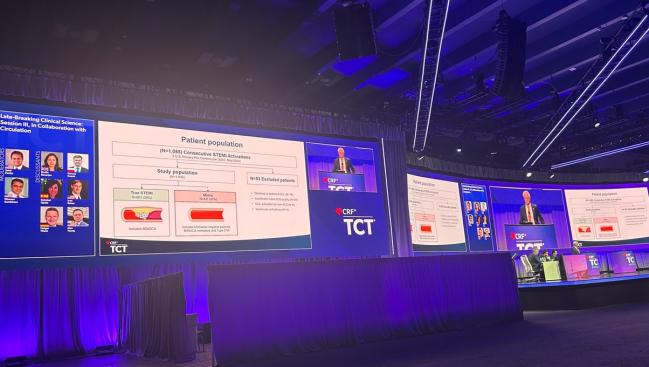
SAN FRANCISCO, CA—Artificial intelligence-based ECG interpretation (AI-ECG) outperformed standard decision-making when it came to detecting angiographically confirmed STEMI across three primary PCI networks in California, Texas, and Massachusetts, a retrospective registry study shows.
The Queen of Hearts platform (PMcardio) had better sensitivity (92% vs 71%) and specificity (81% vs 29%) than did standard processes, with an area under the curve (AUC) of 0.94.
The rate of false-positive cath lab activations also was slashed from the 41.8% seen with standard care to just 7.9% when AI-ECG was used, Timothy Henry, MD (The Christ Hospital, Cincinnati, OH), reported at TCT 2025 earlier this week. The findings were published simultaneously online in JACC: Cardiovascular Interventions.
Though major progress has been made in the treatment of STEMI over the last two decades, with expected in-hospital mortality less than 4%, there are still challenges, Henry said. Those include high rates of false-positive cath lab activations that drain hospital resources, delayed diagnoses in patients with STEMI equivalents, and delays in treatment, which increase mortality and MACE risks.

“AI-EKG analysis has the potential to reduce false activation by up to fourfold. It has the opportunity to identify more STEMI patients on the index EKG, which will significantly lower time to treatment, and it can reduce site variability,” Henry said at a late-breaking clinical science session.
Given their findings, “prospective implementation is warranted to confirm the real-world effectiveness,” he concluded. He noted that earlier in the meeting, Turkish researchers reported preliminary results of the prospective DIFOCCULT-3 trial showing that the Queen of Hearts platform improved diagnostic accuracy, shortened time to treatment, and hinted at improvements in early clinical outcomes.
Sunil Rao, MD (NYU Langone Health, New York, NY), who chaired the latest US guideline on managing patients with ACS, said he was excited by the results, pointing to the logistical challenges presented by false STEMI activations and the possibility that patients will undergo unnecessary procedures.
“We’ve been talking about AI for a long time. It’s permeating all aspects of our culture and our day-to-day life, and I think medicine is no different,” Rao told TCTMD. The models have reached the point, he added, “that now is the right time to try and implement these things.”
This study, said Rao, “is really a great shot across the bow on where I think our field is headed.”
Emergency medicine physician Ivan Rokos, MD (UCI Health – Los Alamitos, CA), the lead discussant following Henry’s presentation, agreed. “I’ve been involved with STEMI systems for over 20 years,” he told meeting attendees. “I want to be a little bit bold here and say, yes, this is the future. And I think it’s time to start thinking now about what I call version two STEMI systems driven by artificial intelligence.”
Queen of Hearts
The Queen of Hearts platform has been trained on more than 2.5 million ECGs to detect STEMI and STEMI equivalents, with angiographic confirmation, in patients with suspected ACS. Henry reported results from the Queen of Hearts US Registry, which incorporated data from the National Cardiovascular Data Registry (NCDR) Chest Pain – MI Registry on STEMI activations from primary PCI networks at the University of California Davis in Sacramento, UT Health in Houston, TX, and Beth Israel Deaconess Medical Center in Boston, MA.
The retrospective analysis included 1,032 STEMI activations between January 2020 and May 2024. The majority (58%) involved true STEMIs, including myocardial infarction with nonobstructive coronary arteries (MINOCA). The remaining 42% were mimics, including biomarker-negative patients, MINOCA mimics (eg, Takotsubo cardiomyopathy or myocarditis), and type 2 MIs.
AI-EKG analysis has the potential to reduce false activation by up to fourfold. Tim Henry
Within the group with true STEMIs, 60% of patients met conventional STEMI criteria and 40% had STEMI equivalents, which still require emergency PCI but don’t meet standard ST-elevation thresholds. STEMI equivalents were less likely to trigger cath lab activation with the initial ECG (58.0% vs 79.6%) and to have a door-to-balloon time of less than 90 minutes (73.5% vs 84.6%). Although this group not surprisingly had more blockages in the left circumflex than those with conventional STEMIs (21.7% vs 6.7%), occlusions also were common in the left anterior descending and right coronary arteries (39.6% and 35.7%, respectively), Henry said. About one-third of STEMI equivalents evolved into conventional STEMIs.
The improved diagnostic accuracy of the AI-ECG versus standard decision-making was observed across almost all subgroups, with the exception of patients with left bundle branch block, in whom the point estimate indicated benefit but was not statistically significant.
The reduction in false-positive activations was most pronounced in the subset of patients with negative cardiac biomarkers, which included findings like left ventricular hypertrophy, acute pericarditis, old MIs, and long QT syndrome. In this group, there was a 91% reduction in false-positive activations. There were smaller improvements in patients with MINOCA mimics and type 2 MIs.
Eyeing Clinical Implementation
The Queen of Hearts AI-ECG model has been certified for use in Europe and has received breakthrough device designation from the US Food and Drug Administration. FDA approval is anticipated in the first quarter of 2026, according to a representative of PMcardio.
Henry explained that the platform gives a “positive”, “probable”, or “negative” result after scanning an ECG, as well as an explanation for how it made that determination. That presents an educational opportunity for emergency medicine physicians, emergency medical technicians, or cardiologists, he said. The platform also maps changes in serial ECGs.
The next step, not only for the Queen of Hearts, but also for other AI-powered tools, is figuring out how to implement and pay for them, Henry said. “Do you get reimbursed for that or does the hospital just pay for things like this because it makes them more efficient? And I think that’s kind of a bigger, broader issue with AI,” Henry told TCTMD.
We as physicians are still ultimately responsible for the patient, but AI can certainly turbocharge and augment our abilities. Ivan Rokos
Rao said using AI to improve decision-making is the future, noting that his institution recently deployed AI-ECG models to help pick up LV dysfunction and atrial fibrillation and is set to launch a model developed in-house to help triage patients with suspected ACS.
Asked whether RCTs demonstrating that the implementation of AI-ECG models for decision-making around ACS improve hard clinical outcomes are necessary before widespread adoption, Rao said, “As cardiologists, we’re spoiled. We really like to see the effects on clinical outcomes, and I would love to see that.”
However, he added, “I do think that reducing false activations is a good outcome. Our goal as physicians is to give the right treatment to the right patient at the right time. And if this facilitates that, I think that’s a good outcome. But, of course, we want to see impact on clinical outcomes to the extent that that’s possible.”
Rokos said he doesn’t think there’s a need for a randomized trial when the Queen of Hearts platform works as it was designed: it finds patients who require an emergent trip to the cath lab more quickly and there’s “some pretty solid efficacy data.”
He emphasized that AI-ECG provides assistance and does not operate autonomously. “Physicians are still in the loop,” Rokos said. He summarized the message from a keynote lecture delivered earlier in the meeting by Robert Wachter, MD (University of California, San Francisco), by saying, “We as physicians are still ultimately responsible for the patient, but AI can certainly turbocharge and augment our abilities.”

Todd Neale is the Associate News Editor for TCTMD and a Senior Medical Journalist. He got his start in journalism at …
Read Full BioSources
Herman R, Mumma BE, Hoyne JD, et al. AI-enabled ECG analysis improves diagnostic accuracy and reduces false STEMI activations: a multicenter U.S. registry. JACC Cardiovasc Interv. 2025;Epub ahead of print.
Disclosures
- The study was partially supported by a European Innovation Council Accelerator grant awarded to Powerful Medical.
- Henry reports grant/research support from Powerful Medical.
- Rao and Rokos report no relevant conflicts of interest.
Related News

Comments