AI-Powered Digital Stethoscope Detects Low EF in Patients With HF Symptoms
The device may help boost early detection of HFrEF for people living in low-resource settings where echo is scarce.

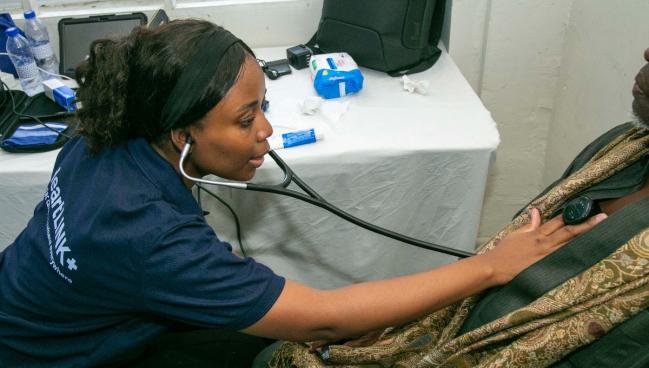
Photo Credit: G-ACT Foundation
NEW ORLEANS, LA—An artificial intelligence (AI)-enabled digital stethoscope may provide another tool to detect heart failure with reduced ejection fraction (HFrEF) in settings that have few resources and limited access to echocardiography, results of the DAMSUN-HF study conducted in Ghana suggest.
In patients with signs and symptoms of HF, use of Core 500 digital stethoscopes integrated with the Sensora AI platform (Eko Health) identified an ejection fraction of 40% or less with high sensitivity (96.9%) and a negative predictive value of 95.1%, Lambert Appiah, MD (Kwame Nkrumah University of Science & Technology, Kumasi, Ghana), reported here at the American Heart Association 2025 Scientific Sessions.
On the implementation side, more than 90% of DAMSUN-HF participants completed all four components of a workflow within a hub-and-spoke treatment model: an initial physical exam and history-taking at a local center followed by auscultation with the AI-enabled stethoscope, referral to a hub center for a confirmatory transthoracic echo (TTE), and interpretation of the results and provision of management recommendations by a cardiologist.
The “AI-powered stethoscope demonstrated remarkable sensitivity, making it a very good adjunct to transthoracic echo in a diagnosis of low EF,” Appiah said, adding that the approach was “feasible in frontline, low-resource settings” without the need for any new physical infrastructure.
Alexis Okoh, MD (Northside Hospital Heart Institute, Atlanta, GA), one of the lead investigators, along with Appiah, told TCTMD that the approach tested in DAMSUN-HF can help patients get needed healthcare not only in remote parts of Ghana but also in underserved rural parts of the United States.
This portable, easy-to-use tool “can serve as a robust adjunct to the standard of care. So the help is here,” Okoh said. “It’s a beautiful opportunity to actually bridge that gap in terms of access, and we are very excited about the future.”
The study was published simultaneously in Circulation.
The DAMSUN-HF Trial
HF is a major cause of premature cardiovascular death in sub-Saharan Africa, and onset can be decades earlier than is seen in high-income countries, Appiah said. Access to echocardiography for diagnosis is limited in Ghana, however, leading to delayed recognition and increases in recurrent hospitalizations and death. In addition, there also are only about 20 cardiologists in the country of 35 million people and hospitals are largely concentrated in the south, leaving patients elsewhere without easy access to care.
“Clearly, there is a problem,” Appiah said. In that context, the AI-enabled stethoscopes may provide a scalable, low-cost solution to early detection of HF in areas with fewer resources.
It’s a beautiful opportunity to actually bridge that gap in terms of access. Alexis Okoh
The DAMSUN-HF study included 115 adults (mean age 62 years; 53% women) living in Ghana who had signs and symptoms of HF, including dyspnea, edema, and functional limitations. They were evaluated within the workflow that included the digital stethoscopes with an AI algorithm, which was trained on more than 40,000 phonocardiograms (PCGs) using echo as the reference standard.
The stethoscopes measure 30-second PCGs from standard auscultation sites, with EF results delivered to a tablet within seconds. Okoh noted that the stethoscope does not have to be used by healthcare providers alone, with users in the study trained for only 30 minutes on how to evaluate patients with it. Then, he said, “all the results are incorporated into an algorithm, and they’re funneled to a healthcare provider to make the interpretation.”
At baseline, most patients had NYHA class III or IV symptoms (44% and 28%, respectively) and hypertension (68%). TTE showed that 59% had an LVEF below 40%.
In addition to the high sensitivity and negative predictive value observed when using the stethoscopes to detect low EF, specificity was 75.6% and positive predictive value was 84.9%. The area under the curve was 0.88 overall, with slightly better results in women versus men and in younger versus older patients.
All patients underwent the initial evaluation for cardiopulmonary symptoms and were assessed with the digital stethoscopes, 96.5% underwent confirmatory TTE within 7 days, and 92.7% had a cardiologist interpret the results and provide management recommendations within 48 hours of the echo.
Filling an Equity and Evidence Gap
Discussing the results after Appiah’s presentation, Aminah Sallam, MD (Smidt Heart Institute at Cedars-Sinai, Los Angeles, CA), noted that even though 80% of deaths from cardiovascular disease occur in low- and middle-income countries, only about 3% of CV research originates there, “underscoring a profound equity and evidence gap.”
DAMSUN-HF helps in this regard, Sallam said. “These findings demonstrate both the diagnostic strength and operational feasibility of integrating AI into an under-resourced health system without implementing new imaging infrastructure or hiring additional personnel.”
This study . . . potentially address[es] a common bias where tools are trained and tested in high-income settings. Aminah Sallam
Moreover, “by validating this technology in a low-and-middle-income country, this study improves the diversity and external validity of cardiovascular AI, potentially addressing a common bias where tools are trained and tested in high-income settings,” she added. “Ultimately, this study offers a scalable framework and template for task-shifted heart failure detection and could accelerate earlier implementation of guideline-directed therapy, advancing truly global, equitable AI in cardiovascular care.”
Appiah acknowledged some limitations of the study, including the modest sample size, its conduct in a single country, the inclusion of a mostly symptomatic cohort, and the short duration of follow-up, which precluded an assessment of the impact of the effort on clinical outcomes.
Okoh said there are plans to conduct a cluster-randomized trial including at least 5,000 patients to further evaluate the technology.

Todd Neale is the Associate News Editor for TCTMD and a Senior Medical Journalist. He got his start in journalism at …
Read Full BioSources
Okoh AK, Appiah LT, Wiafe YA, et al. AI-enabled digital auscultation for detecting heart failure with reduced ejection fraction in sub-Saharan Africa: the DAMSUN-HF study. Circulation. 2025;Epub ahead of print.
Disclosures
- The study was supported by the Global Access to Cardiovascular Therapeutics and Diagnostics (G-ACT) Foundation. EKO Health provided in-kind support in the form of donated EKO Core 500 digital stethoscopes with the SENSORA software used in the study.
- Okoh reports serving as a clinical study consultant and member of the speaker’s bureau for Edwards Lifesciences.
- Appiah reports no relevant conflicts of interest.
Related News

Comments