Barbershop Effort Falls Short for Hypertension Prevention in Black Men
The program didn’t have a big impact on BP, but there were lessons for future attempts to address these health disparities.

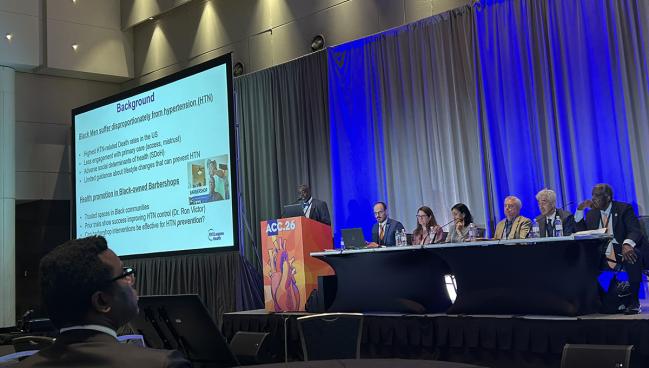
NEW ORLEANS, LA—A community health worker-led initiative based in barbershops did not have a major impact on blood pressure in Black men with elevated BP, although there were promising signals it might slow progression to more severe hypertension in the cluster-randomized trial.
Joseph Ravenell, MD (NYU Langone Health, New York, NY), reported the results here at the American College of Cardiology (ACC) 2026 Scientific Session.
There was little change in systolic BP through 1 year, the primary outcome, irrespective of whether the program was self-directed or was delivered with the help of a facilitator whose job was to understand and help overcome barriers to implementation.
A positive finding, however, was that few men overall progressed to stage 2 hypertension, a secondary outcome, during the study. The proportion was significantly smaller in the facilitated versus self-directed group at 12 months (2.9% vs 6.9%; P = 0.03), a difference that became nonsignificant by 18 months (4.6% vs 7.9%; P = 0.13).
“A community health worker-led barbershop-based [effort] can be implemented successfully using either a barbershop facilitation strategy or a self-directed strategy,” Ravenell said. Though the BP changes in the study were modest and did not differ between the two arms, “barbershop-based prevention programs may help slow progression to stage 2 hypertension and help address long-standing hypertension disparities among Black men.”
Ravenell noted that Black men have the highest hypertension-related death rate in the United States, which is at least partly related to reduced engagement with primary care due to access issues, historical and current mistrust of the medical community, and the presence of adverse social determinants of health (SDOH), Ravenell said. He added that there can also be limited guidance about lifestyle changes that can prevent hypertension in this group.
Previously, bringing health promotion to barbershops in Black communities—which are considered safe spaces where men often talk about their health, Ravenell said—has proven effective at improving hypertension control, with lasting effects. This latest effort aimed earlier in the process, for prevention of hypertension.
We do believe that there is promise in these community health worker-based approaches. Joseph Ravenell
With the Community-to-Clinic Linkage Implementation Program (CLIP), performed through the RESTORE network, a community health worker measured BP when men came in for their haircuts, screened for SDOH, referred men to primary care for hypertension management, provided counseling regarding healthy lifestyle habits, addressed any social needs, and provided referrals for health coaching if requested. At monthly check-ins, the workers reviewed Life’s Essential 8, evaluated whether participants needed clinical or social referrals, and gave reminders about follow-up visits.
Ravenell and colleagues evaluated the impact of the program in a cluster-randomized trial that involved 22 Black-owned barbershops in Staten Island, NY, assigned to either have a facilitator for the initiative or not. The study included 430 self-identified Black men (mean age 38 years) with either elevated BP (120-129/< 80 mm Hg) or untreated stage 1 hypertension (130-139/80-89 mm Hg) who were regular customers at the shops. Mean BP at baseline was 128.6/82.8 mm Hg.
Most participants (74.4%) had a GED/high school education or less, and only about half (51.2%) had health insurance. Hispanic/Latino ethnicity was reported in 43.7%, “which is important because this is a very understudied group in the cardiovascular literature,” Ravenell said.
Retention in the study was high, with 67.8% of men completing a follow-up visit at 6 months, 90.4% at 1 year, and 96.0% at 18 months.
The primary outcome was the reduction in systolic BP through 12 months. Over that span, there was no significant change in the facilitated arm and only a slight decline of about 1 mm Hg in the self-directed arm. After adjustment for age, body mass index, and ethnicity, a difference-in-differences analysis showed a significant 1.62-mm Hg greater decline in the self-directed group (P = 0.031). Diastolic BP increased slightly in both arms, with no difference between groups (P = 0.69).
Keith Ferdinand, MD (Tulane University School of Medicine, New Orleans), a panelist at the session where the results were presented, appreciated the focus on young Black men who tend to not go to the doctor and often have uncontrolled BP. He highlighted that the trial did not meet its primary endpoint and that the hint of benefit in terms of hypertension progression came on a secondary endpoint, questioning investigators about the time and energy required to implement the program.
Ravenell responded by saying that there were many lessons learned while conducting the study.
“We do believe that there is promise in these community health worker-based approaches,” he said. “What we were able to show is that these community health workers can actually stay connected to these men, and [that] gives us the opportunity to get them connected to care. But because this was a group of men who largely did not have a diagnosis, it was a challenge to actually get them to go to the doctor.”
Ferdinand asked, too, about whether there was a plan to educate the men in the study about the benefits of pharmacotherapy in stage 1 or 2 hypertension, noting that “the idea that blood pressure medicines cause sexual dysfunction and other adverse reactions is probably overstated with the newer medicines.”
Indeed, “there are lots of myths and misconceptions about pharmacotherapy that we have seen in prior studies that we’ve done in these communities,” Ravenell said. “And so for those men who did have hypertension, we were able to connect with many of them and encourage them to start pharmacotherapy.”.
In the future, his team hopes to be able to intervene with the primary care physicians who are caring for these men to encourage them to follow recommendations in the latest US hypertension guidelines.
They also want to examine which CLIP components might be most impactful, assess the scalability and sustainability of the approach in various settings, including rural areas, and explore policy and reimbursement pathways to support CVD prevention programs led by community health workers.

Todd Neale is the Associate News Editor for TCTMD and a Senior Medical Journalist. He got his start in journalism at …
Read Full BioSources
Ravenell JE. Community-engaged implementation study of hypertension prevention and navigation in black men (CLIP). Presented at: ACC 2026. March 28, 2026. New Orleans, LA.
Disclosures
- The study was supported by a grant from the American Heart Association.
- Ravenell reports no relevant conflicts of interest.
- Ferdinand reports consulting fees/honoraria from Amgen, Boehringer Ingelheim, Eli Lilly, Medtronic, Novartis, and Pfizer.
Related News



Comments