BEAT PAROX-AF: Pulsed-Field Ablation Not Superior to Radiofrequency
Increases in procedural speed and safety, however, support the continuing shift to the newer modality, one expert says.

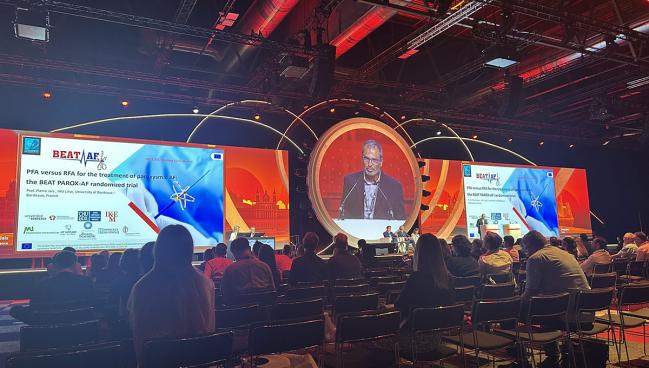
In the BEAT PAROX-AF trial, clinical success after a single procedure was 77.2% with pulsed-field ablation (PFA) and 77.6% with radiofrequency ablation (RFA) at 1 year, a nonsignificant difference (P = 0.84), Pierre Jais, MD (University of Bordeaux, France), reported recently at the European Society of Cardiology Congress 2025.
Despite the lack of superiority for PFA, the newer modality “was faster with fewer adverse events,” primarily because of a lower rate of pulmonary vein (PV) stenosis, Jais said, noting that all centers involved in the trial were highly experienced with ablation.
“Young pulsed-field ablation is already as effective as radiofrequency ablation that we have been refining for over 30 years,” he said at a press conference. “So it’s making me hopeful that in the future we will see better results with refined forms of pulsed-field ablation.”
Tobias Reichlin, MD (Inselspital – University Hospital Bern, Switzerland), the discussant for the study, acknowledged both the excellent efficacy with either ablation modality and the improved speed and safety with PFA.
“These findings support the ongoing shift towards PFA for AF ablation, because comparable efficacy can be achieved with greater efficiency and safety,” he concluded.
BEAT PAROX-AF
BEAT PAROX-AF, conducted at nine centers in France, Czechia, Germany, Austria, and Belgium, included 292 patients (58% men) with drug-resistant, symptomatic paroxysmal AF randomized to PFA with the Farapulse system (Boston Scientific) or RFA with the ThermoCool SmartTouch contact force-sensing catheter (Biosense Webster/Johnson & Johnson MedTech) applied using the CLOSE protocol and CARTO mapping system. Mean patient age was slightly higher in the PFA arm (65.0 vs 62.5 years), with a mean CHA2DS2-VASc below 2 in both the PFA and RFA groups (1.8 and 1.7, respectively).
The primary endpoint was single-procedure clinical success, defined as the absence of the recurrence of arrhythmias lasting at least 30 seconds on any type of monitoring, no use of class I or III antiarrhythmic drugs, and no redo ablations, through 12 months. Jais noted that the trial was planned with the expectation that RFA would have a lower success rate based on prior trials, such as FIRE AND ICE. “We made the assumption that we would compare the new energy to 65% success rate, which is no longer the case because in the meantime, the CLOSE protocol was there and turned out to be more successful,” he explained.
Nonetheless, Jais said, “I think it’s quite remarkable and good for our patients that whatever technology we use, we can achieve almost 80% success rate with one procedure.”
The findings were consistent across various subgroups.
The overall rate of procedure-related serious adverse events was numerically lower with PFA versus RFA (4.8% vs 7.6%). But in a post-hoc look at clinically relevant serious adverse events or events with durable consequences, PFA appeared much safer. There was one TIA in the PFA group, as compared with no TIAs, two drained tamponades, two cases of PV stenosis > 70%, and 12 cases of PV stenosis > 50% in the RFA group.
There were no deaths, MIs, symptomatic strokes, or cases of persistent diaphragmatic paralysis, peripheral or organ thromboembolism, heart block, or atrioesophageal fistula in either arm of the trial.
In terms of efficiency, PFA shaved about 40 minutes off the average procedural time (56 vs 95 minutes).
“At the end of the day, [what has] me choosing PFA over the thermal energies is that it’s safer. That’s really what makes the difference for me, but it’s also simpler and faster,” Jais said, adding that he’s not using much RFA or cryoballoon ablation anymore.
‘Reassuring’ Findings
Reichlin pointed out that PFA is the latest innovation in AF ablation technologies, which started with RFA about 30 years ago. Cryoballoon ablation came about a decade later as the prototype for single-shot procedures, he said.
Prior to BEAT PAROX-AF, two head-to-head trials pitted PFA against the thermal ablation modalities—ADVENT, comparing PFA with RFA or cryoballoon ablation, and SINGLE SHOT CHAMPION, comparing the newer technique with a cryoballoon. Both trials found PFA to be noninferior to the other ablation approaches when it came to efficacy.
Reichlin raised some issues to consider when thinking about how to integrate the findings of BEAT PAROX-AF with those from the previous studies. These include the types of arrhythmia monitoring used (intermittent versus continuous), the role of operator learning curve, whether second-generation PFA catheters will have better performance, and whether there could be a “ceiling effect” when looking at efficacy using a 30-second threshold for arrhythmia recurrences.
“Maybe there’s not much room for improvement” when using that definition, Reichlin said.
Complication rates were very low in BEAT PAROX-AF, consistent with the findings of ADVENT and SINGLE SHOT CHAMPION, which Reichlin led. “I think it underscores the high level of safety that has been achieved with the technologies,” he said.
He added, however, that large registries—including POTTER-AF—show that atrioesophageal fistula remains a risk with RFA, to the tune of about one per every 4,000 ablations. No fistulas have been reported among the more than 250,000 PFAs that have been performed to date, he said. “That’s very reassuring.”
Outside of the trials, registries have started to uncover some rarer complications associated with PFA. Several studies presented earlier this year at Heart Rhythm 2025, for instance, highlighted increases in biomarkers suggestive of myocardial damage, hemolysis, and renal dysfunction; MRI evidence of asymptomatic cerebral emboli; and potential risks of coronary spasm and stenosis.
Coronary spasm “is not good to have” and can lead to ventricular fibrillation requiring acute resuscitation, Jais acknowledged. “It’s super rare, but it may happen.”
Even so, the thermal ablation modalities carry some risk to the coronary arteries as well, he pointed out, adding that the consequences may be greater with RFA or cryoballoon ablation than with PFA.
“Altogether, the safety profile [with PFA] may be really better for patients,” Jais said.

Todd Neale is the Associate News Editor for TCTMD and a Senior Medical Journalist. He got his start in journalism at …
Read Full BioSources
Jais P. PFA versus RFA for the treatment of paroxysmal AF: the BEAT PAROX-AF randomized trial. Presented at: ESC 2025. August 31, 2025. Madrid, Spain.
Disclosures
- The study has received funding from the European Union’s Horizon 2020 research and innovation program and was also partly funded by IHU Liryc.
- Jais reports receiving research contracts from Abbott, Boston Scientific, Biosense Webster, and Medtronic and holding stock in inHEART.
- Reichlin reports receiving grant support through his institution from the Swiss National Science Foundation, the Swiss Heart Foundation, the Straub Foundation, Sitem Insel Support Funds, Biosense Webster, Biotronik, Boston Scientific, and Medtronic, as well as consulting/speaker fees paid to his institution from Abbott/St. Jude Medical, Bayer, Biosense Webster, Biotronik, Boston Scientific, Medtronic, and Pfizer-BMS.
Related News


Comments