‘Buzz and Discussion’ Driving Return to In-Person Cardiology Meetings
Politics and war can be barriers in today’s world, but in-person meetings provide a human connection that Zoom can’t match.
When the American College of Cardiology (ACC) was the first major cardiology society to cancel its annual Scientific Session in 2020 because of COVID-19, the transmission of science didn’t exactly go dark.
In those strange, confusing early days, the ACC pivoted and launched virtual presentations of its planned late-breaking clinical trials, as did the European Society of Cardiology (ESC) and American Heart Association (AHA).
The format, for some, represented the future. Online attendance was massive, dwarfing the in-person numbers, and this increase was partly driven by more physicians attending from countries typically underrepresented at international conferences. Despite increased accessibility, as well as the merits of getting new information without leaving home, any change to the meeting landscape that might have occurred with COVID-19 hasn’t had a lasting impact.
While meeting attendance numbers in the US are still down from their prepandemic highs, the ESC’s annual congress recently hosted nearly 30,000 healthcare professionals in Madrid, Spain.
Brahmajee Nallamothu, MD (University of Michigan, Ann Arbor), vice chair of the AHA Scientific Sessions, said the pandemic provided a “natural experiment” in which cardiology could imagine a world where congresses consisted entirely of Zoom presentations. If a conference was solely about putting out results, that format should have thrived even after the pandemic ended.
“I think the in-person meeting is really valuable,” Nallamothu told TCTMD. “I mean, in a way, why do we go to weddings? Why do we go to other communal events? There’s a ritualistic part of these meetings that I think is very important for the scientific and clinical communities. It’s a way of reenergizing your battery.”
What Virtual Meetings Are Missing
Beyond the ritual, however, is having access to the type of learning that happens beyond the top-line results of a large, randomized trial: it’s the “buzz and discussion” right after a major presentation, said Nallamothu.
“You don’t need to be in the room to see the event curves. You can get that on your own,” he told TCTMD. But, he added, “there have been great examples in recent years where the subsequent add-on discussion was so valuable to the community. The ISCHEMIA trial, for example, had mixed results, and placing those results, especially with its complex design, in context was the value of many of the conversations that followed the presentation. These [discussions] helped people process all these data and understand at a practical level how they were going take the results back home.”
There’s a ritualistic part of these meetings that I think is very important for the scientific and clinical communities. It’s a way of reenergizing your battery. Brahmajee Nallamothu
Bernard Prendergast, MD (Cleveland Clinic London, England), co-chairman of EuroPCR and course director for PCR London Valves, said that many had forecast the end of in-person medical meetings when the pandemic brought travel to a standstill. However, as COVID-19 stretched on, it was obvious what was missing from online presentations.
“Of course, there’s the very human element of connecting with friends, with colleagues, with collaborators,” Prendergast told TCTMD. “That is uniquely important, because there is a limit to what we can achieve through virtual communication. . . . Networking opportunities remain absolutely essential.”
Cardiovascular medicine is also a very dynamic field, he said, with new information and new views on science emerging on an almost weekly or monthly basis.
“The role of the congress becomes less one of providing the latest data and becomes more of an opportunity to reflect on those data and decide how we’ll use them in practice,” said Prendergast. “At PCR, for example, for a long time we’ve modeled our sessions on 50% of time being in information delivery and 50% being on discussion and exchange and interaction on what those things mean.”
Likewise, Ajay Kirtane, MD (NewYork-Presbyterian/Columbia University Irving Medical Center, New York, NY), a program director for TCT, said physicians historically needed to attend conferences to get up-to-date information, but that’s no longer true. Simultaneous publications, meeting websites, specialized news sources, and social media allow people to stay in the know without leaving home.
“If you only cared about information, you’d probably get a broader download than if you weren’t at the meeting,” he told TCTMD. “The thing most of us have realized, [the meetings] aren’t for the top-line information—it’s for people’s actions, their facial expressions, the chance to get the nuance you can never get even with hot takes on social media.”
That exchange of ideas and networking amongst colleagues is one of the main strengths of in-person meetings, agreed Kathryn Berlacher, MD (University of Pittsburgh Medical Center, PA), chair of the ACC Scientific Sessions.
“I think we attend in-person meetings to experience the different types of learning that you can’t do at home alone on your computer,” she told TCTMD. “You go for conversations, the formal conversations that you might watch on stage between panelists or the informal conversations that you have in the hallway with somebody else who was in the same session. Even if you’re in an academic center where you’re going to grand rounds, oftentimes you’re too busy [to chat] because you have to rush off to other things.”
Politics and Pricy Travel at Play
While the pandemic may have ended, meeting planners still have a number of challenges to navigate. Many US hospitals and physicians are under financial pressure because of the recent federal budget cuts, and the political climate is challenging.
“We’ve heard from international colleagues that not only are they in some cases concerned about coming here, but some just don’t feel like they want to come because they don’t feel wanted,” said Kirtane. “That’s individual geography of course, and that’s where the politics get involved, but you hope that medicine might be able to transcend that. It doesn’t always work because people have to come through immigration to meetings. That’s obviously more of a challenge now than it’s been in the recent past.”
With the current US administration, there is also a merging of science and politics that wasn’t seen in the past. The current environment, say meeting planners, is difficult, but Berlacher said they have not altered their meeting content in any way and continue to reach out to representatives from the US Food and Drug Administration and Centers for Medicare & Medicaid Services when they’d like them involved in sessions, panels, and other meetings.
Jean-François Riffaud, CEO of the ESC, said his organization has come through the pandemic in good financial shape, but added that there is no shortage of anxiety given the global state of affairs.
“I’m more concerned about the evolution of the Society,” Riffaud told TCTMD. “I’m concerned about the extremely high level of risk for the sector we’re in and the environment in general. I’m not only talking about what’s happening in the US but also in Europe, because I’m not looking at the ESC as only a European organization. Of course, our home is Europe, but our reach is global and so we have to anticipate the potential negative consequences of war here, or the disruption in regulation there.”
Regardless of events on the political world stage, “the ESC stands alongside the global cardiology community in our shared pursuit of science and medicine that serves patients," said Riffaud.
We attend in-person meetings to experience the different types of learning that you can’t do at home alone on your computer. Kathryn Berlacher
For many colleagues around the world, the affordability of flights, registration, and several days of accommodation in an expensive city when traveling to a meeting is a concern, Prendergast said. “That puts it out of their reach and that’s unfortunate,” he said. “In that sense, virtual meetings and virtual access remain very important.”
Some meetings, such as PCR, have discussed allowing some attendees to pay subsidized rates for the conference, he said. Another option would be to spread the meetings around the world. Instead of expensive cities like San Francisco, Chicago, Paris, or London, maybe less pricy options are possible, such as Lagos or Buenos Aires, said Prendergast.
With smaller numbers, meeting planners are also making adjustments.
“Everybody feels the pinch,” said Berlacher. “It forces you to look at your data and right-size the meeting and make sure that you’re using your space optimally. Do we really need all those fancy lights? That’s really what we’ve done. We’ve never limited educational content or things based on the budget at all, but we have gone back and asked, ‘How many sessions do we need over how many days? Over what hours?’”
Interaction Is Critical
The idea that medical meetings are even needed was challenged more than a dozen years back by John Ioannidis, MD (Stanford University School of Medicine, CA). In a provocative editorial, he questions the usefulness of conferences, arguing that these meetings may “serve a specific system of questionable values” harmful to medicine and healthcare.
The problems with conferences begin with the large carbon footprint of traveling physicians: why can’t late-breaking results be released in a peer-reviewed journal when they’re ready? Why do doctors need to travel to meetings to hear the findings? Beyond the environmental impact, the plethora of meetings and their “bulk production of abstracts” promotes mediocre resume-building, with many abstracts not even making it into medical journals, he says. That can lead to premature or inaccurate ideas about research.
Ioannidis also argues, among other things, that conferences create a “branding system” that builds the reputations of scientists and promotes “herding after elevated prestigious opinion leaders.” In some circles, leadership might be awarded not for hard work, merit, or creativity, but by political skill and the ability to navigate power dynamics.
Tomasz Guzik, MD, PhD (University of Edinburgh, Scotland), ESC program committee chair, said his organization has made efforts to focus on the needs of cardiologists and other professionals at every stage of their career, from trainees to high-profile cardiologists who run major trials.
“While the program showcases large and practice-changing trials, we are equally committed to providing a stage for young researchers to share their pioneering discoveries,” he said. “We don’t just provide a stage for the very famous trialist to present their data. We want to create something for everyone.”
The tagline of this year’s ESC meeting, which was held in conjunction with the World Congress of Cardiology, was “cardiology beyond borders.” It included sessions within global health-dedicated tracks that focused on the burden of cardiovascular disease around the world, including developing nations. Cardiology is hyperspecialized, with clinicians largely focused on their own area, but the congress programmers hoped the meeting could expose attendees to not just other disciplines, but also problems facing healthcare professionals in other countries.
For example, said Guzik, sessions were designed to address challenges in the implementation of guidelines and treatments, such as TAVI for aortic stenosis, viewed through the lens of different continents and countries. The ESC program also highlighted pressing global issues, including a session dedicated to cardiovascular care in Ukraine during wartime, discussions on the cardiovascular impact of climate change, and sessions exploring the social challenges shaping cardiovascular care in modern societies.
“I think direct interactions like this are exceptionally important,” said Guzik, adding that some of this was lacking during the Zoom era. However, the ESC has retained its hybrid format, ensuring accessibility to people who cannot travel while also recognizing that many on-site participants continue to watch sessions online, as it provides added convenience.
This year at the ESC, there were 10 Hot Line sessions with 40 trials. Nearly all those were followed by “Ask the Trialists” sessions, creating an open and interactive forum that replaced traditional top-down formats with direct dialogue and exchange. Similarly, several new guidelines were presented, each accompanied by “Ask the Task Force” sessions where the audience could pose clinical scenarios to the experts about how the changes in guidelines will affect their everyday practice. The ESC also introduced the “Fireside Chat” format where more intimate and interactive discussions could occur.
“Anybody can read the New England Journal of Medicine paper describing the trial,” Guzik told TCTMD. “What makes the ESC unique is that we bring people into the very moment when the reality of cardiovascular medicine is being shaped. It is not just about learning the results: it is about being part of history as a landmark trial is revealed for the first time.”
That shared, live experience, in a room with thousands of colleagues, is unforgettable and impossible to replicate by reading alone.
It is not just about learning the results: it is about being part of history as a landmark trial is revealed for the first time. Tomasz Guzik
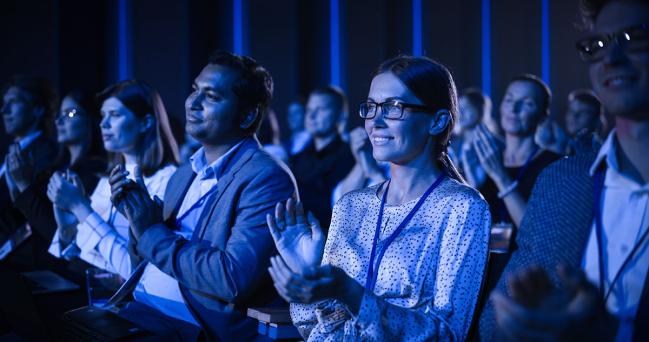
“I remember John McMurray presenting one of his trials a few years ago, [and] when the outcome curves appeared, the audience burst into applause, like at a sporting event,” Guzik continued. “This year we saw the same energy several times, with spontaneous cheering for Bryan Williams’ BaxHTN trial results. In my view, these are defining moments in the history of cardiology.”
In planning this year’s meeting, Nallamothu, working together with Joanna Chikwe, MD (Cedars-Sinai Medical Center, Los Angeles, CA), chair of the AHA Scientific Sessions, said the organizers wanted to provide value beyond the trial results. As in the past, they included several additional venues, such as “Meet the Trialist” sessions around late-breaking clinical trials and science. The ACC makes similar opportunities available to attendees.
The AHA, too, has developed core curriculums to help doctors navigate the meeting with their areas of interest in mind, while creating unique tracks of short, accessible science presentations for those not experts in different specialties. Science “has gotten so narrow” that there might be only a dozen people in the audience who understand even what the presentation’s title means, joked Nallamothu.
“But that’s what expertise is all about, right?” he said. “What we’re trying to do is have really great people with deep expertise take a step back and have the opportunity to tell us why what they work on is so important.”
Ardem Patapoutian, PhD (Scripps Research Institute, La Jolla, CA), who won the 2021 Nobel Prize in Physiology or Medicine for discovering receptors that respond to mechanical stimuli such as touch and temperature, is delivering the Nobel Laureate lecture at this year’s AHA in November. For Nallamothu, it’s a fitting speaker—a world-renowned expert known for furthering our understanding of touch—as cardiologists gather together under one roof.
Structured Curation of Data
In today’s age, where information is bombarding clinicians from all directions, Guzik said the team behind organizing the ESC Congress takes its role as “gatekeeper” seriously. He emphasized that the structured curation of data is undertaken by nearly 100 experts who make up the scientific program committee. Abstracts, presentations, Hot Lines, and late-breaking science sessions are very rigorously selected, with an eye on clinical relevance.
Prendergast and Kirtane both said scoring of submissions and adjudication of submitted work remains a critical part of their jobs as meeting planners, the goal being to ensure quality science is ready to be disseminated to a larger audience. Most major meetings now coordinate publication of studies—both large and small—in the major cardiology journals.
The opportunity to use simulation technology to do things in practical terms that you cannot do alone in your office or your study becomes very important. Bernard Prendergast
Nearly all meetings today provide hands-on experience for doctors.
“The opportunity to use simulation technology to do things in practical terms that you cannot do alone in your office or your study becomes very important,” Prendergast said. “There’s a huge appetite for it. It can range from ‘at-the-elbow’ support to how to read a CT scan. A peer, mentor, or a [key opinion leader] sitting at the desk with a new fellow, that in itself is a very powerful experience in terms of mentoring and exposure as much as it is about education.”
Berlacher said the ACC planners have adjusted their programs to reflect the new era where meetings can be a launching pad for “deeper dives” into education. Many learners, she added, prefer interactivity and want to “learn by doing,” which has led them to incorporate virtual reality and simulations into meeting programming.
“Incorporating new technology into education is really important,” she said. “The other thing that we aim to do is to use the data from our meetings to inform future education. There is a science to education and there is data about learning. Our hope is that we include the science not only in our daily patient care, but also in planning educational conferences.”

Michael O’Riordan is the Managing Editor for TCTMD. He completed his undergraduate degrees at Queen’s University in Kingston, ON, and…
Read Full BioRelated News



Comments