CAC Predicts Obstructive CAD, but Thresholds Diverge by Sex
The disparate cutoffs may help determine whether a patient should go to the cath lab. Prospective validation comes next.


For both women and men with symptomatic CAD, it may be possible to determine the odds of obstructive disease using coronary artery calcium (CAC) scoring, according to a new retrospective study that aimed to pinpoint sex-specific thresholds.
Regardless of age, CAC scores of ≥ 1,400 for men and ≥ 1,000 for women identified obstructive CAD with a 90% specificity, the authors report in a paper published recently in JSCAI. The cut points were obtained by comparing the CAC score with coronary angiography plus adjunctive tools.
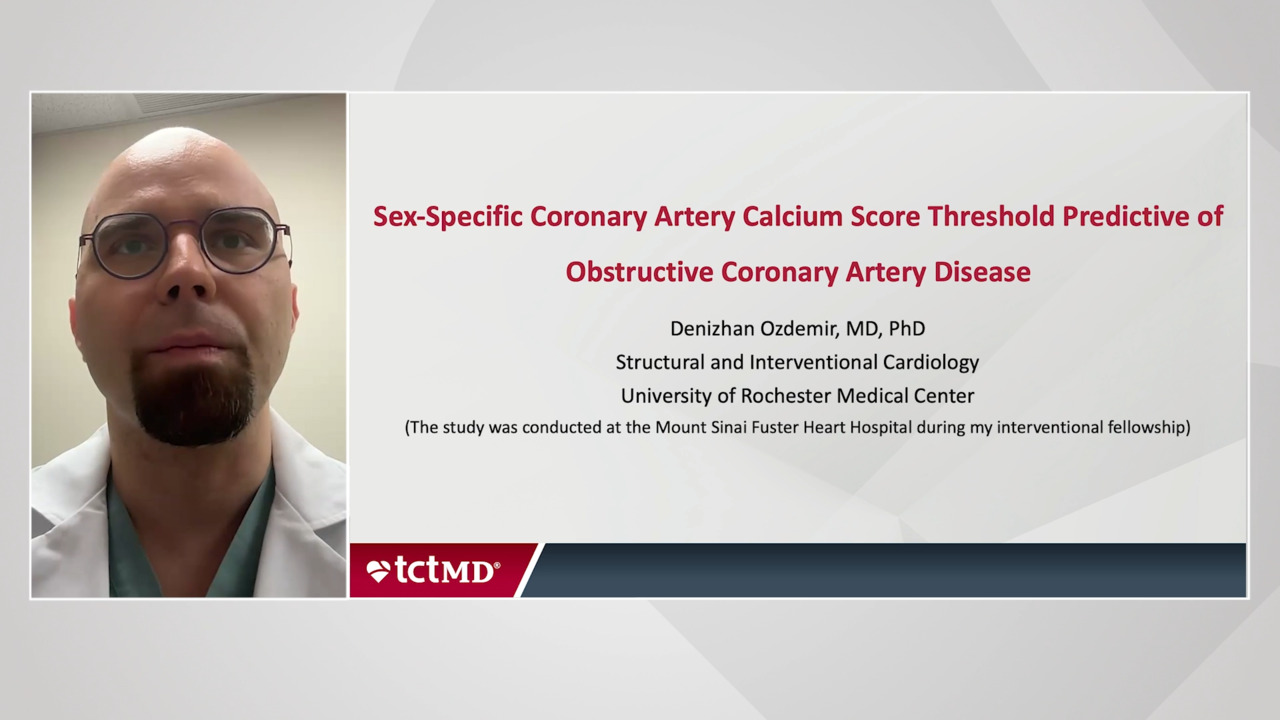
They say the findings, which are based on symptomatic patients who had already been referred to the cath lab, may be useful in “identifying patients who could benefit from more intensive secondary prevention strategies or further diagnostic evaluation, particularly in cases where symptoms or noninvasive testing are inconclusive.”
To TCTMD, Ozdemir said given the ready availability of CAC scoring, it made sense to look for how best to individualize management decisions by sex.
“If that information is available and things are not clear . . . maybe it’s inconclusive, this is something to consider that may sway the pendulum towards saying ‘Hey, perhaps the patient has an obstructive lesion,’” he said.
Ozdemir and colleagues also say prospective validation of their findings could inform whether the thresholds would be useful in identifying patients who could benefit from therapeutic escalation with agents like GLP-1 receptor agonists or PCSK9 inhibitors.
Commenting for TCTMD, Matthew Budoff, MD (Harbor-UCLA Medical Center, Torrance, CA), said the results should be interpreted cautiously.
“I do think it’s helpful to have some cut points where it’s very likely the patient has obstructive disease and so you don’t need to do a nuclear test or something else like that to confirm,” he said.
However, he noted that while the specificity levels were high, the sensitivities were not. The ≥ 1,400 CAC threshold for men was associated with a sensitivity of 27%, a positive predictive value of 88%, and a negative predictive value of 30%. In women, the ≥ 1,000 CAC threshold was associated with a sensitivity of 26%, a positive predictive value of 78%, and a negative predictive value of 47%.
With the sensitivity so low, Budoff added, the thresholds are really only useful in the specific setting of risk stratification for symptomatic patients.
“If you try to apply it to people who don’t have symptoms, who just have a CAC score of 1,000, they’re not likely to have obstructive disease, certainly not with 90% specificity,” he noted.
No Differences by Age
The study included 1,799 consecutive patients (mean age 66 years) who underwent coronary angiography at a single large tertiary referral center between 2018 and 2022 and had an available CAC assessment. Of these, 1,223 had obstructive CAD and 576 had nonobstructive CAD. While the baseline characteristics between both CAD groups were similar, nonobstructive CAD was more common in women and those with atrial fibrillation.
The accuracy between coronary angiography and clinical assessment was 86%, with a kappa score of 0.65.
In men, a multivariate analysis confirmed that having a CAC score ≥ 1,400 was the strongest predictor of obstructive CAD (HR 3.34; 95% CI 2.23-5.02), followed by hyperlipidemia, obesity, and atrial fibrillation. This was also true in women, with a CAC score ≥ 1,000 being the strongest predictor of obstructive CAD (HR 2.81; 95% CI 1.77-4.47), followed by diabetes and hyperlipidemia.
A separate analysis by age was consistent with the main findings. In women under 65 years, a CAC score ≥ 1,000 had an odds ratio (OR) for predicting obstructive CAD of 3.24 (95% CI 1.34-7.86), while for women age 65 and older the OR was 2.84 (95% CI 1.66-4.84; P for interaction = 0.8).
In men under age 65, having a CAC score ≥ 1,400 was associated with an OR of 2.77 (95% CI 1.39-5.53), while in men age 65 years or older, the OR was 3.53 (95% CI 2.17- 5.77; P for interaction = 0.58).
“Not seeing any meaningful differences by age is reassuring that this is anatomic disease and that those thresholds apply regardless,” Ozdemir noted.
He added that while the study was done in a large center, the findings need further confirmation in diverse settings, with the potential that prospectively validated thresholds could eventually be useful when applied to trial populations to enrich patient selection.

L.A. McKeown is a Senior Medical Journalist for TCTMD, the Section Editor of CV Team Forum, and Senior Medical…
Read Full BioSources
Ozdemir D, Vasa D, Farhan S, et al. Sex-specific coronary artery calcium score threshold predictive of obstructive coronary artery disease. JSCAI. 2025;Epub ahead of print.
Disclosures
- Ozdemir and Budoff report no relevant conflicts of interest.
Related News



Comments