Carotid Revascularization Doesn’t Improve Cognition: CREST-2
Neither stenting nor endarterectomy provided a boost versus medical therapy alone in patients with asymptomatic stenosis.

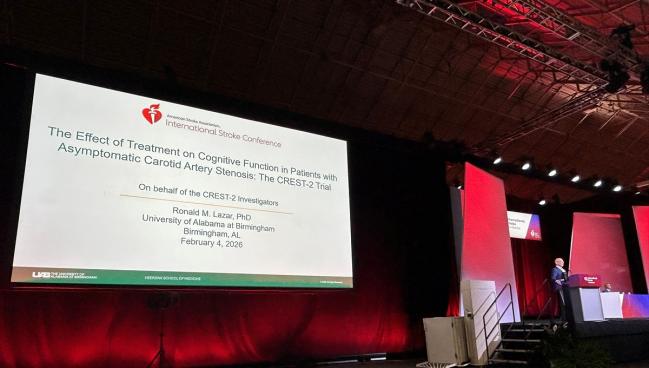
NEW ORLEANS, LA—Revascularization with either stenting or endarterectomy does not improve cognitive function compared with medical management alone in patients who have asymptomatic high-grade carotid artery stenosis, a CREST-2 analysis shows.
There were no significant differences between the revascularization and control arms in the trajectories of scores on five cognitive tests evaluating learning, attention, memory, and executive function or of a composite of those scores, Ronald Lazar, PhD (University of Alabama at Birmingham), reported here at the International Stroke Conference.
“Given the results of reperfusion in the setting of acute stroke in improving neurologic function, many people began to think that if we revascularize these patients, not only would you prevent stroke, but perhaps you can improve cognition as well,” Lazar said.
The new results, however, “suggest that those with greater than 70% stenosis and diminished cognition may already have irreversible neurologic injury,” he concluded.
Prior studies have shown that patients with asymptomatic carotid stenosis have reduced cognitive function before undergoing revascularization. Lazar and his colleagues, for instance, demonstrated that patients entering the CREST-2 trial had cognitive deficits, particularly in memory, at baseline.
Studies exploring the possibility that carotid revascularization might improve cognitive function have yielded mixed results, though they’ve been subject to various limitations related to the types of screening instruments used, control groups, length of follow-up, and sample size.
The cognitive function analysis of the CREST-2 trial, which was conducted at 155 sites and included 2,485 patients, strengthens the evidence in this area. The study—which encompasses two separate trials of stenting and endarterectomy, each compared with intensive medical management alone—showed that stenting, but not surgery, significantly reduced long-term stroke risk.
The impact on cognition was a prespecified secondary outcome, with 2,165 patients providing data for this analysis. The cognitive test battery, administered by telephone at baseline and then annually up to 4 years of follow-up, included five neuropsychological assessments:
- Word list learning (learning)
- Digit Span (attention)
- Word list delayed recall (memory)
- Animal naming (executive function)
- Controlled oral word association (executive function)
The investigators calculated Z-scores, which place each individual result in reference to scores from all patients in the cohort, for each test and for the composite of all five.
Unadjusted trajectories in mean composite Z-score over time, based on 7,060 tests during the trial, showed no differences between the revascularization and control arms for either the stenting or endarterectomy studies.
The researchers then used linear mixed models to adjust for covariates, confirming that the slopes for all five cognitive measures as well as the composite were not significantly influenced by revascularization versus intensive medical management.
The findings were consistent in patients with the poorest cognitive function at baseline.
To assess whether the telephone-based test battery was sensitive enough to detect neurological status, the researchers performed an additional analysis showing that when patients had a stroke during follow-up, there was a significant and measurable dip in cognitive function. That “confirms to us the sensitivity of our cognitive battery,” Lazar said.
We need to look at the overall landscape of things that can impact cognition. Seemant Chaturvedi
Commenting for TCTMD, Seemant Chaturvedi, MD (University of Maryland School of Medicine, Baltimore), a member of the CREST-2 executive committee, congratulated Lazar and his team for completing the cognitive analysis, noting that “this was certainly the biggest study ever of this type in patients with asymptomatic carotid disease.”
He added that “the battery that they used was appropriate in that it was able to evaluate some key cognitive domains and yet it was still practical enough to be done within 30 minutes during a large-scale trial.”
That revascularization did not provide a boost in cognitive function is not unexpected, “because we know that cognition is very complex and there are many factors that can impact cognitive ability,” Chaturvedi said, pointing, for example, to the burden of small-vessel disease, changes related to Alzheimer’s disease, APOE status, and sleep apnea. “When you consider the complexity of those factors, it is maybe not that surprising.”
It’s also possible, he said, that some patients with asymptomatic carotid narrowing don’t have a true flow-limiting stenosis, which could have influenced the results seen here.
These findings won’t necessarily change how he counsels patients with asymptomatic carotid stenosis when they’re considering revascularization, because most are focused on the potential for reducing stroke risk, said Chaturvedi. “I haven’t had too many patients inquire as to whether there’ll be any cognitive benefit.”
That said, “if patients ask about it, I think we can say that as of now, there’s no definite proof that it will improve cognition,” he added.
He also advocated for a more holistic approach to managing cognitive function in patients with carotid stenosis. “We need to look at the overall landscape of things that can impact cognition,” Chaturvedi said. “For these patients, we’re seeing them at one point in time, but over the next 5, 10 years, we want to optimize their brain health.”

Todd Neale is the Associate News Editor for TCTMD and a Senior Medical Journalist. He got his start in journalism at …
Read Full BioSources
Lazar RM. The effect of treatment on cognitive function in patients with asymptomatic carotid artery stenosis: the CREST-2 trial. Presented at: ISC 2026. February 4, 2026. New Orleans, LA.
Disclosures
- Lazar reports having consulted for Eisai and DiaMedica Therapeutics and receiving stocks/stock options from iMind.
- Chaturvedi reports consulting for Novartis and Bayer.
Related News

Comments