CHAMPION-AF: A Win for Watchman FLX, but With Caveats
Physicians wrestled with endpoint composition, low event rates, a possible difference in ischemic strokes, and more.

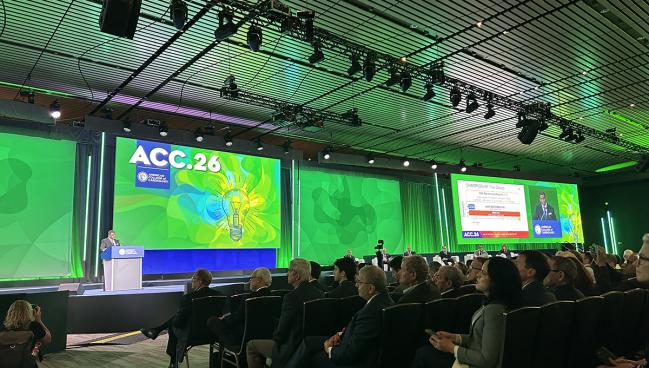
NEW ORLEANS, LA—Among patients with atrial fibrillation (AF) and a high stroke risk who were eligible for long-term anticoagulation, left atrial appendage occlusion (LAAO) was no worse than direct oral anticoagulant (DOAC) therapy when it came to efficacy within the CHAMPION-AF trial, meeting the primary endpoint.
Implantation of the Watchman FLX device (Boston Scientific) also came with a lower risk of non-procedure-related bleeding over 3 years of follow-up, but when the up-front risks of LAAO were taken into consideration, there were comparable rates of overall ISTH major bleeding in the two arms of the trial, Saibal Kar, MD (Cardiovascular Institute of Los Robles Health System, Thousand Oaks, CA), reported here at the American College of Cardiology 2026 Scientific Session.
"In patients with nonvalvular atrial fibrillation suitable for anticoagulation, left atrial appendage closure using the Watchman FLX device, at 3 years was noninferior to NOACs for the composite primary endpoint [of] cardiovascular death, stroke, and systemic embolization, and significantly reduced clinically relevant nonprocedural bleeding," Kar concluded.
He said, therefore, that "the Watchman FLX left atrial appendage closure device may be considered as an alternative to NOACs in a shared decision-making process with atrial fibrillation patients who are deemed suitable for long-term oral anticoagulants."
The results, published simultaneously online in the New England Journal of Medicine, were highly anticipated in the wake of the CLOSURE-AF trial, recently published in the same journal. As reported by TCTMD when that trial was first presented at the American Heart Association 2025 Scientific Sessions in November, CLOSURE-AF showed that LAAO failed to meet the noninferiority bar compared with standard care among patients with AF and high risks of both stroke and bleeding. In fact, the procedure led to a significantly higher rate of a primary composite endpoint that included stroke, systemic embolism, cardiovascular/unexplained death, and major bleeding (BARC ≥ 3).
Though the negative trial had limitations of its own, it clearly influenced how physicians interpreted the new CHAMPION-AF results.
“The CLOSURE-AF study raises the burden of proof to demonstrate at worst equivalence, if not superiority, of the device, and I don’t think that CHAMPION-AF convincingly provided that proof,” Gregory Marcus, MD (University of California, San Francisco), who wrote an accompanying editorial in NEJM, told TCTMD. He pointed out that CLOSURE-AF was not funded by industry, whereas CHAMPION-AF was funded by the maker of the Watchman FLX device.
He, and others, pointed to several limitations of CHAMPION-AF. For one, the observed event rates were much lower than those used to power the trial—a common problem for modern studies of patients with atrial fibrillation, who have seen declines in adverse outcomes over the years as treatments have improved. Still, the discrepancy made it easier for the Watchman FLX device to satisfy prespecified noninferiority criteria with a margin that was already “not small” at 4.8%, Marcus said.
“The bar they had to meet was not necessarily very high,” he said. He pointed out, too, that there were more primary endpoint events in the LAAO arm than in the DOAC group (81 vs 65), including more ischemic strokes (45 vs 27).
Another issue to consider is that the primary safety endpoint selectively focused on non-procedure-related bleeding, ignoring periprocedural bleeding associated with LAAO, Marcus said. It’s unclear, he added, why LAAO would have an advantage even for non-procedure-related bleeding considering participants in the device arm were recommended to continue on single antiplatelet therapy after 4 months. Prior trials have indicated that apixaban, the most widely used DOAC, seems to have a similar bleeding profile compared with aspirin, for example.
Marcus said that there are also questions around the procedure that require further research, such as the potential impact on hemodynamic and endocrine function of blocking off the LAA in younger, healthier, and more functional patients with AF; whether LAAO is as effective as DOACs for reducing dementia risk related to the arrhythmia; and the downstream effects of leaks around the device, including problems related to clotting.
For now, “I’m not convinced that these devices should be considered an equal substitute for NOACs,” he said.
Patients can now meet with their cardiologist and discuss the trade-offs of each strategy. Benjamin Hibbert
Speaking with TCTMD, Benjamin Hibbert, MD, PhD (Mayo Clinic, Rochester, MN), was more positive about the findings, saying that CHAMPION-AF is a win for patients.
“This solidifies LAAO as an alternative to DOACs. Patients can now meet with their cardiologist and discuss the trade-offs of each strategy,” he said.
If patients are inclined to undergo a procedure, “they may be willing to accept a potential very small increased risk of stroke/systemic embolism to get off medications,” he said. “Conversely, patients taking a DOAC can be reassured that their risk of major bleeds/intracerebral hemorrhage are comparable to having a device, although they are much more likely to have bleeding events that need medical attention. Both strategies are acceptable, and those discussions will really center around patient preference.”
The CHAMPION-AF Trial
LAAO has been adopted widely as a stroke-prevention alternative to long-term anticoagulation in patients who are not good candidates for the medications, which are limited by issues related to bleeding, compliance, and cost. The latest US guidelines for AF contain a class 2a recommendation stating that percutaneous LAAO is reasonable in patients who have at least a moderate risk of stroke and a contraindication to chronic anticoagulation stemming from an irreversible cause.
CHAMPION-AF, conducted at 141 sites in 16 countries, explored the impact of the Watchman FLX device in patients who were good candidates for DOAC therapy. Investigators enrolled 3,000 patients (mean age 71.7 years, 31.9% women) who had an increased risk for stroke and randomized them to LAAO with the Watchman FLX device or treatment with an approved DOAC. Mean CHA2DS2-VASc score was 3.5, and mean HAS-BLED score was 1.3. More than two-thirds of patients (68.9%) had paroxysmal AF, and nearly half (47.8%) had undergone a prior ablation for their arrhythmia.
In the LAAO arm, patients underwent the procedure within 14 days of randomization, with 92.5% in this group actually having the device implanted. The postimplant antithrombotic regimen included DOAC plus aspirin, DOAC alone, or dual antiplatelet therapy (DAPT) for 3 months, followed by P2Y12 inhibitor or aspirin monotherapy thereafter. Most patients (85.0%) were prescribed DOAC monotherapy at discharge, and 12.6% received DAPT.
Imaging of the LAA at 4 months, with transesophageal echocardiography or CT, revealed effective closure (residual leak ≤ 3 mm) in 98.6%.
In the anticoagulation group, 87% reported being adherent to treatment at most of their follow-up visits. The rate of crossover to LAAO during the study was 13.7%, with most of those patients receiving the implant before a primary endpoint event.
The primary efficacy endpoint was a composite of CV death, stroke, or systemic embolism, which occurred at a rate of 5.7% in the LAAO arm and 4.8% in the DOAC arm through 3 years (between-group difference 0.9%; 95% CI -0.8%-2.6%). Because the upper end of the confidence interval was below 4.8%, LAAO met criteria for noninferiority versus DOAC therapy (P < 0.001).
The rate of CV death was 2.7% in each group. Ischemic stroke or systemic embolism was numerically more common in the LAAO arm (3.2% vs 2.2%).
The primary safety endpoint was non-procedure-related bleeding (incorporating ISTH major and clinically relevant nonmajor bleeding). The rate was significantly lower in the LAAO arm (10.9% vs 19.0%; P < 0.001 for superiority). When combining both procedure-related and non-procedure-related ISTH major bleeding, rates were similar in the LAAO and DOAC arms (5.9% vs 6.4%; P < 0.001 for noninferiority).
Kar noted that clinically relevant nonmajor bleeds required an intervention and that the difference between groups was observed despite the fact that the trial cohort as a whole had a low risk of bleeding as indicated by the HAS-BLED score. In addition, Kar said, the analysis took into account only first events, which likely underestimated the bleeding difference between groups.
Hemorrhagic stroke occurred in 0.4% in each group, with similar rates of all-cause mortality (5.0% with LAAO and 4.9% with DOACs).
Pericardial effusions occurred in 0.7% of patients in the LAAO group, with device-related thrombus (DRT) detected in 4.8% of those who were imaged; 1.8% had a clinically relevant thrombus that led to resumption of oral anticoagulation and two had a DRT-related stroke. The rate of procedure-related serious adverse events was 2.3%.
A secondary net clinical benefit endpoint incorporating CV death, stroke, systemic embolism, or non-procedure-related bleeding occurred in 15.1% of patients treated with LAAO and 21.8% of those treated with anticoagulation (P < 0.001 for both noninferiority and superiority).
Assessments of quality of life and cognition were similar in the two groups.
“These data suggest that the use of left atrial appendage closure as a possible alternative to oral anticoagulation should be part of a shared decision-making process with patients who have atrial fibrillation,” the researchers write in their paper.
Some Still Not Convinced
Gregory Katz, MD (NYU Langone Health, New York, NY), told TCTMD that the results of CHAMPION-AF came out about as he would have expected based on what was known before about LAAO, “which is that it’s fine. It’s not a godsend, it’s not a panacea, but it’s a tool that for the correctly selected patient probably has a role, but that role is certainly not in all-comers with the goal of trying to take everybody off of oral anticoagulation.”
When a trial of a device like this comes out with the top-line results showing noninferiority to medical therapy, there is always the possibility that it will lead to a lot more patients getting the device, he said, adding that “I’m hopeful that’s not what happens in the real world” after CHAMPION-AF.
The increased number of strokes in the Watchman FLX arm, though the finding is only borderline significant and comes on a secondary outcome, is “ a pretty concerning endpoint to me,” Katz said.
He, too, didn’t feel that the trial, with its limitations, could truly show that LAAO was noninferior to DOAC therapy in this population of patients who could receive either therapy, saying that even the data from trials of the Watchman device that came before CHAMPION-AF “kind of stinks.”
Even so, there has been an indication creep with LAAO, Katz said, noting that there is now a CPT code for combined LAAO plus AF ablation. The fact that about 30,000 LAAOs are performed in the US each year isn’t supported by the totality of the evidence around the procedure, and part of that appears to be driven by advertising seen by patients, he indicated.
“I’ve had patients come into my office after a diagnosis of A-fib because they saw something about the Watchman on TV or online, and they’re basically like, ‘When can I get this procedure done and stop my Eliquis?’” Katz said. “I don’t think that patients are really well served by hearing that message that this is something that you should do as a way of getting off of a blood thinner. I think that this is more something that should be reserved for somebody who doesn’t do well with a blood thinner.”
I don’t think that patients are really well served by hearing that message that this is something that you should do as a way of getting off of a blood thinner. Gregory Katz
Sanjay Kaul, MD (Cedars-Sinai, Los Angeles, CA), detailed some methodological and statistical qualms with the trial. He told TCTMD that “the results of CHAMPION-AF would have to be unequivocally positive to overcome the skeptical prior” evidence from CLOSURE-AF, as well as from PREVAIL and PROTECT-AF, which failed to establish noninferior efficacy, before it.
“It failed to meet that evidentiary bar,” he said.
The bottom line, Kaul said, is that “it’s a win on the scoreboard but a loss as far as delivering meaningful, reliable therapeutic value. Good trial design balances feasibility with rigor; when it’s designed to deliver a win, it signals more about clever protocol writing and trial design than breakthrough efficacy.”
He said he’d still want LAAO available for patients who can’t tolerate oral anticoagulation, but “if the device has only downside with no upside, why would I offer it to patients who are eligible for oral anticoagulant therapy?”
Sunil Rao, MD (NYU Langone Health), said he hoped CHAMPION-AF would simplify his decision-making around LAAO but added, “I’m not sure that it’s actually done that.”
He cited the same statistical issues pointed out by others to question whether the trial can prove noninferiority of LAAO. “To me, it complicates our decision-making a little bit. I think left atrial appendage closure is a great alternative,” he said. “The challenge now for clinicians, including myself, is to start thinking about which patients are the ones that are the right candidates for it.”
That can be a difficult because physicians have tended to overestimate risks of bleeding with oral anticoagulation, Rao said.
A Need for Careful Shared Decision-making
Even physicians who were critical of some aspects of CHAMPION-AF, and of the LAAO literature in general, said there is a role for the procedure in clinical practice.
The devices make sense, Marcus said, in patients who have true contraindications to long-term DOAC therapy and who have had a thrombus detected in the LAA. In that latter group, “I actually have placed them and then continued a NOAC because I think there are potentially still benefits to the NOAC even in the setting of a left atrial appendage occlusion device.”
For patients who are eligible for long-term DOAC therapy, but who don’t want to take them for whatever reason, LAAO “may not be unreasonable” to offer as an option “if a healthcare professional could have a very thorough discussion with the patient regarding what’s known and not known and what the evidence is regarding risks and benefits,” Marcus said. That would ideally be performed, he added, by an independent arbiter and “not the operators who may have a monetary incentive to put in the devices.”
It’s a win on the scoreboard but a loss as far as delivering meaningful, reliable therapeutic value. Sanjay Kaul
Katz said he uses LAAO in his practice for patients who can’t tolerate anticoagulation for a true medical reason, such as chronic GI bleeding, transfusion-dependent myelodysplastic syndrome, or intolerance of the medications.
“But it’s certainly not something that I’m offering to just my all comers who have A-fib” in light of the nontrivial up-front risks and unclear long-term benefits of the procedure, he said.
Hibbert said he’s always counseled patients that LAAO is “probably not going to be as good as systemic anticoagulation just because there are other mechanisms of stroke other than the left atrial appendage.” He added, however, that the potential small increase in ischemic stroke observed in the device arm of CHAMPION-AF is “clinically insignificant.”
“I don’t think that’s going to move the needle for a lot of patients,” Hibbert said.
More to Come
The investigators point out that these results may not be applicable to the highest-risk patients, since most CHAMPION-AF participants had a CHA2DS2-VASc score of 3 or 4. More information on the impact of LAAO in the high-risk population will come from the ongoing LAAOS-4 trial.
The CATALYST trial is also forthcoming. Investigators aim to enroll 2,650 patients with AF who are recommended for long-term DOAC therapy, randomizing them to LAAO with the Amplatzer Amulet device (Abbott) or a commercially available DOAC.
In addition, patients in CHAMPION-AF will be followed out to 5 years, with the primary endpoint at that time being stroke or systemic embolism. This will give more insights into whether the difference in ischemic stroke or systemic embolism observed at 3 years remains over the longer term.
In the meantime, “a dispassionate and objective evaluation of the totality of evidence would question the overexuberant use of this device in clinical practice (over 600,000 devices have been implanted since approval),” Kaul said.
“There is pending evidence from CATALYST,” he said, “but the current sobering results should ideally put a break in the overuse.”

Todd Neale is the Associate News Editor for TCTMD and a Senior Medical Journalist. He got his start in journalism at …
Read Full BioSources
Doshi SK, Kar S, Nair DG, et al. Left atrial appendage closure or anticoagulation for atrial fibrillation. N Engl J Med. 2026;Epub ahead of print.
Marcus GM. Left atrial appendage closure – should recommendations be expanded? N Engl J Med. 2026;Epub ahead of print.
Disclosures
- CHAMPION-AF was funded by Boston Scientific.
- Kar reports serving as national co-principal investigator (PI) of the REPAIR-MR trial and as a member of the steering committee for the TRILUMINATE trial for Abbott Vascular; serving as national co-PI of the CHAMPION-AF and SIMPLAAFY trials for Boston Scientific and of the Laminar pivotal trial for Johnson & Johnson; consulting for Abbott Vascular, Boston Scientific, Intershunt, Johnson & Johnson, Medtronic, Peija, V-Wave, and W. L. Gore & Associates; having stock options in PiCardia; and serving on the executive committee of the V-Wave trial.
- Marcus reports receiving grants/contracts from the Patient-Centered Outcomes Research Institute, the California Tobacco-Related Disease Research Program, Omron, and the National Heart, Lung, and Blood Institute, the National Institute on Drug Abuse, and the National Institute on Alcohol Abuse and Alcoholism of the US National Institutes of Health, as well as consulting for and having stock/stock options in InCarda Therapeutics.
Related News
Comments